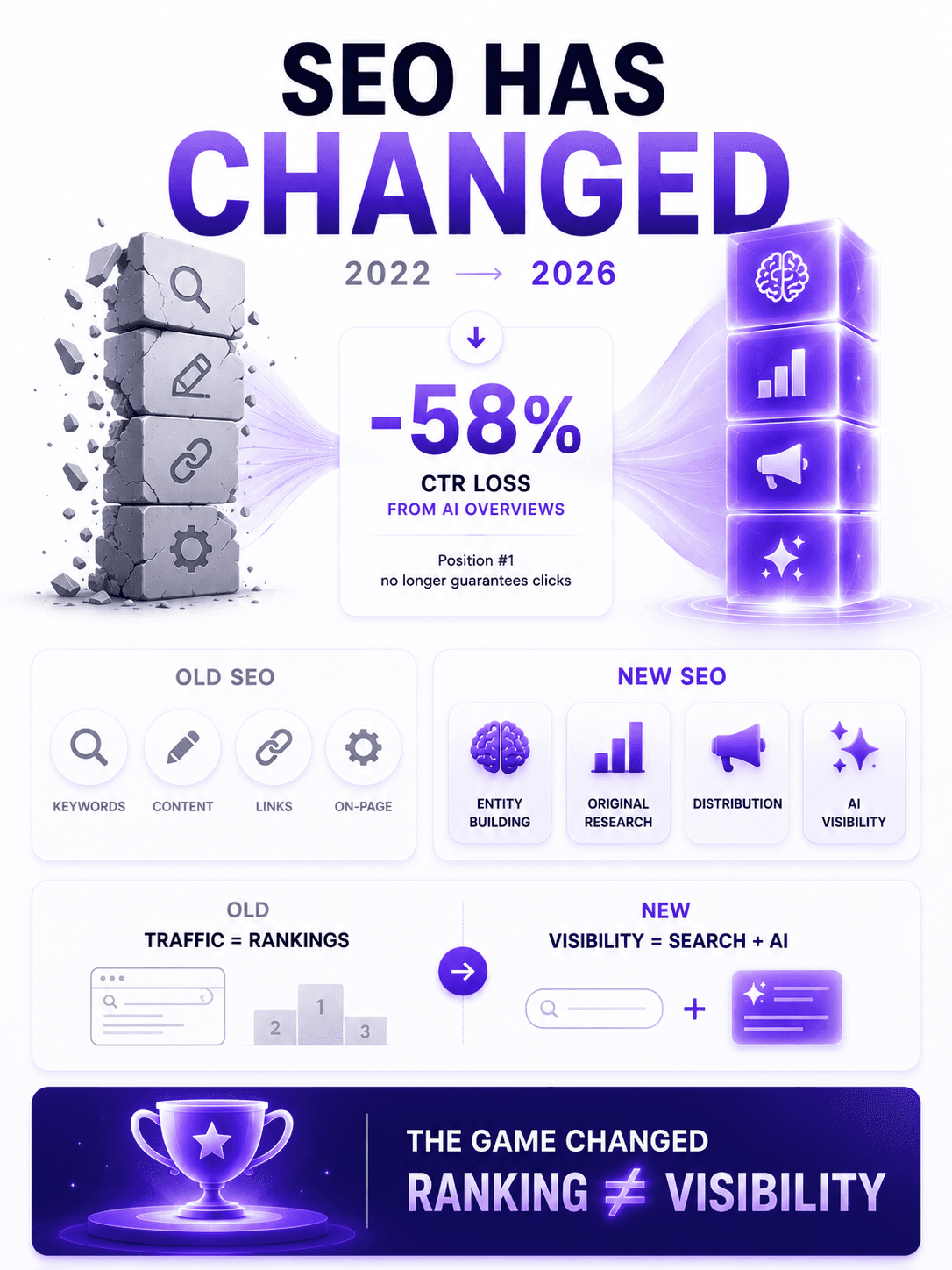
This blog reveals why traditional SEO work no long...
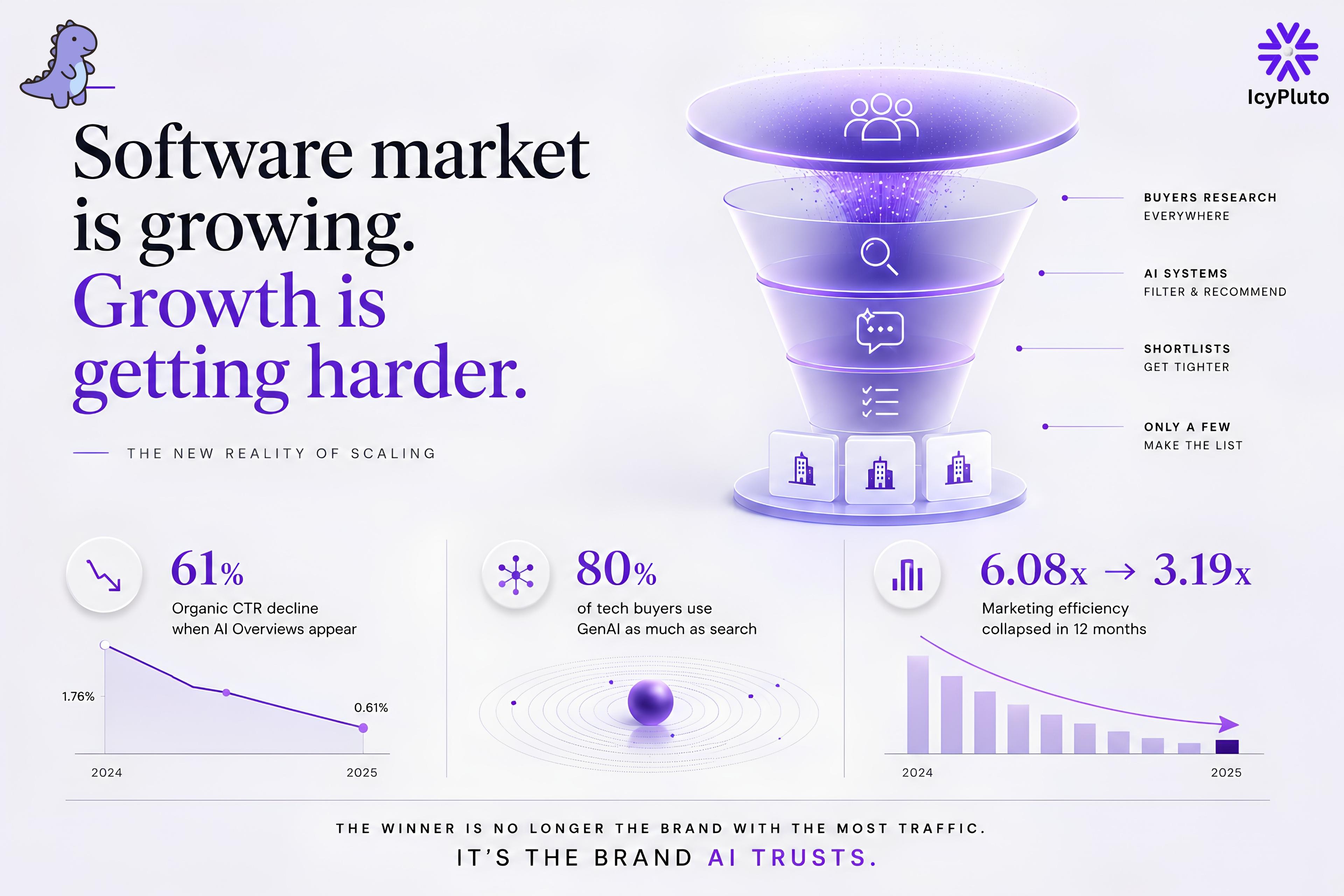
This blog explains how the old growth playbook is ...
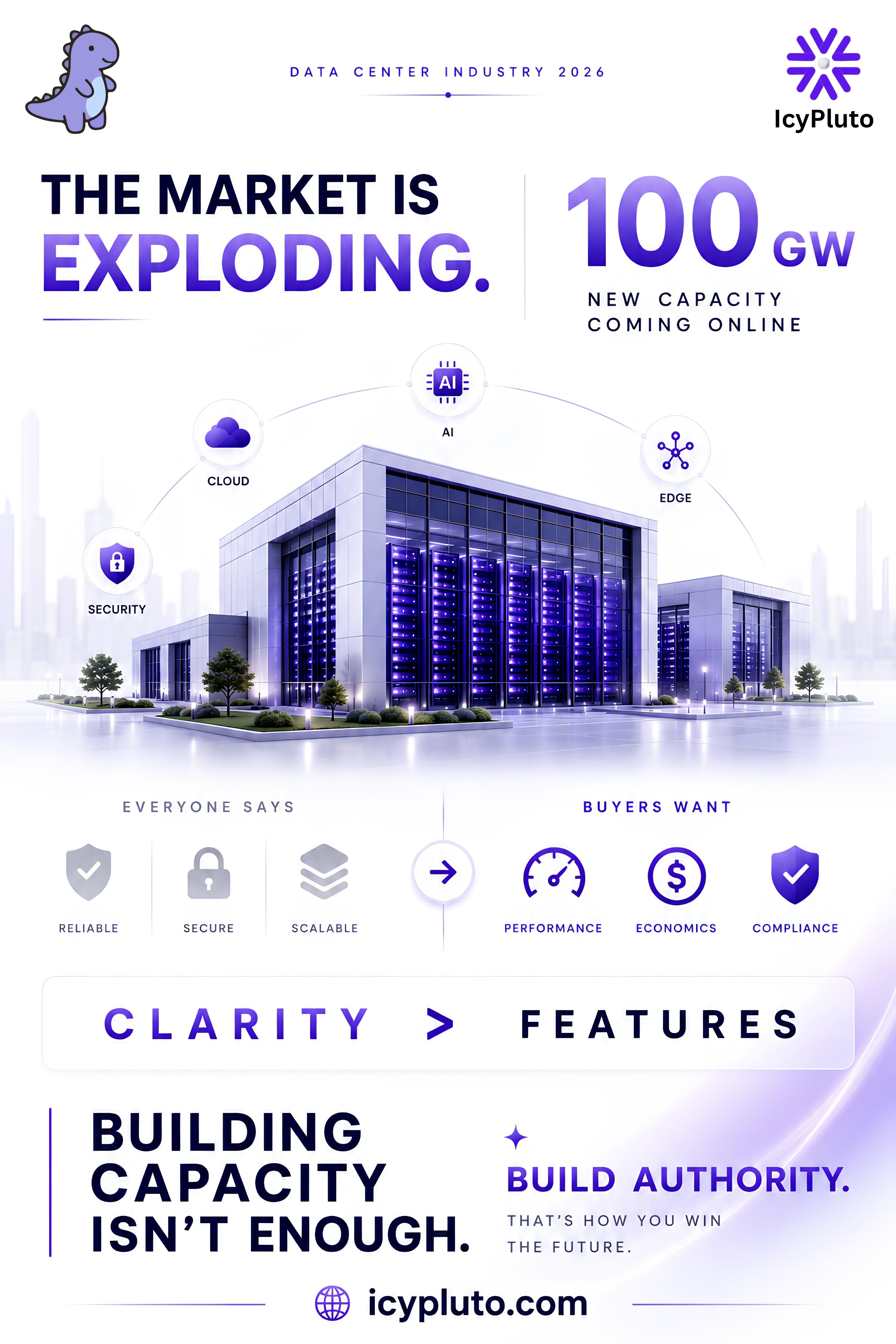
This blog explores the marketing gaps holding back...
There's a new traffic pattern quietly devastating digital marketing teams across industries. It doesn't announce itself with a manual penalty notification or a dramatic algorithm warning. It arrives looking like success — a beautiful, rising traffic curve that makes your content team feel untouchable. Until it doesn't.
Practitioners and SEO analysts are now giving this pattern a name: "Mount AI."
At IcyPluto, where our AI CMO is built to think beyond today's rankings and into tomorrow's visibility, we've been closely tracking this emerging crisis. And what we're seeing should be a wake-up call for every brand relying on scaled AI-generated content as their primary SEO growth lever.
This article breaks down exactly what the Mount AI pattern is, why it happens, and — most importantly — what smart marketers need to do before they find themselves staring at a traffic cliff.
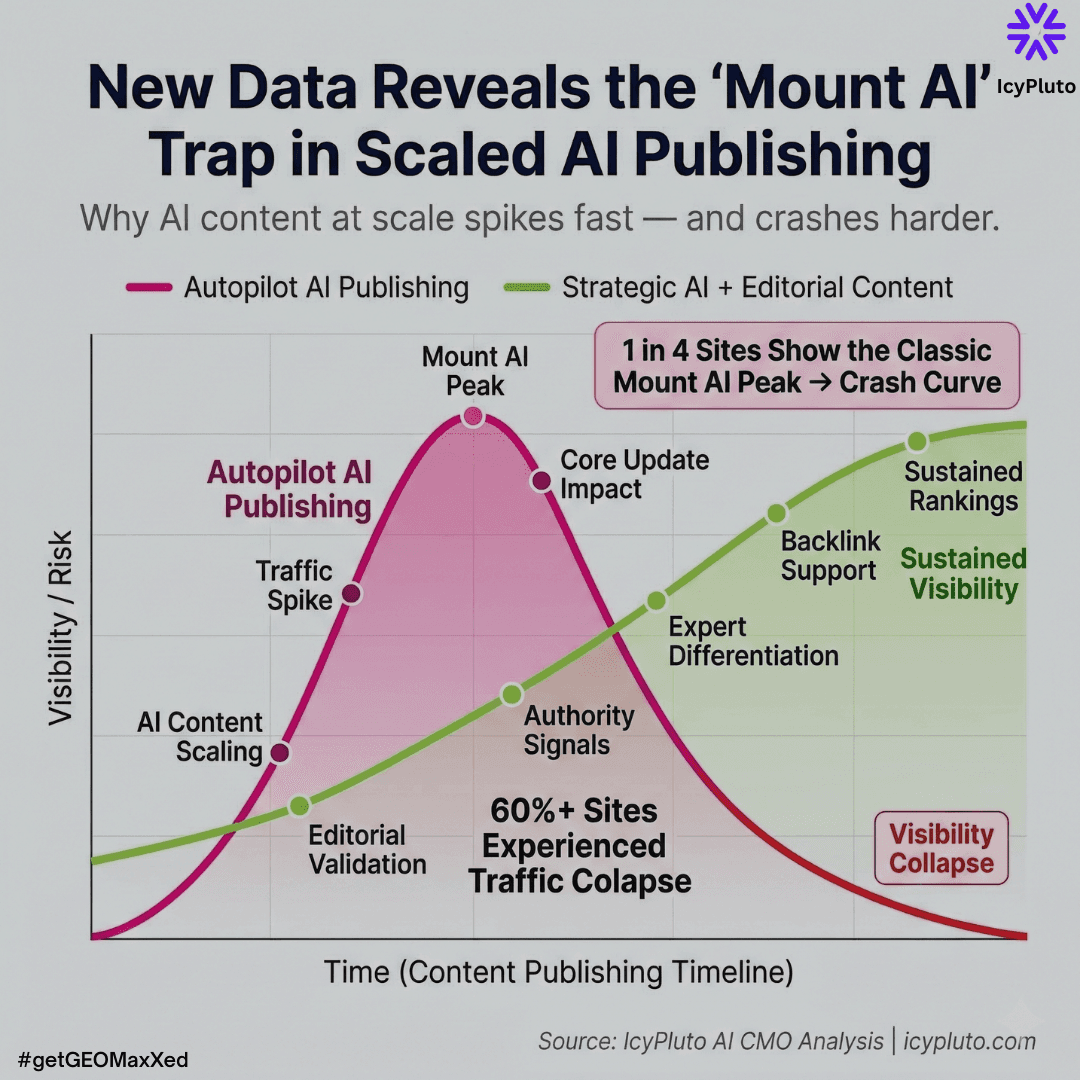
The Mount AI pattern describes a very specific journey that sites publishing high volumes of AI-generated content are experiencing. Picture a mountain from the side: a gradual slope upward, a sharp peak, and then a steep drop down the other side.
Here's how it plays out in real terms:
A brand (or a content team chasing short-term wins) starts publishing AI-generated articles at scale — sometimes dozens per week, sometimes hundreds per month.
Initial results look promising. Organic traffic climbs. Keyword rankings improve. The dashboard turns green.
Then, a Google core update rolls in. Or the algorithm's quality-signal evaluators catch up to the content. Visibility begins to crack.
Within weeks or months, traffic collapses — often dramatically. In some documented cases, sites that published thousands of AI-generated pages have seen organic traffic drop to near zero.
Recent practitioner-led research across SEO communities and content performance datasets suggests that over 60% of sites that adopted aggressive AI-content scaling strategies eventually experienced a significant traffic collapse. Even more revealing — approximately 1 in 4 sites that rode this wave hit a classic "peak and crash" curve, meaning the traffic looked genuinely impressive right up until the moment it didn't.
This isn't a minor ranking dip. This is structural damage.
The reason the Mount AI pattern is so dangerous is precisely because it mimics success for a while. When you publish AI content at scale, you're essentially casting a wide net across hundreds of long-tail keywords simultaneously. Google's crawlers discover the new pages, index them, and many of them begin to rank for lower-competition queries.
Traffic spikes. Social proof builds. Leadership celebrates. More AI content gets commissioned.
But what's actually happening beneath the surface is that Google's systems are beginning to evaluate the quality signals attached to that content. Are users engaging with it? Is there depth, uniqueness, and real-world expertise present? Are other authoritative sites linking to it? Is the information original or simply a repackaged version of what already exists in the index?
When those signals come back weak — as they almost always do for bulk AI content published without editorial oversight — the algorithm begins to recalibrate. Authority signals that were never properly built start exposing the content's hollow foundation.
Here's where the Mount AI crisis gets significantly worse — and where the conversation usually stops being about rankings and starts being about brand survival.
Most marketers think about SEO penalties in one dimension: Google rankings. If you lose rankings, you lose organic traffic. That's painful enough. But in 2026, there's a second front that very few teams are protecting.
When your site loses organic search visibility, it doesn't just disappear from Google's blue links. It also starts disappearing from AI-generated answers.
Think about how people search today. They ask ChatGPT. They prompt Perplexity. They use AI Overviews in Google Search. These AI systems pull answers from sources they've evaluated as authoritative, reliable, and substantive. A site that has been hammered by algorithm quality updates — one whose content is thin, repetitive, and unoriginal — is exactly the kind of source these AI systems learn to avoid.
The result? A double penalty:
You lose traditional organic search visibility (fewer clicks from blue links)
You lose AI answer inclusion (fewer mentions in ChatGPT, Perplexity, Google AI Overviews)
Research tracking AI-referred traffic shows that sessions from platforms like ChatGPT, Perplexity, and Microsoft Copilot have grown by hundreds of percentage points year-over-year. While AI-referred traffic is still a smaller share of overall sessions for most sites today, its growth trajectory is undeniable — and it's only accelerating.
For brands that are already invisible in traditional search because of the Mount AI crash, losing AI visibility as well creates a compound problem. Your brand stops being discoverable. Full stop.
Zero-click searches — where users get their answers directly inside an AI overview without ever clicking through to a source — are rising sharply. Studies have documented click-through rate drops exceeding 30% on queries where AI Overviews appear. For brands already struggling with organic rankings, this trend is catastrophic.
This is the true risk that the Mount AI pattern exposes: it's not just an SEO problem. It's a brand discovery problem.
It's worth being precise here, because there's a lot of misunderstanding in this space. Google does not penalize content simply because it was written with AI assistance. The search engine has been clear and consistent on this point — what matters is quality, helpfulness, and whether the content genuinely serves the user.
What Google does penalize is content that:
Provides no original value beyond what's already indexed
Is thin, generic, or templated in a way that fails to demonstrate real-world expertise
Is clearly produced at scale with the primary intent of manipulating search rankings, not helping readers
Lacks the authority signals (backlinks, engagement, topical depth) that indicate genuine trust
When AI content is published at scale without meaningful human editorial oversight, it almost inevitably checks many of these boxes. Not because AI is inherently bad at writing, but because the process of bulk publishing tends to prioritize volume over substance, speed over accuracy, and keyword density over genuine insight.
Google's core algorithm updates are specifically designed to reassess the quality signals across large volumes of content. When a major core update rolls out, it doesn't just look at individual pages — it reassesses the overall quality signal of a domain.
Sites that have flooded their domain with low-quality AI content often face a domain-wide quality reevaluation. This is why the Mount AI crash can be so severe and so sudden. It's not that one article failed. It's that the algorithm looked at the entire domain and concluded that the site had prioritized gaming the system over genuinely serving readers.
Recovery from a domain-level quality demotion is a long, difficult process — often requiring a comprehensive content audit, manual rewrites of underperforming pages, and months of rebuilding authority signals from scratch.
If the Mount AI pattern is the cautionary tale, the strategic alternative is what practitioners are calling "Strategic AI + Editorial Content" — a hybrid model where AI is used as a tool to accelerate research, structure drafts, and scale output, while human editorial expertise ensures quality, depth, and authenticity.
The distinction matters enormously in outcomes. Sites following the strategic hybrid model don't experience the dramatic spike-and-crash. Instead, they show a steadier, more durable growth in visibility — building authority over time rather than burning it.
Here's what that looks like in practice:
Editorial validation at every stage: Every piece of AI-assisted content goes through a human expert who adds original insights, real-world examples, and subject matter expertise before publication.
Authority signals built deliberately: Rather than publishing hundreds of shallow pages hoping a few rank, teams focus on building genuine topical authority through comprehensive, well-researched content clusters.
Backlink support through genuine value: Content that deserves to be linked to — because it's insightful, original, and useful — naturally attracts backlinks. This is the kind of authority signal that sustains rankings through algorithm updates.
AI visibility monitoring: Teams actively track not just Google rankings but how their brand appears in AI-generated answers across platforms like ChatGPT, Perplexity, and AI Overviews. Visibility in these channels is becoming as important as traditional rankings.
Expert differentiation as a core strategy: The content doesn't just cover a topic — it demonstrates a perspective, a point of view, and a level of expertise that AI alone cannot replicate.
If you're a marketer reading this and feeling even a slight sense of recognition — if your team has been publishing AI-assisted content at volume and your traffic has been growing — the most important thing you can do right now is run a proactive diagnosis.
Don't wait for the crash to tell you there's a problem. Look at your content inventory. Ask the hard questions:
What percentage of your published content adds genuine, original value that isn't already indexed elsewhere?
Which pages are building backlinks and engagement — and which are essentially invisible?
Can you identify a clear human editorial voice and subject-matter expertise in your content, or does it read like a generic AI summary?
How visible is your brand in AI-generated answers, not just Google blue links?
The sites that recover fastest from Mount AI crashes — and the ones that never fall off the cliff in the first place — are the ones that catch the problem early and respond with genuine editorial investment.
At IcyPluto, we've built our AI CMO specifically to address the kind of strategic blindspots that lead brands into the Mount AI trap.
Most marketing tools will tell you where you're ranking. They'll show you traffic numbers and keyword positions. What they won't do is tell you why your authority is eroding, which content is actually building sustainable visibility, and how your brand is performing in the AI-mediated discovery layer that's increasingly sitting above traditional search.
Our AI CMO is built to give marketers exactly those answers.
What IcyPluto's AI CMO does differently:
Real-time visibility intelligence: Not just rankings, but a comprehensive view of your brand's discoverability across both traditional search and AI answer platforms — so you can see the full picture before problems compound.
Content authority mapping: Understand precisely which content is building real authority versus which pages are quietly underperforming and potentially creating domain-level risk.
Strategic content prioritization: Instead of defaulting to volume, our AI CMO helps you identify where editorial investment will drive the most lasting impact — the content opportunities that build genuine authority rather than temporary rankings.
Double penalty detection: By monitoring both organic search visibility and AI answer inclusion simultaneously, IcyPluto surfaces the double penalty risk before it becomes irreversible.
Actionable differentiation signals: Our system identifies where your content has genuine expert differentiation versus where it risks blending into the thin-content noise that Google is aggressively filtering.
The brands that will thrive as the Mount AI pattern continues to shake out are not the ones publishing the most content. They're the ones publishing the right content, backed by strategic intelligence that goes beyond keyword rankings.
The Mount AI pattern is a story that's still being written across thousands of websites right now. For some brands, the peak is still ahead of them — they're on the upward slope, watching traffic climb, feeling confident. For others, the crash has already happened and recovery feels overwhelming.
The core lesson in both cases is the same: search visibility cannot be manufactured at scale through volume alone. Google's algorithm is explicitly designed to surface expertise, authority, and trust — signals that take real time and real editorial investment to build.
AI is a genuinely powerful tool for marketing teams. It can accelerate research, help structure complex content, and dramatically increase the efficiency of skilled writers and strategists. But it cannot replace the human expertise, original perspective, and editorial judgment that search engines — and AI answer platforms — are specifically optimized to reward.
In a landscape where the Mount AI pattern is becoming an industry-wide cautionary tale, the clearest competitive advantage isn't publishing more. It's publishing smarter, backed by the kind of strategic intelligence that tells you not just where you rank today — but whether you'll still be ranking six months from now.
That's exactly what IcyPluto is built for.