AI SEO writing is getting more specific, and that ...
This blog reveals how to maximize visibility in tr...
This blog reveals how to maximize visibility in tr...
Search is no longer just about rankings on Google. It is about being cited inside AI-generated answers. As platforms like ChatGPT and other LLMs reshape discovery, brands are competing not just for clicks, but for mentions inside AI responses.
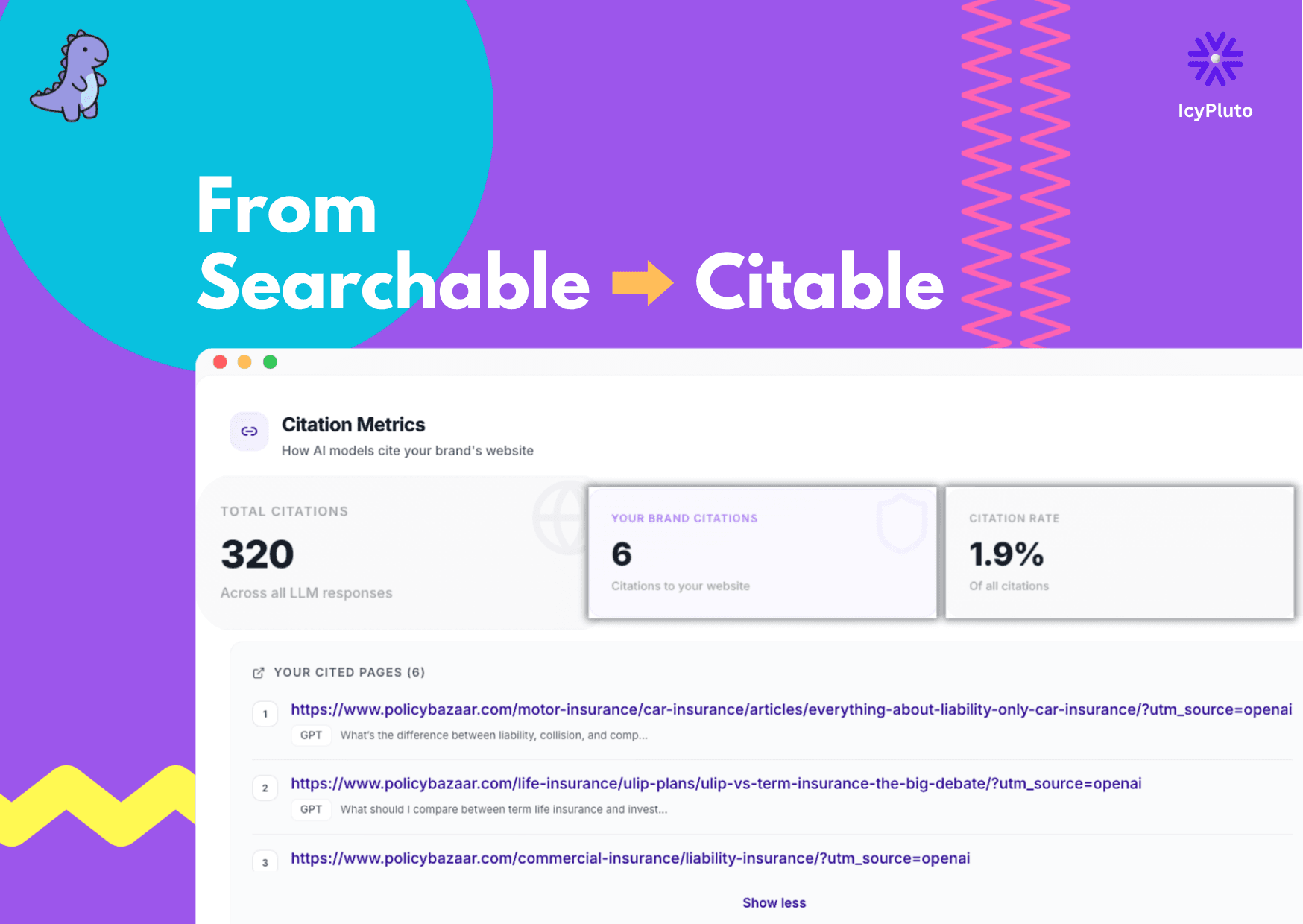
The image highlights a critical shift. Out of 320 total AI-generated citations, only 6 were attributed to the brand, resulting in a 1.9% citation rate. This is the new visibility gap.
Most brands are still optimizing for traditional SEO. But AI search works differently. It prioritizes:
Contextual authority
Topical relevance
Structured, answer-ready content
Without visibility into how often your brand is cited by AI, you are essentially operating blind in one of the fastest-growing discovery channels.
That is where IcyPluto’s Citation Metrics feature becomes a game-changer.
IcyPluto’s Citation Metrics is designed to answer a question most marketers are not even asking yet:
👉 “How often do AI models mention my brand when answering user queries?”
Instead of focusing only on rankings, this feature tracks:
Total citations across LLM responses
Your brand’s citations
Citation rate percentage
Specific URLs that are being referenced
From the image:
Total citations: 320
Your brand citations: 6
Citation rate: 1.9%
This is not just data. It is competitive intelligence.
Because if your competitors are being cited more often, they are effectively owning mindshare inside AI.
Most companies are producing more content than ever. Yet, their presence in AI-generated responses remains minimal.
Why?
Because AI models do not reward volume. They reward clarity, authority, and structure.
A 1.9% citation rate, like shown in the image, reveals a deeper issue:
Content is not optimized for AI retrieval
Pages are not structured for direct answers
Authority signals are weak or inconsistent
Even high-ranking pages can fail in AI search if they are not citation-worthy.
This is the blind spot IcyPluto exposes.
The feature shows exact URLs being cited, such as:
Insurance comparison articles
Liability insurance explainers
ULIP vs term insurance content
This tells you something powerful.
AI prefers educational, comparison-driven, and explanatory content.
Brands can use this insight to double down on:
Deep-dive guides
“Everything you need to know” content
Comparison frameworks
Instead of guessing what works, you now see what AI already trusts.
Traditional SEO measures share of search. Citation Metrics introduces share of AI voice.
With only 6 out of 320 citations, the brand is capturing a very small slice of AI attention.
This metric allows you to:
Benchmark against competitors
Track improvement over time
Set measurable AI visibility goals
For example:
Moving from 1.9% to 5% citation rate can significantly increase brand exposure inside AI answers
Even small gains can compound visibility across thousands of queries
This is the new KPI for modern SEO teams.
Generative Engine Optimization is emerging as the next evolution of SEO.
Citation Metrics helps bridge that gap by showing:
Which keywords trigger citations
What type of content gets picked
Where your content falls short
Instead of optimizing for rankings alone, brands can now optimize for:
Answerability
Context relevance
Information completeness
This fundamentally changes content strategy.
When AI models cite your content, it does more than drive clicks.
It builds:
Brand credibility
Top-of-mind awareness
Perceived authority
Users increasingly trust AI summaries. If your brand appears consistently, it becomes the default authority in that category.
Citation Metrics helps you:
Track that authority
Expand it strategically
Protect it from competitors
Here is something most marketers are missing:
👉 AI citations often predict future search dominance.
Content that AI prefers today often aligns with:
Featured snippets
Zero-click search results
Voice search answers
This means improving citation rate is not just about AI.
It is about owning the future of search itself.
Based on insights from Citation Metrics, brands can take clear actions:
First, restructure content into direct-answer formats. AI prefers clarity over creativity.
Second, build topical depth, not just keyword coverage. Comprehensive pages are cited more often.
Third, focus on high-intent informational queries, especially comparisons and explanations.
Fourth, continuously monitor which pages gain citations and replicate those patterns across your content strategy.
The goal is simple:
👉 Become the most reliable source for answers in your niche.
The shift to AI-driven search is accelerating.
Yet, most dashboards still measure outdated metrics like rankings and impressions.
Citation Metrics introduces a new layer:
AI visibility
AI trust signals
AI-driven brand exposure
This is not optional anymore.
Brands that ignore this will lose visibility silently, even if their traditional SEO looks strong.
The future of search is not about who ranks first. It is about who gets referenced.
Even with hundreds of AI citations happening, only a fraction belong to the brand. That gap is the opportunity.
IcyPluto’s Citation Metrics does not just show you where you stand. It shows you how to win in AI search.