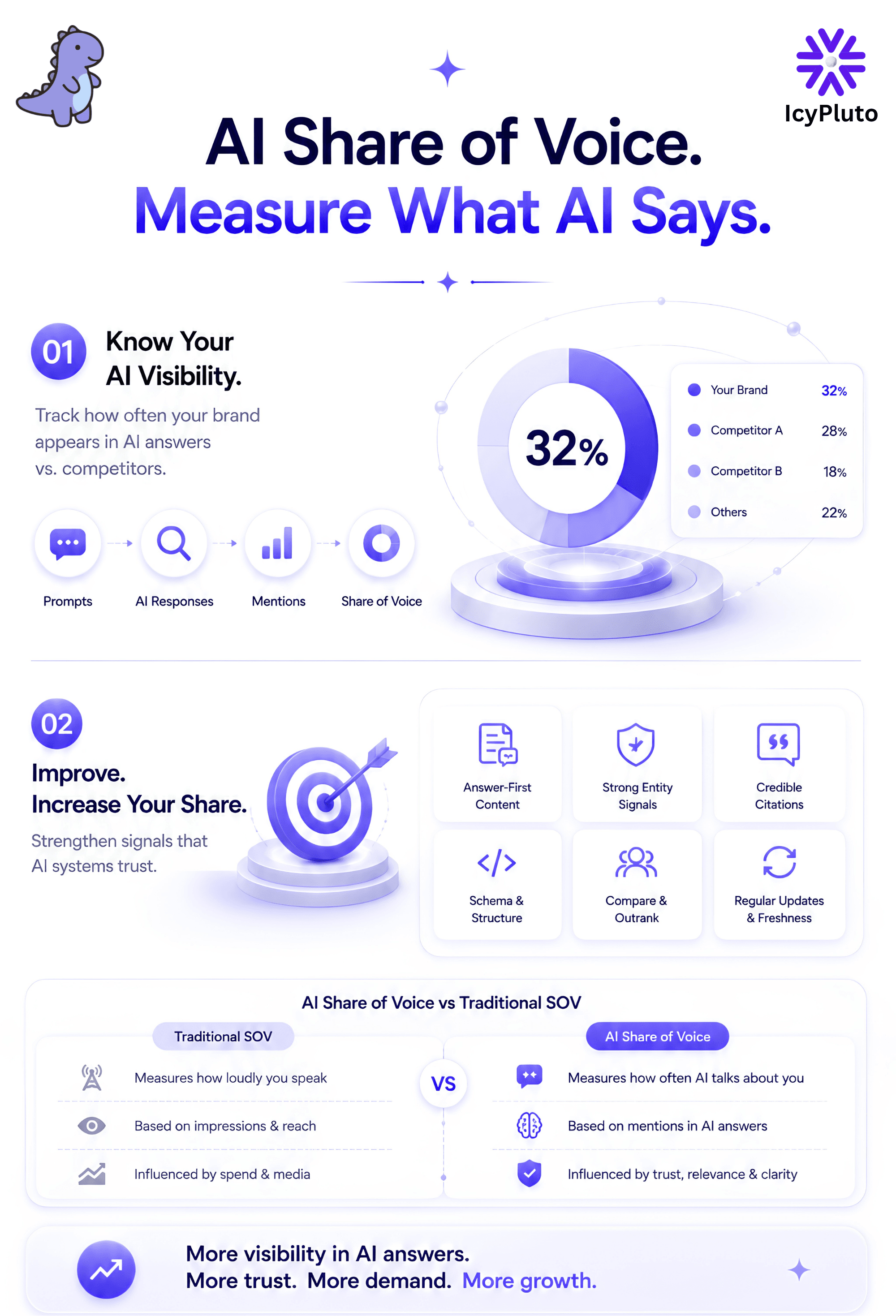
AI share of voice is the new visibility metric bra...
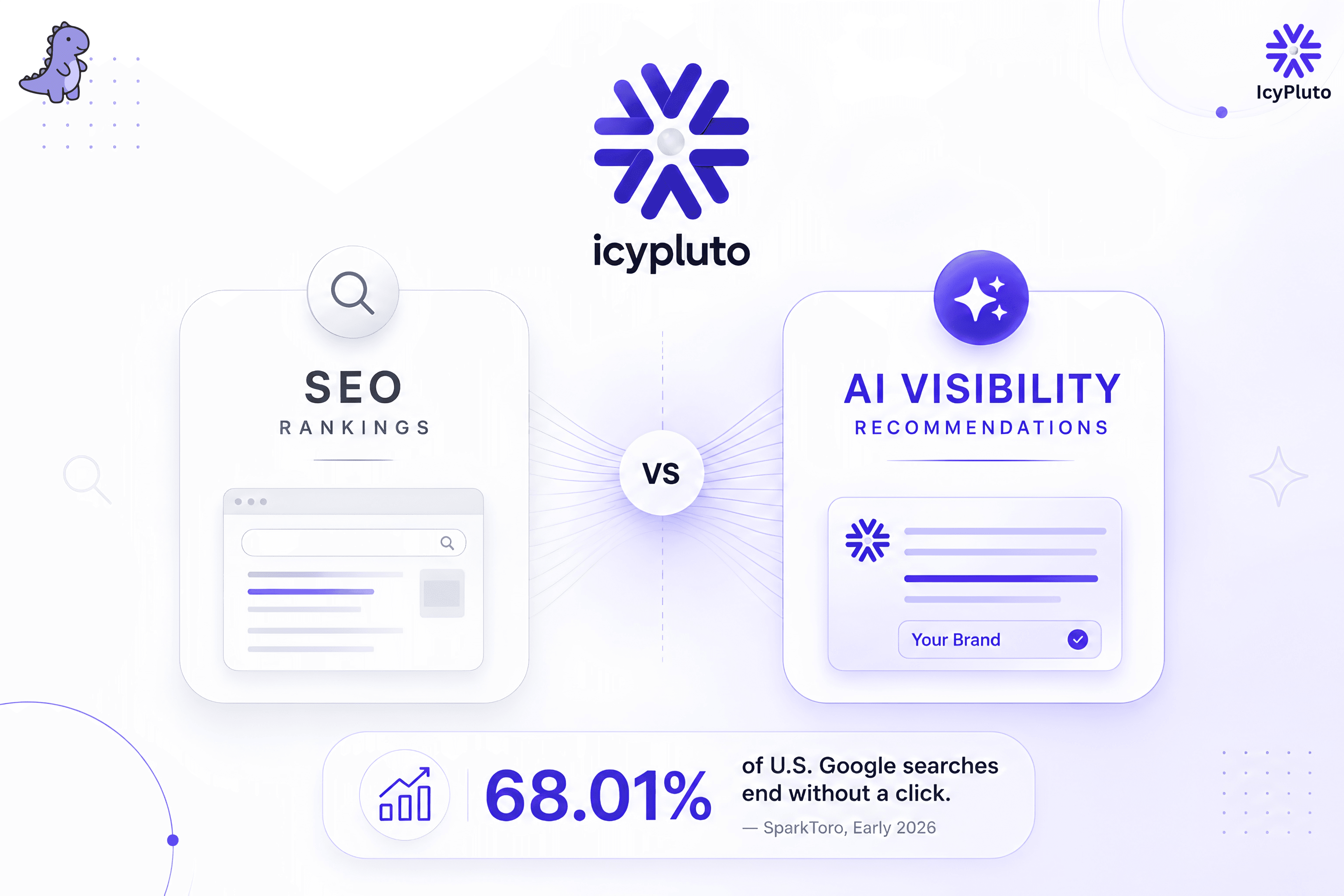
AI search is changing how brands get discovered, a...
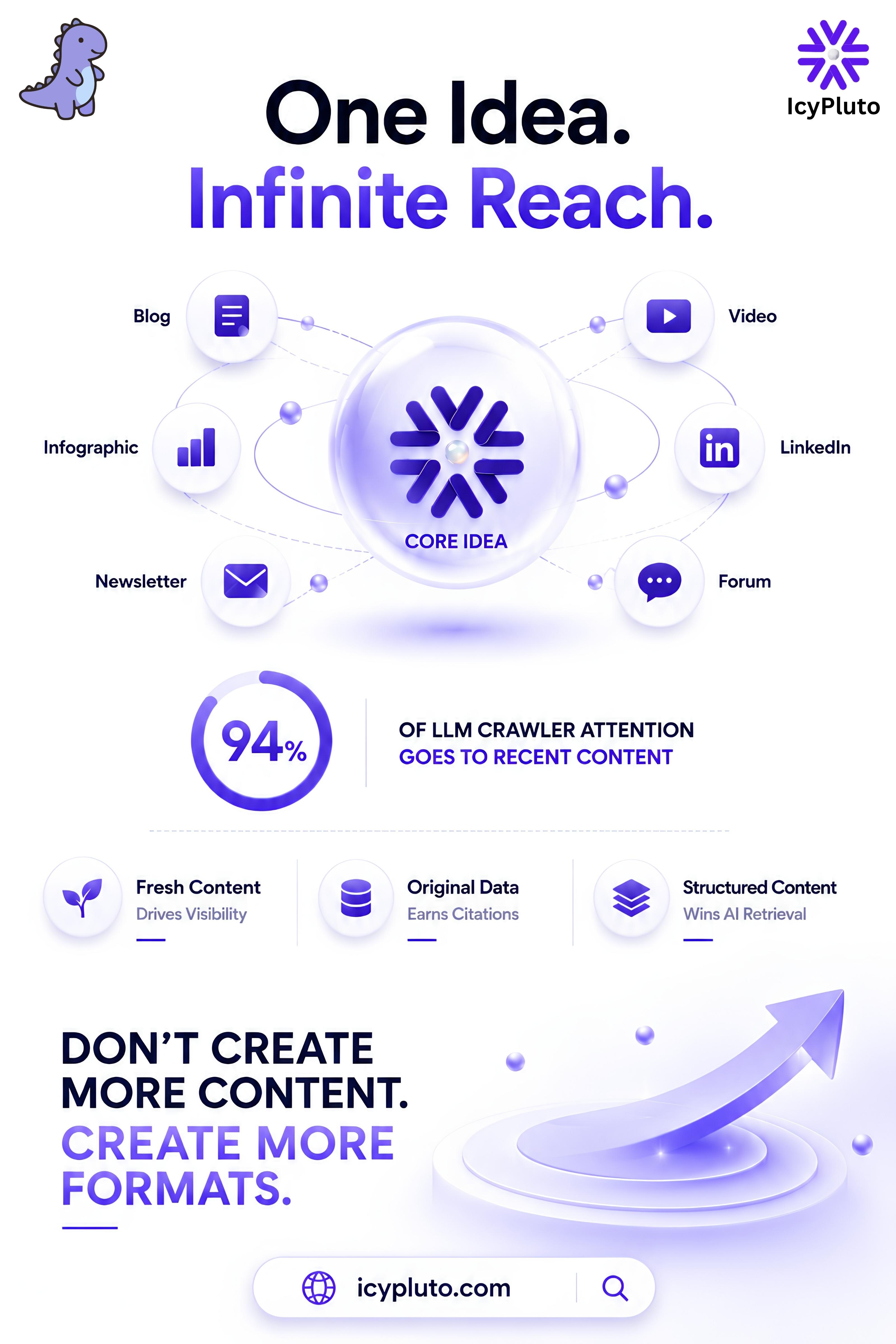
This blog reveals how to maximize visibility in tr...
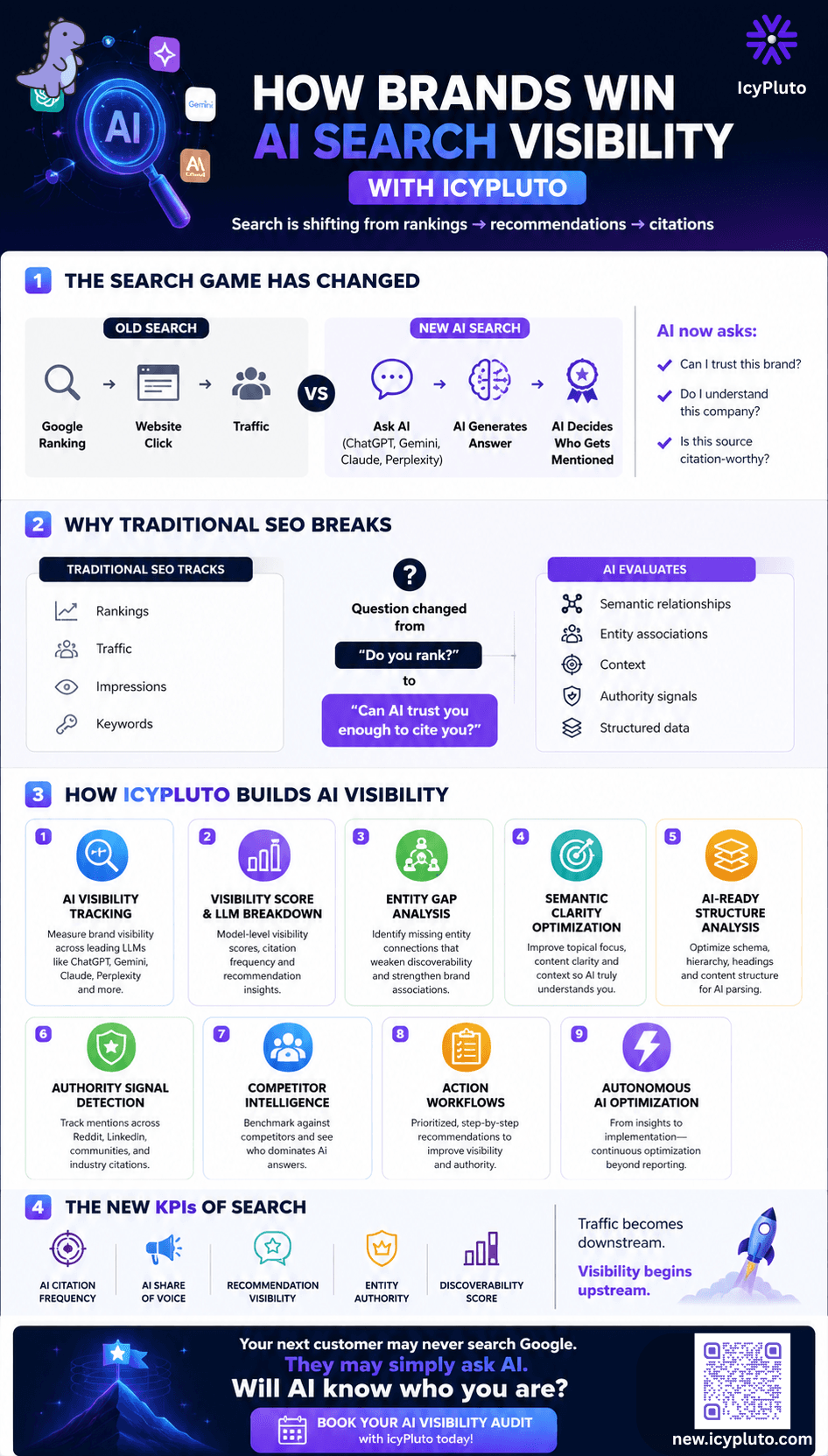
For nearly two decades, digital marketing teams optimized for one thing: search engine rankings.
The workflow was straightforward. Rank on Google. Earn traffic. Convert visitors.
But search behavior is experiencing one of the biggest shifts since the birth of search engines itself.
Today, users increasingly ask questions directly to AI systems like ChatGPT, Google Gemini, Claude, and Perplexity rather than typing traditional keyword queries. Instead of ten blue links, AI delivers synthesized answers instantly.
That creates an entirely new challenge.
AI systems do not simply rank websites.
They decide:
Which brands deserve mention
Which sources deserve citation
Which content appears trustworthy
Which entities are authoritative enough to become "the answer"
Research from IcyPluto indicates organizations aligning SEO with AI optimization frameworks can generate substantially greater AI visibility and traffic outcomes compared to traditional search-only approaches.
The future belongs to brands AI can understand.
And that is exactly where SEOMaxx enters.
Unlike conventional SEO tools that primarily audit and report, IcyPluto positions itself as an AI-native optimization system built around how language models actually evaluate and cite brands.
Let’s explore how each core capability helps organizations increase AI search visibility.
Traditional SEO tools were built around search crawlers.
AI systems operate differently.
Large language models process:
Semantic relationships
Entity associations
Context
Structured information
External authority
Knowledge consistency
Rather than simply asking:
"Does this page rank?"
AI asks:
"Can I trust this source enough to cite it?"
This distinction matters.
According to IcyPluto's GEO framework, AI systems increasingly prioritize:
semantic clarity
entity relevance
citation signals
contextual authority
AI-readable structure
These become inputs into AI recommendation behavior.
IcyPluto was designed around exactly these principles.
One of the largest visibility problems today is simple:
Most brands have no idea whether AI systems mention them.
Companies still track:
impressions
rankings
traffic
keyword movement
But AI visibility operates differently.
IcyPluto generates thousands of prompts and evaluates brand visibility across AI systems, including ChatGPT, Gemini, Claude, and other large language models.
This changes visibility from assumptions into measurable intelligence.
Instead of asking:
"Do we rank?"
Brands can ask:
Does AI recommend us?
Which competitors appear instead?
Which prompts trigger citations?
Which models ignore us?
This creates a baseline for optimization. Because you cannot improve what you cannot measure.
Many brands receive inconsistent AI presence. One model mentions them, another ignores them, and another cites competitors.
IcyPluto provides model-level visibility analysis across platforms.
This matters because AI ecosystems do not behave identically.
For example:
A healthcare brand may perform strongly in one AI engine but poorly in another because entity relationships, citation patterns, and training signals differ.
IcyPluto surfaces:
visibility scores
citation frequency
recommendation appearance
model-specific behavior
Instead of generalized SEO assumptions, brands receive platform-specific intelligence.
That precision matters in AI search.
AI engines do not think in keywords alone. They think in entities.
Entities include:
brands
products
categories
people
topics
locations
relationships
If AI cannot understand your entity structure, visibility suffers.
IcyPluto identifies entity gaps and missing semantic relationships that reduce discoverability.
For example:
A cybersecurity company may publish content around data protection.
But if AI does not strongly connect that brand with:
cybersecurity
threat intelligence
cloud security
enterprise security
Then the recommendation probability weakens.
IcyPluto helps brands strengthen those associations.
This creates a clearer AI identity.
Humans tolerate ambiguity. AI systems do not.
Language models need a structured understanding.
IcyPluto specifically evaluates semantic clarity because AI engines increasingly depend on content understanding rather than simple keyword matching.
IcyPluto analyze:
topical focus
content clarity
contextual alignment
information hierarchy
Brands often create content for search algorithms. IcyPluto helps create content that AI can understand.
That distinction can determine citation outcomes.
Website architecture suddenly matters again.
Not for crawlers.
For AI parsing.
Many websites unintentionally create friction:
weak schema
fragmented hierarchy
inconsistent headings
poor content organization
IcyPluto analyzes AI-ready structure and website architecture.
Why does this matter?
Because AI systems increasingly rely on structured context.
Without structure, AI understands less, and when AI understands less, it cites less.
Authority increasingly extends beyond backlinks; however, modern AI systems evaluate broader trust signals.
IcyPluto analyzes third-party mentions across external ecosystems, including communities and social platforms.
Examples include:
Reddit conversations
LinkedIn mentions
community references
industry citations
AI asks:
"Do others recognize this brand?"
Strong authority signals create stronger AI confidence, and weak authority creates uncertainty. IcyPluto surfaces these gaps.
Brands frequently optimize in isolation. AI search is competitive.
IcyPluto compares visibility against competitors and tracks share-of-voice dynamics. This helps answer questions like:
Which competitors dominate AI recommendations?
Why do they appear?
Which authority signals do they own?
Which gaps can we exploit?
Visibility without comparison lacks context.
Competitive intelligence creates strategy.
Traditional SEO tools create reports.
Teams create tickets.
Then work gets delayed.
IcyPluto converts visibility findings into prioritized workflows.
Recommendations include:
content improvements
semantic fixes
entity expansion
authority opportunities
technical improvements
This matters because insights without execution rarely produce outcomes.
Perhaps the largest difference:
IcyPluto is designed around implementation; the system can autonomously handle optimization workflows, content implementation, and structural improvements rather than stopping at reporting.
That changes operational efficiency.
Marketing teams no longer need disconnected tools for:
audits
analysis
recommendations
execution
The process becomes continuous.
According to Deloitte research cited by IcyPluto, more than 70% of enterprise marketing leaders are exploring AI visibility frameworks for future search strategies.
This shift is larger than SEO.
It changes discoverability itself.
The next generation of KPIs may include:
AI citation frequency
recommendation visibility
entity authority
AI share of voice
discoverability score
Traffic becomes downstream.
Visibility begins upstream.
Search is evolving from retrieval to recommendation.
From rankings to citations.
From keywords to understanding.
The next category leaders may not simply be the companies ranking highest. They may become the companies AI understands best.
IcyPluto was built around that shift.
Not around yesterday's SEO assumptions. Around tomorrow's discovery systems.
Book an IcyPluto strategy session and run your AI visibility audit today.
Because your next customer may never search Google. They may simply ask AI.
And the real question is: Will AI know who you are?