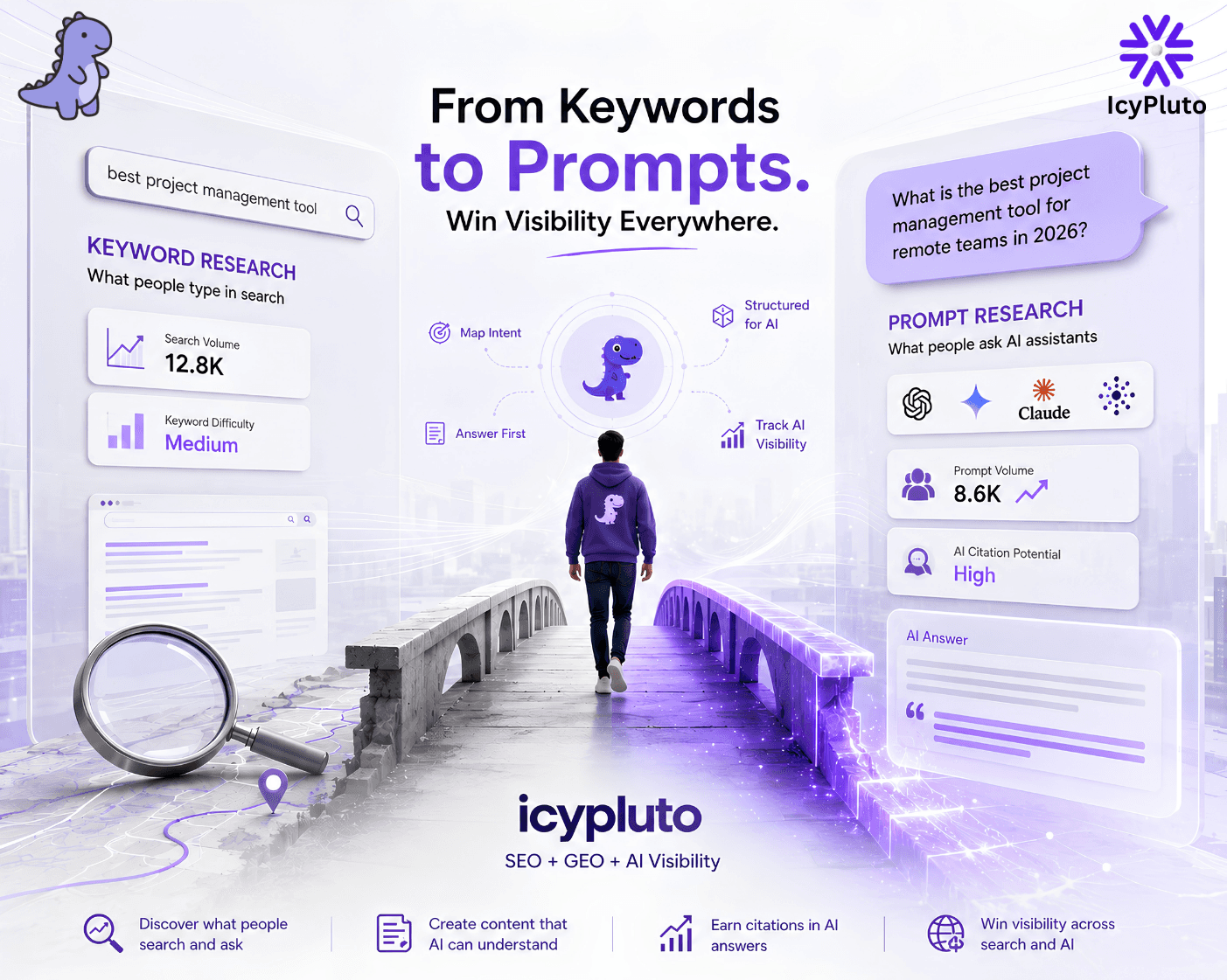
This blog explains how keyword research must now b...
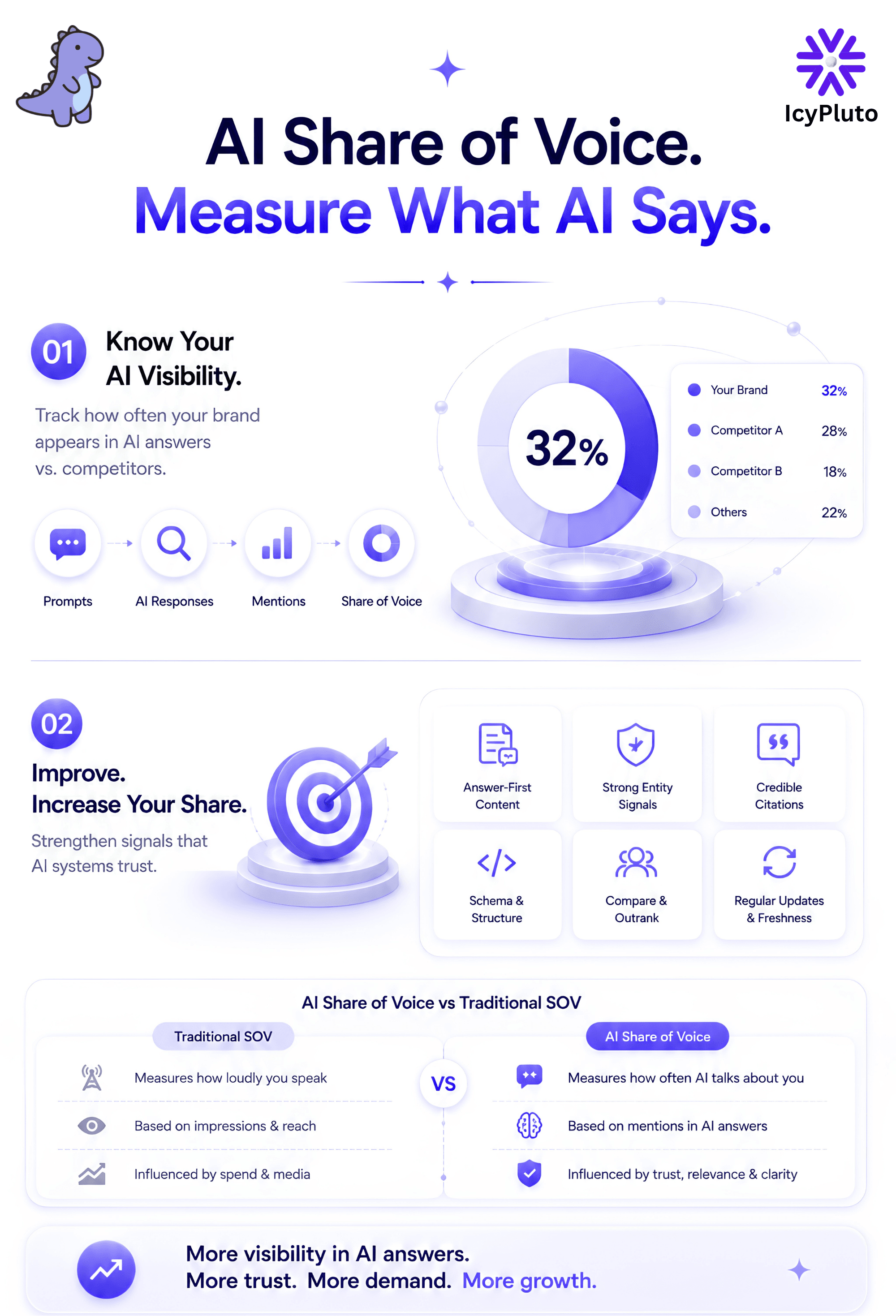
AI share of voice is the new visibility metric bra...
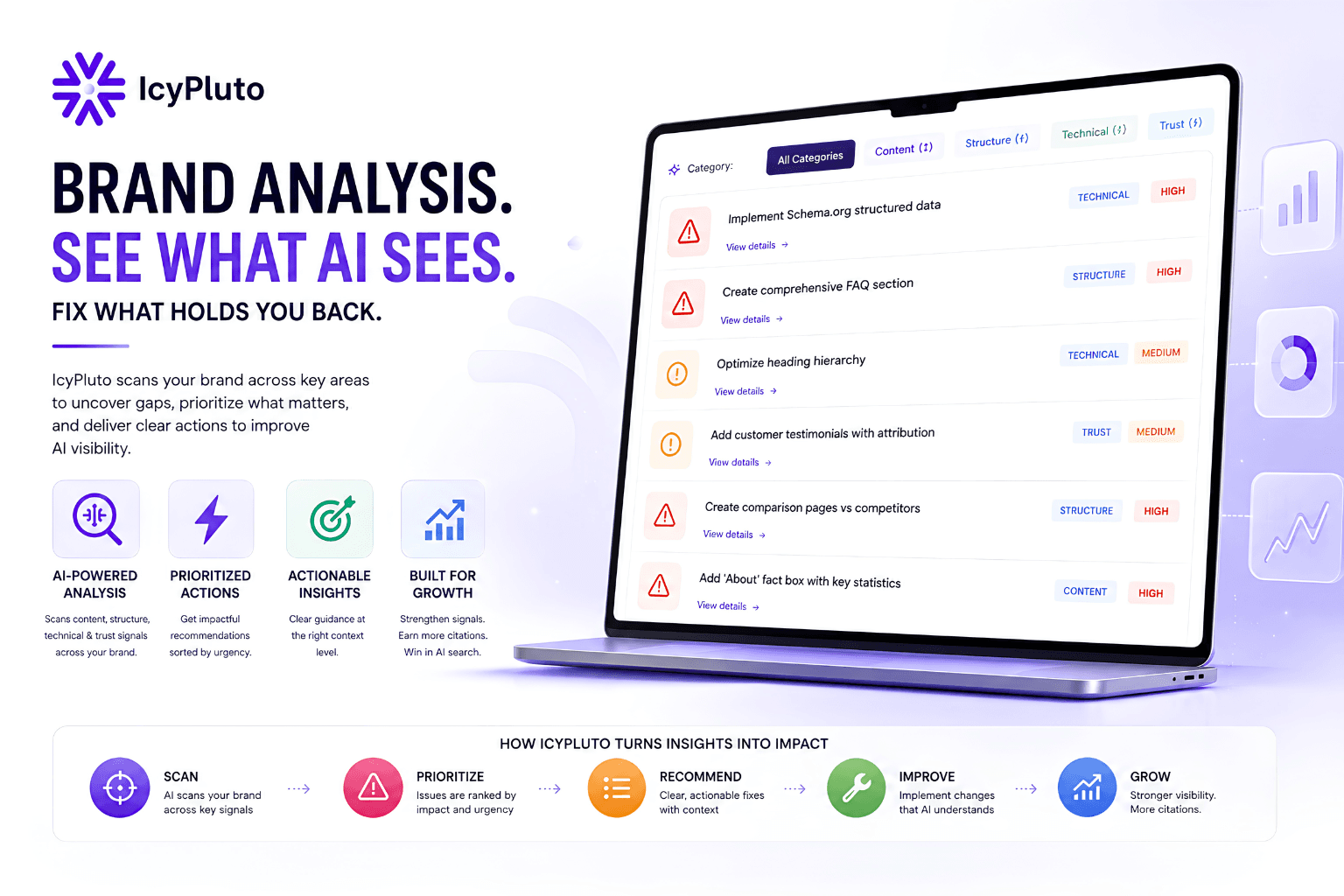
This blog explains why brands are losing visibilit...
Artificial intelligence is changing search faster than most companies realize.
Google’s AI Overviews, ChatGPT, Perplexity, Gemini, and Claude are no longer just search companions. They are becoming the new discovery engines for brands. According to Gartner, traditional search engine volume could decline by 25% by 2026 as users increasingly shift toward AI-powered answer engines. At the same time, Adobe reported that AI-assisted search traffic grew by over 1,200% year-over-year across several enterprise categories.
The problem is that most brands are still optimizing for traditional SEO while AI models operate on a completely different layer of understanding.
This is where IcyPluto’s Action Feature becomes strategically important.
Instead of simply showing rankings or visibility scores, the Action Feature provides brands with actionable AI optimization recommendations that directly improve how AI systems understand, cite, reference, and recommend businesses online. It transforms AI visibility from a vague concept into an operational workflow.
For companies entering the era of Generative Engine Optimization (GEO), this changes everything.
For more than two decades, SEO was primarily focused on keywords, backlinks, metadata, and SERP rankings. Those elements still matter, but AI systems now evaluate brands differently.
Large language models process:
Structured data
Entity consistency
Brand references
Citation patterns
Semantic trust
Cross-platform validation
Hyperlink references
Knowledge graph alignment
This means brands with strong traditional SEO can still perform poorly inside AI-generated answers.
A recent BrightEdge study found that 68% of AI-generated search answers pull information from structured and entity-rich sources rather than purely keyword-optimized pages. Another Statista report showed that over 52% of users now trust AI-generated recommendations for product research and decision-making.
The shift is massive.
The brands that dominate AI search visibility in the next three years will not necessarily be the brands with the most backlinks. They will be the brands with the cleanest AI-readable infrastructure.
IcyPluto’s Action Feature is designed specifically for this transition.
The Action Feature inside IcyPluto acts like an AI visibility optimization engine.
Instead of giving brands generic SEO advice, it identifies precise technical and semantic gaps that affect how AI systems interpret a company online.
The feature analyzes:
Brand consistency
Schema markup presence
Citation structures
AI visibility gaps
GEO optimization opportunities
Cross-platform brand signals
Hyperlink references
Structured data implementation
Then it converts those findings into prioritized action items with severity levels, impact estimation, and implementation guidance.
This operational approach matters because most SEO tools stop at analytics. IcyPluto goes further by telling teams exactly what to fix to improve AI discoverability.
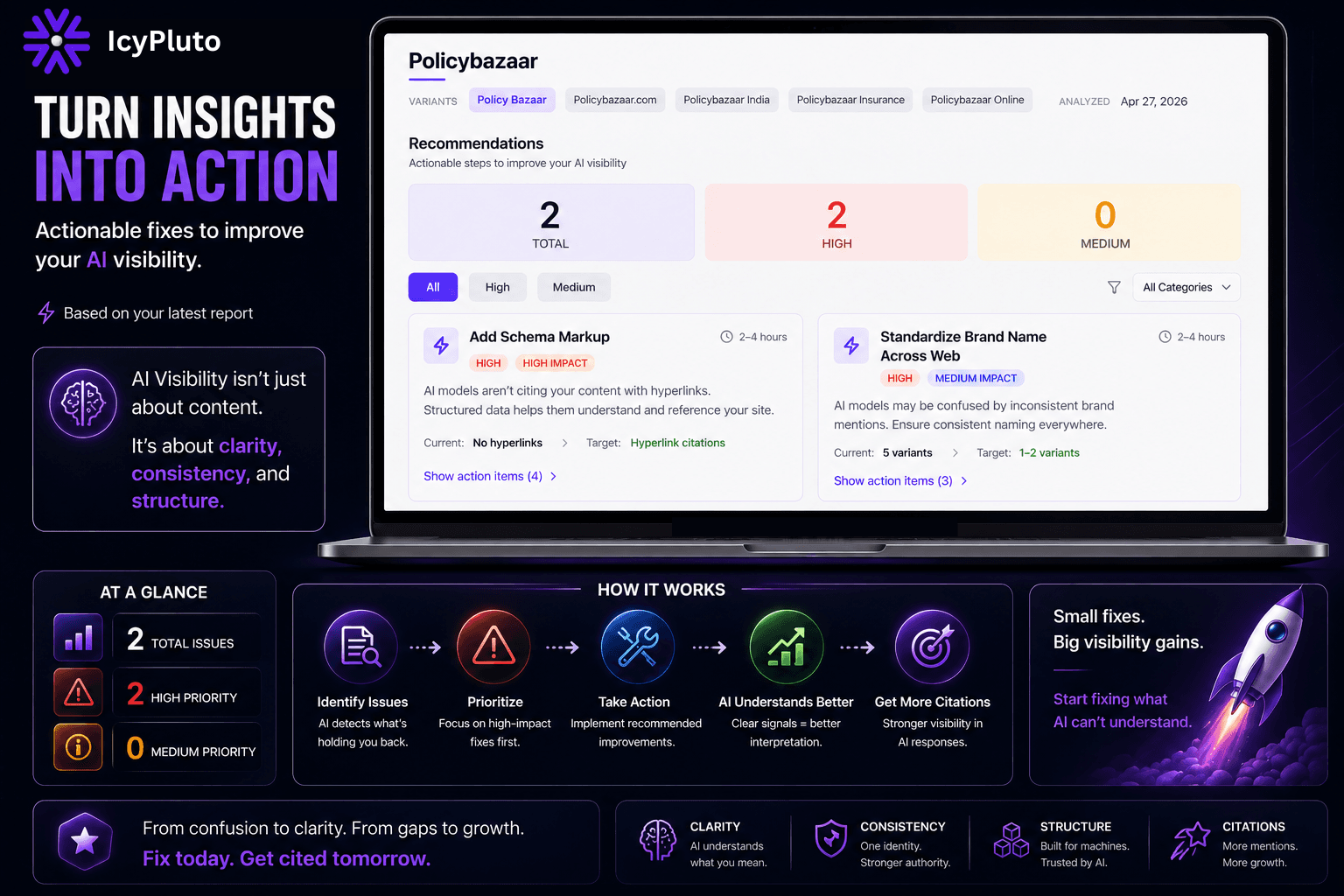
The screenshot example highlights two important AI visibility recommendations:
The platform identifies when AI models are unable to properly cite or understand content because structured data is missing.
According to Google Search Central, schema markup significantly improves content comprehension for machine learning systems. Websites using structured data often see up to 30% higher rich-result visibility and improved contextual indexing.
In AI search environments, schema becomes even more critical because language models rely heavily on entity clarity and semantic structure.
IcyPluto surfaces this issue immediately and provides action pathways.
AI systems struggle with fragmented brand identities.
If a company appears online as:
Policy Bazaar
Policybazaar
PolicyBazaar India
PolicyBazaar Online
AI systems may treat these as separate entities.
This weakens:
Citation authority
Entity trust
Knowledge graph consistency
AI confidence scores
Research from Semrush and Ahrefs shows inconsistent brand mentions can reduce local and semantic search trust significantly, especially for AI-assisted retrieval systems.
IcyPluto detects these inconsistencies and recommends standardization strategies to consolidate authority.
Generative Engine Optimization is becoming one of the most important digital marketing shifts since mobile SEO.
Unlike traditional search optimization, GEO focuses on improving how AI systems retrieve, summarize, and recommend brands inside generated responses.
This requires brands to optimize for:
AI citations
Semantic authority
Entity recognition
Machine readability
Knowledge graph consistency
Structured relationships
Source credibility
A McKinsey report predicts that AI-assisted customer journeys could influence over 40% of digital purchasing decisions by 2027. That means companies invisible to AI systems risk becoming invisible to customers.
IcyPluto’s Action Feature bridges this gap by operationalizing GEO into clear execution workflows. Instead of asking marketing teams to “improve AI visibility,” it breaks visibility into measurable actions.
That operational clarity is rare in the current market.
Most AI visibility platforms suffer from one major flaw. They overwhelm users with dashboards but fail to provide execution intelligence.
Marketing teams do not need more vanity metrics. They need:
Prioritized fixes
Impact analysis
AI-specific recommendations
Workflow visibility
Action-oriented guidance
IcyPluto’s Action Feature solves this by categorizing recommendations based on:
Severity
Estimated impact
Implementation time
Optimization category
This creates operational momentum.
For example:
High impact schema gaps become immediate priorities
Medium impact naming inconsistencies become cleanup tasks
AI citation opportunities become strategic GEO initiatives
This transforms AI optimization into a scalable marketing process.
Schema markup is no longer optional.
AI systems increasingly depend on structured metadata to:
Understand entities
Identify relationships
Verify facts
Attribute citations
Generate accurate responses
According to Search Engine Journal, websites with structured data are significantly more likely to appear in AI-enhanced search experiences.
Schema types that influence AI discoverability include:
Organization schema
FAQ schema
Article schema
Product schema
Review schema
Breadcrumb schema
When AI systems cannot interpret content structure, they are less likely to cite or trust the source. This is exactly why IcyPluto flags schema-related issues as high-impact recommendations.
The Action Feature identifies missing markup and helps brands close semantic gaps before they affect visibility.
Traditional SEO focused heavily on backlinks. AI-driven search introduces another layer: entity confidence.
Language models need confidence that:
A brand is legitimate
Mentions are connected
Citations are trustworthy
References point to the same entity
When naming inconsistencies appear across websites, directories, press releases, and social profiles, AI confidence weakens. Google’s Knowledge Graph and modern AI retrieval systems heavily rely on entity reconciliation.
This means consistency across:
Website branding
Social media handles
Press mentions
Directory listings
Metadata
Structured data
has a direct influence on discoverability.
IcyPluto’s Action Feature simplifies this process by identifying fragmented brand variants and recommending consolidation.
This is particularly important for enterprises operating across multiple domains, regions, or sub-brands.
Many SEO tools provide data. Very few provide operational intelligence.
IcyPluto’s differentiation lies in converting AI visibility problems into execution-ready tasks.
That creates several advantages:
Teams can immediately identify:
What is broken
Why it matters
How much impact it has
How quickly it can be fixed
This dramatically reduces decision-making friction.
The Action Feature creates alignment between:
SEO teams
Content teams
Developers
Brand managers
GEO strategists
Everyone operates from a shared AI visibility framework.
Instead of randomly optimizing pages, brands can focus on:
High-impact semantic fixes
AI citation improvements
Structured data expansion
Entity consolidation
This improves efficiency and ROI.
The next generation of marketing dashboards will not only track:
Rankings
Traffic
Conversions
They will also track:
AI citation frequency
AI visibility share
LLM recommendation presence
Entity authority
GEO performance
AI discoverability scores
This evolution is already happening.
According to Deloitte, over 70% of enterprise marketing leaders are actively exploring AI visibility measurement frameworks as part of their 2026 search strategy.
Brands that adapt early will build long-term competitive advantages. Brands that delay may lose discoverability entirely in AI-native search environments.
IcyPluto’s Action Feature positions organizations ahead of this shift by turning AI optimization into a measurable operational discipline.
The future of digital visibility is not just about ranking. It is about being understood.
AI systems increasingly determine:
Which brands get cited
Which products get recommended
Which websites become trusted sources
Which companies dominate AI-generated answers
This creates a new competitive layer where semantic clarity, structured intelligence, and entity consistency matter more than ever.
IcyPluto’s Action Feature directly addresses these emerging requirements.
By identifying AI visibility gaps and converting them into actionable workflows, the platform helps brands move from traditional SEO toward AI-native optimization. That transition will define the next era of search leadership. Companies that embrace GEO today will likely dominate AI discovery tomorrow.