The way people find content on the internet is being fundamentally rewritten — not by a slow, gradual shift, but by a sudden and dramatic restructuring triggered by one of Google's most aggressive rollouts in recent memory. Google's AI Overviews feature has now been confirmed to have reduced organic search clicks by a staggering 42%, according to fresh data pulled from an analysis of dozens of publisher websites tracked through Google Search Console. This isn't a theory or a prediction — it's a hard, data-backed reality that every content creator, digital marketer, and publisher needs to take seriously right now.
At IcyPluto, we've been closely watching how artificial intelligence is reshaping the cosmos of digital marketing. This development isn't just a search trend — it's a signal flare. The traffic landscape is changing at a speed that few anticipated, and understanding what's happening, why it's happening, and what opportunities still exist is no longer optional for anyone serious about visibility online.
A comprehensive analysis covering a portfolio of 64 publisher websites, using performance data pulled directly from Google Search Console, has laid out the numbers with remarkable clarity. Before AI Overviews began rolling out into Google Search at scale, the collective organic search traffic across these sites was hovering at approximately 1.7 billion clicks every single quarter. That baseline held steady from early 2023 through the first quarter of 2024 — a period of relative predictability in the search landscape.
Then things changed.
The moment Google began expanding AI Overviews into its standard search results, traffic dropped 16% almost overnight. What made matters worse is that there was no recovery bounce. The traffic didn't dip and rebound. It simply fell — and stayed down.
As Google accelerated the expansion of AI Overviews across more search categories throughout mid-2025, the decline didn't plateau. It deepened. By the time the fourth quarter of 2025 arrived, the cumulative damage was quantifiable and clear: organic search traffic had fallen a full 42% compared to where it stood before AI Overviews entered the picture. From nearly 1.7 billion clicks per quarter to a significantly reduced figure — that kind of decline represents millions of lost visits for individual publishers and tens of millions in aggregate across the broader content ecosystem.
The mechanics behind this shift are not complicated once you understand what AI Overviews actually do. When someone types an informational query into Google — something like "how does photosynthesis work" or "what are the symptoms of dehydration" — the AI Overview kicks in and delivers a summarized, synthesized answer directly at the top of the search results page. The user gets what they were looking for without ever needing to click on a website.
This is the zero-click future that SEO professionals have been warning about for years, only it has arrived faster and hit harder than even the pessimists predicted. For content categories that are informational and evergreen in nature — the kind of content that has traditionally anchored publisher traffic strategies — AI Overviews are essentially acting as a traffic dam. The information flows to the user, but the clicks don't flow to the publisher.
The categories most affected are exactly what you'd expect: health, science, how-to guides, general knowledge articles, and anything that answers a clear, stable factual question. These are the verticals where AI Overviews appear most frequently, and they are the same verticals that make up the backbone of many publisher content libraries.
Here is where the story takes a turn that most people weren't expecting, and it's genuinely good news for publishers who are paying attention. While evergreen and informational content has taken a severe beating in organic search, breaking news content has gone in the exact opposite direction.
Over the period stretching from November 2024 through early 2026, breaking news traffic across the same portfolio of publisher sites grew by a remarkable 103%. That's not a modest uptick — that's a doubling of traffic driven by real-time, breaking story coverage. And the reason behind this surge reveals something important about how Google has chosen to handle AI Overviews in the context of fast-moving news events.
The data shows that AI Overviews appeared in roughly 15% of news-related search queries — a far lower rate than in categories like health and science, where AI Overviews appear at nearly three times that frequency. This disparity is not an accident. It appears to reflect a deliberate approach by Google to limit AI-generated summaries in contexts where accuracy, recency, and reliability are paramount.
Think about it from Google's perspective. When a major geopolitical event unfolds, when a natural disaster strikes, or when a high-profile story breaks, the details are shifting by the minute. An AI system trained on historical data and generating summaries from cached or slightly outdated sources could easily produce inaccurate information — something known in AI circles as "hallucination." For Google, having its AI Overview confidently state wrong information about a breaking news story would be a reputational disaster of the highest order.
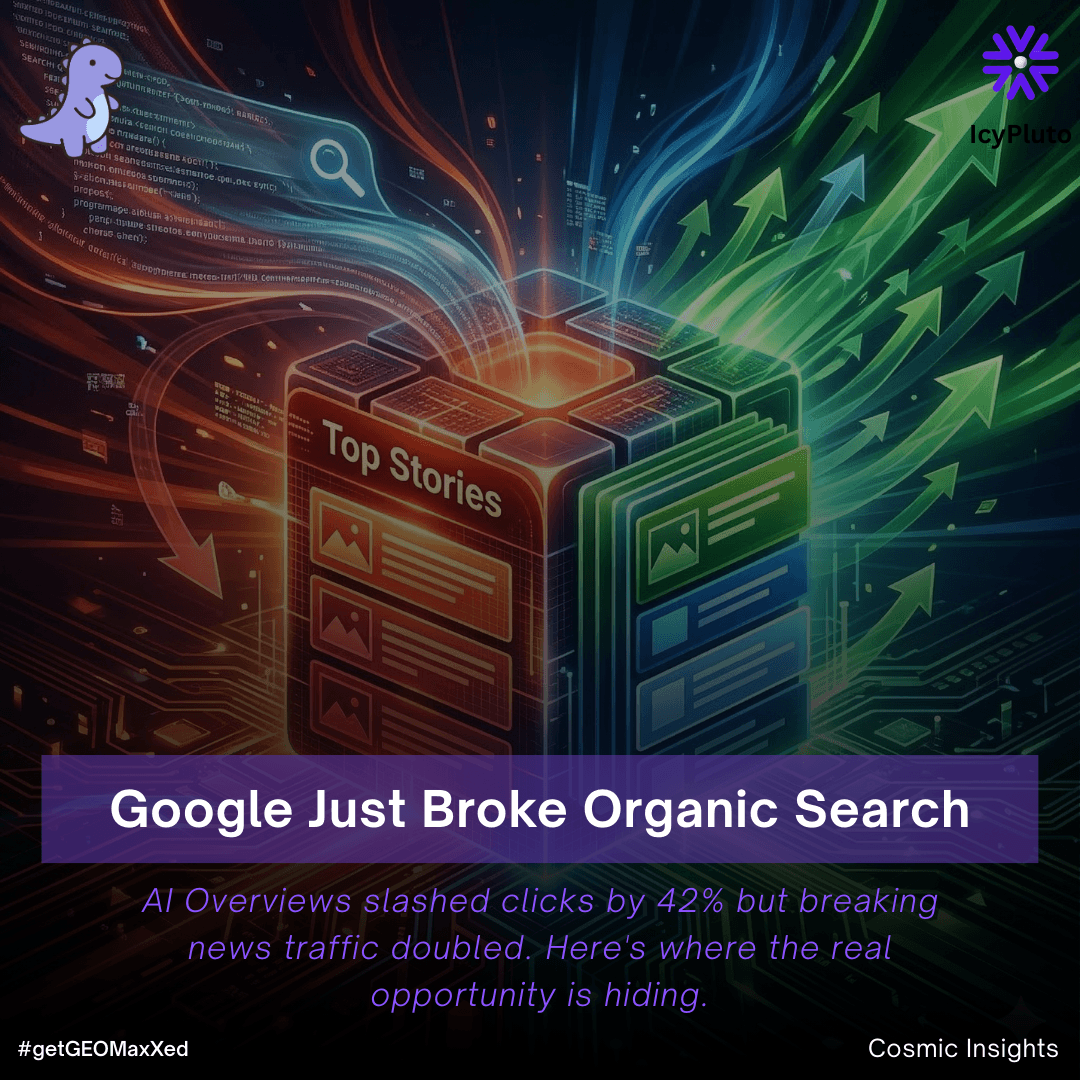
So instead of deploying AI Overviews, Google defaults to a different mechanism for news queries: the Top Stories carousel. This is the horizontally scrolling or vertically stacked set of news article links that appear prominently at the top of search results for trending or breaking topics. Crucially, those stories link directly to publisher websites. The traffic flows through, not around. For publishers who are actively covering major developing stories — international conflicts, economic shifts, political developments, major weather events — the Top Stories carousel has become a powerful traffic driver.
This dynamic represents one of the clearest opportunities in the current search landscape: publishers who invest in fast, credible, high-quality breaking news coverage stand to benefit significantly from how Google has structured its results pages in the AI era.
There's another major development buried inside this data that deserves its own spotlight, because it fundamentally changes how publishers should think about their traffic strategy. Google Discover — the personalized content feed that surfaces articles, videos, and other content to users on the Google app and Chrome's new tab page — has quietly grown into one of the most significant traffic channels in the digital media landscape.
Across the same portfolio of 64 publisher sites, Discover traffic grew by 30% during the period under analysis. More striking than the percentage growth is what it means in absolute terms: for the first time in the dataset's history, traffic from Google Discover and traffic from traditional Google web search have converged to roughly equal levels. Two channels that once stood in dramatically different weight classes are now essentially tied.
The data reveals a notable acceleration in Discover traffic following Google's December 2025 core algorithm update. Publishers who saw their Discover feeds light up after that update experienced a meaningful spike in referral traffic. However, it's worth noting that some of those gains softened somewhat after Google rolled out a separate Discover-focused core update in February 2026, suggesting that the Discover algorithm is in an active period of recalibration.
What Chartbeat's separate tracking data reinforces is that Google's traffic to news publishers has increasingly come through Discover rather than traditional search. This is a structural shift, not a blip. If your content strategy doesn't include intentional optimization for Discover distribution — thinking about compelling headlines, engaging thumbnails, timely topics, and content that people actively want to see in a personalized feed — you're leaving a growing slice of available traffic on the table.
For the IcyPluto community, understanding that Discover functions differently from search is critical. Discover content isn't pulled by a user typing a query — it's pushed to users based on their demonstrated interests and behaviors. That means the quality and relevance of your content matters even more than keyword placement. Strong editorial judgment about what topics resonate with specific audiences becomes a core competency for Discover success.
The overall picture painted by this data is one of significant disruption paired with significant opportunity — and the key is knowing which opportunities to pursue. Let's break down the strategic takeaways for publishers, marketers, and content teams trying to navigate this shifting landscape.
This doesn't mean abandoning evergreen content entirely. It means recognizing that evergreen informational content — the kind that answers straightforward factual questions — faces serious headwinds in the current environment. AI Overviews are exceptionally well-suited to handle exactly this type of query, which means that publishers relying heavily on high-volume, low-specificity informational content need to recalibrate.
One path forward is depth. Content that goes far deeper than what an AI Overview can synthesize — original research, primary source interviews, nuanced analysis, expert commentary, data visualization — retains value that a surface-level AI summary cannot replicate. Another path is specificity. Hyper-targeted content addressing the very precise needs of a defined audience is less likely to be displaced by a generic AI answer.
The 103% growth in breaking news traffic is not a subtle hint — it's a loud and clear signal that real-time, high-credibility news coverage is one of the most defensible traffic channels available right now. Google appears to have made a structural decision to direct users to publisher pages for developing stories rather than generating AI summaries, and that policy is creating a genuine opening for publishers who can consistently deliver fast, accurate, and credible breaking coverage.
The convergence of Discover and web search traffic means that any strategy built exclusively around search query optimization is working with half the picture. Discover rewards content that is timely, emotionally resonant, visually compelling, and tightly aligned with the interests of a defined audience. Building for Discover means thinking about your reader's experience as a consumer rather than as a query-answering machine.
Perhaps the most important strategic lesson from a 42% decline in search clicks is this: dependence on a single traffic source is existential risk. Publishers and brands who have been operating as if Google organic search would always be their primary referral engine are now living through the consequences of that assumption. Diversification — across Discover, Google News, social channels, email newsletters, direct traffic, and community platforms — isn't a nice-to-have. It's a survival strategy.
What we're witnessing with Google AI Overviews is one part of a much larger transformation happening across the digital attention economy. AI systems are increasingly capable of synthesizing information, answering questions, and satisfying user intent without requiring users to navigate to external websites. This pattern is not unique to Google — it's playing out across search engines, AI chatbots, voice assistants, and content platforms worldwide.
At IcyPluto, we believe the publishers, marketers, and content teams who will thrive in this environment are those who lean into what AI cannot easily replicate: human perspective, original reporting, timely insights, authentic community engagement, and creative depth. The brands that treat AI as both a competitive challenge and a strategic tool — rather than simply a threat or a shortcut — will find themselves better positioned as the landscape continues to evolve.
The 42% decline in search clicks is a number that demands attention. But within that same data set lives a 103% surge in breaking news traffic and a 30% rise in Discover engagement. The opportunity isn't gone — it has shifted. And the publishers who recognize where it has moved, and who move with it, are the ones who will define what success looks like in the AI-driven era of digital content.
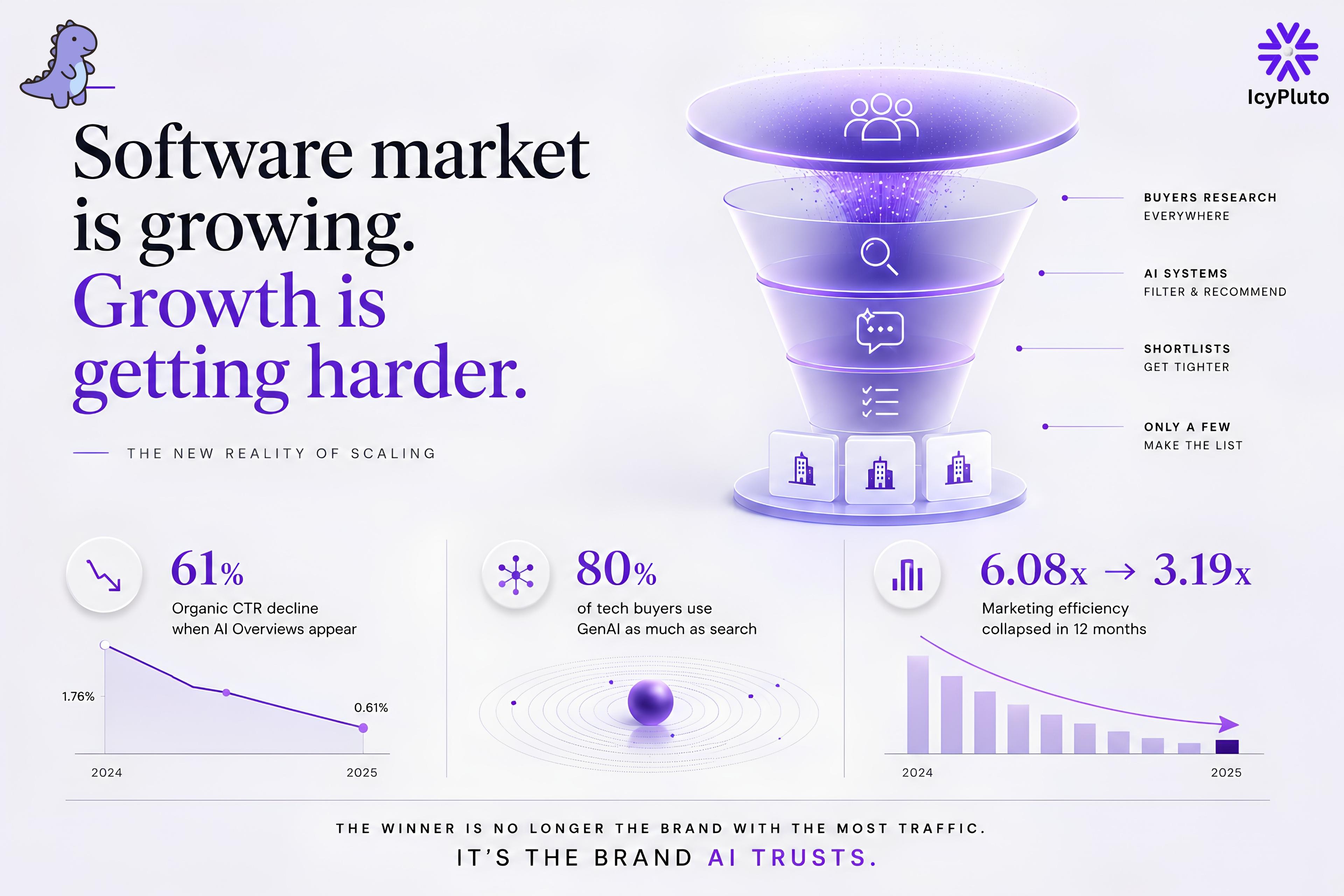
This blog explains how the old growth playbook is ...
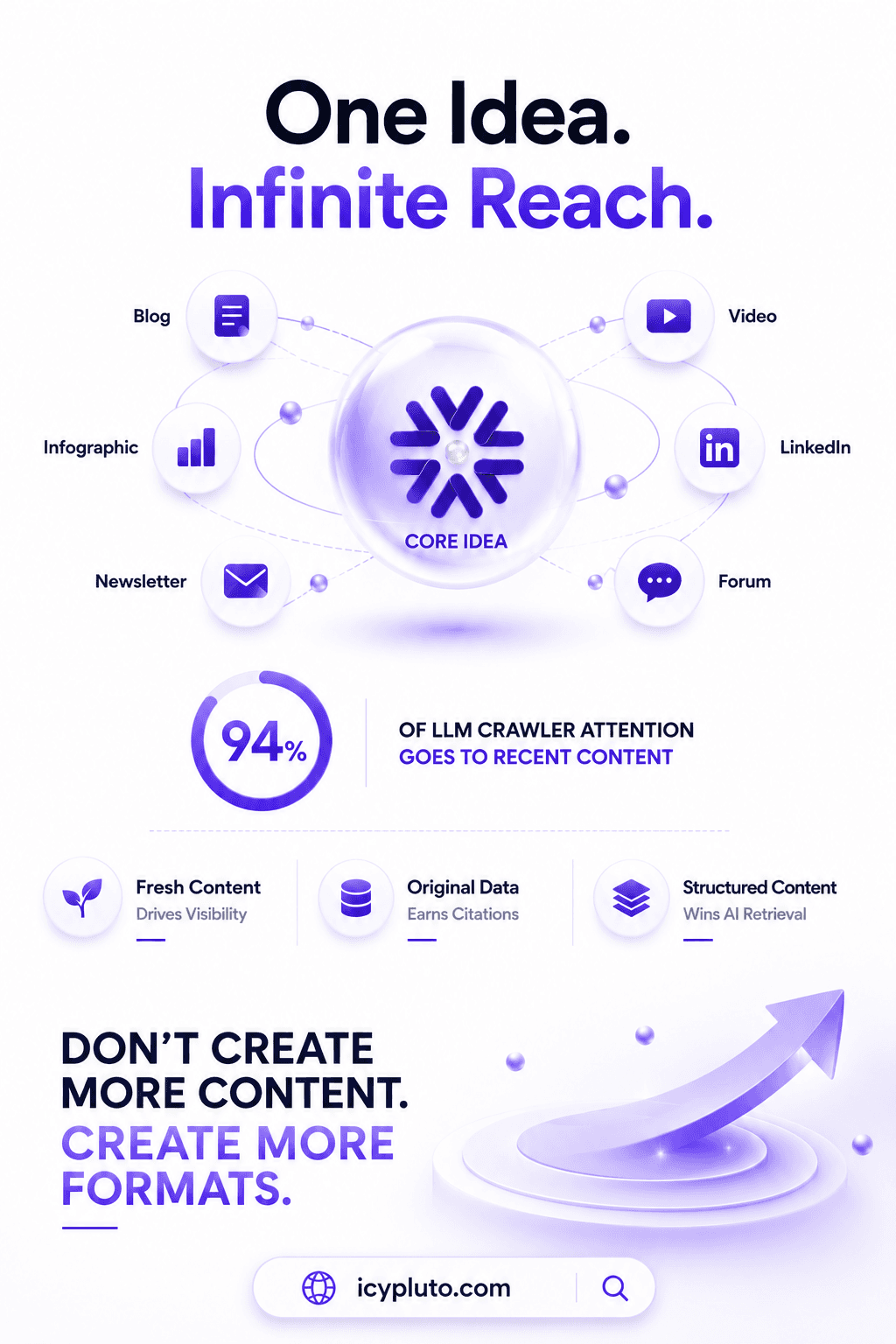
This blog reveals how to maximize visibility in tr...
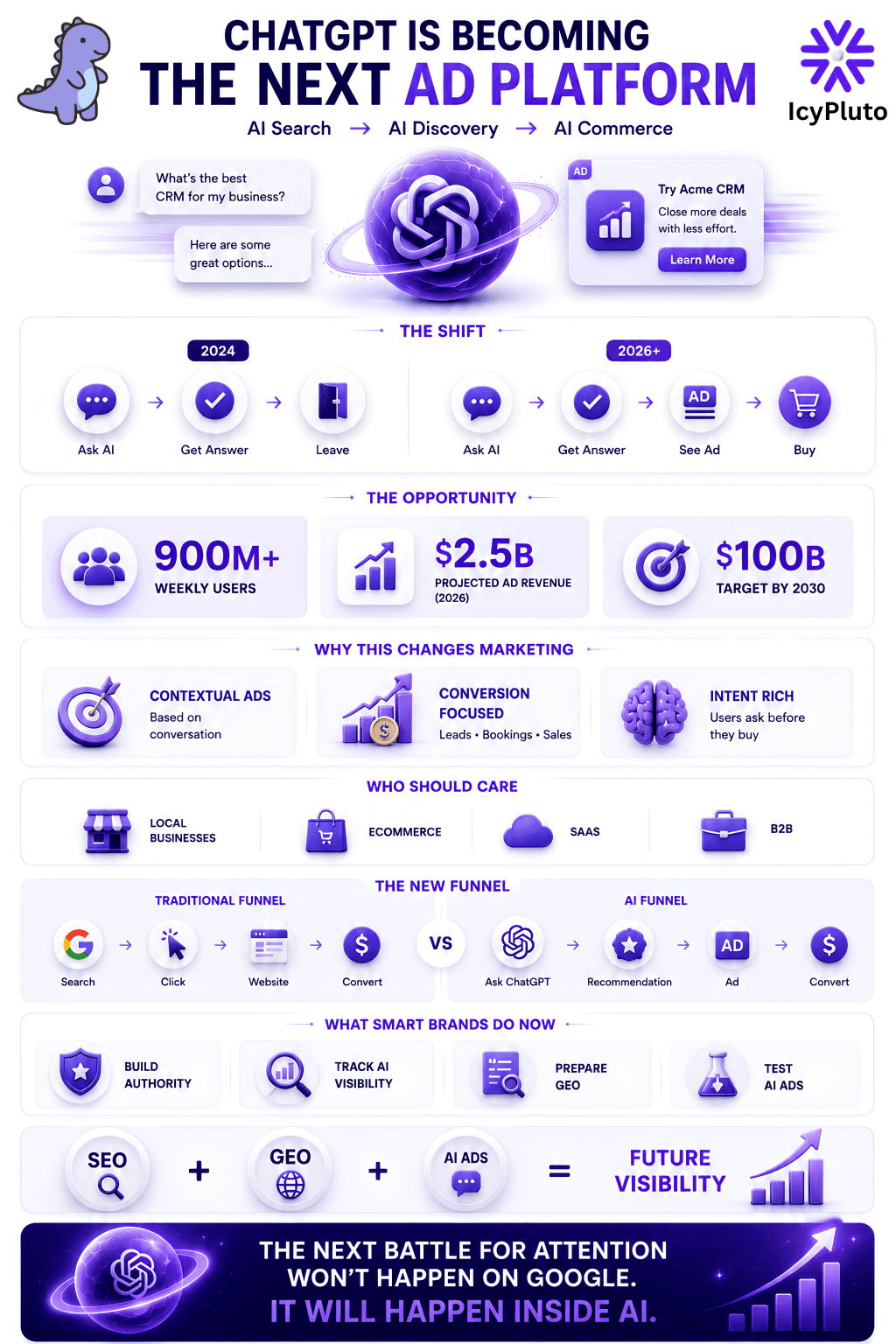
This blog post explores OpenAI's groundbreaking la...