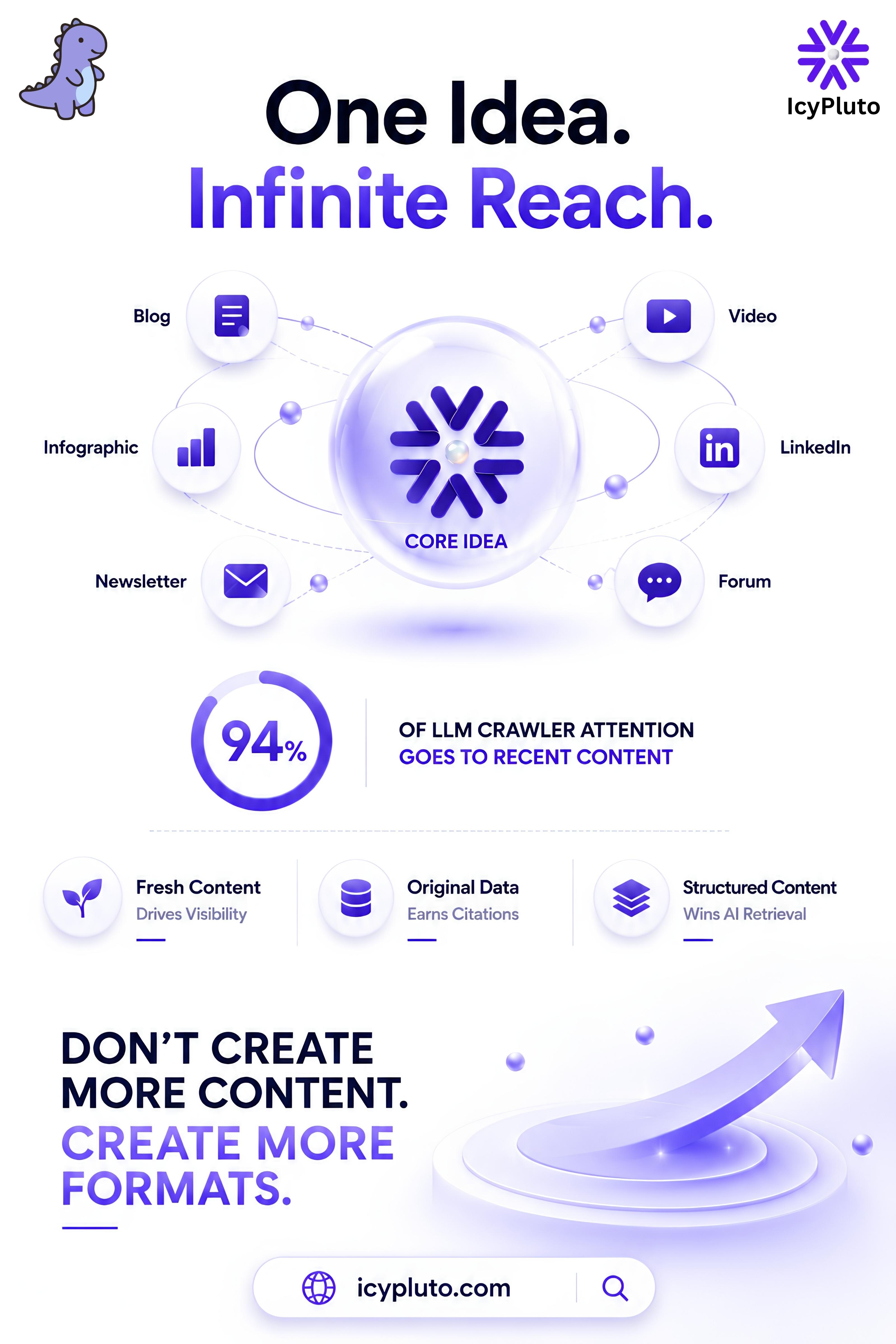
This blog reveals how to maximize visibility in tr...
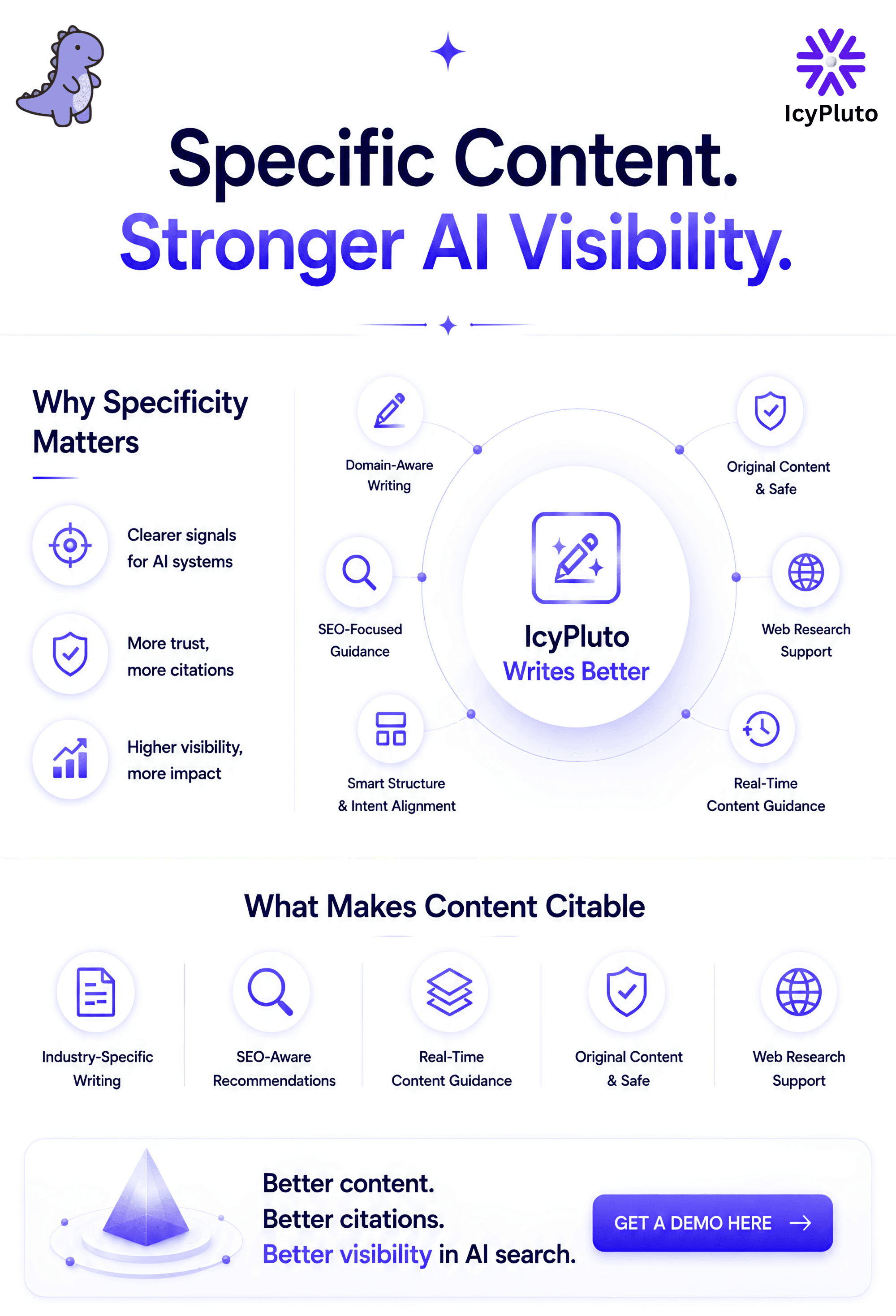
AI SEO writing is getting more specific, and that ...
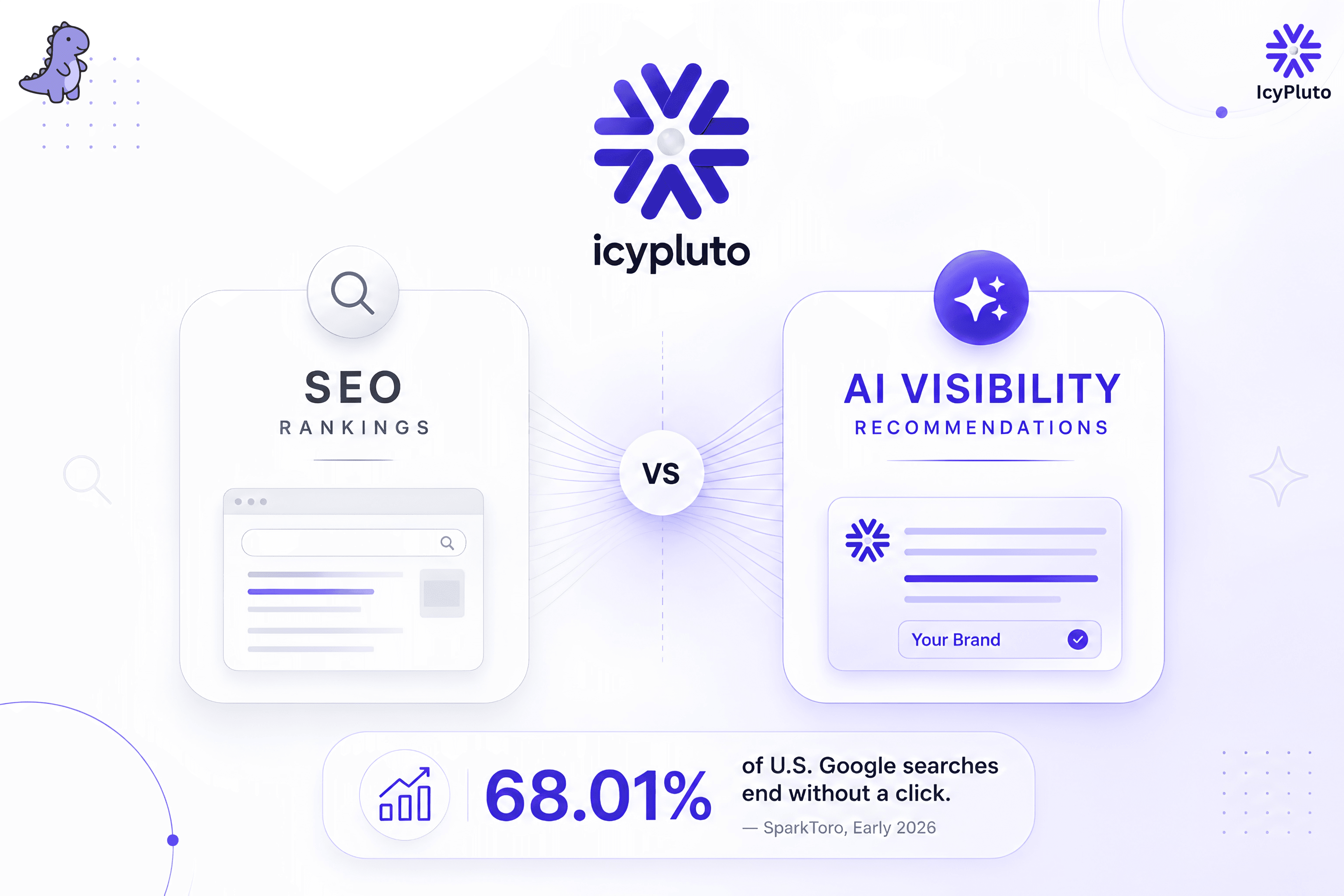
AI search is changing how brands get discovered, a...
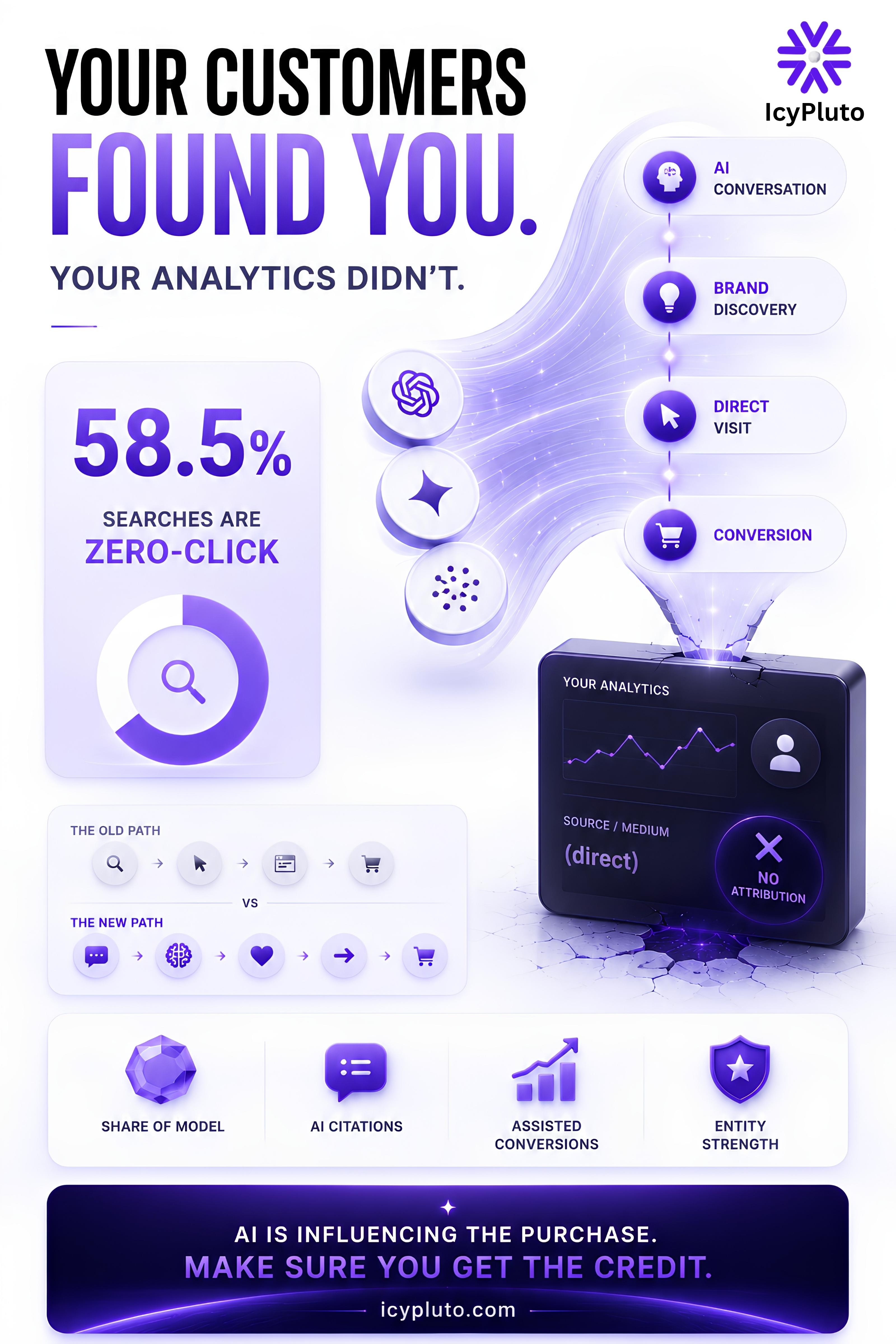
Your marketing attribution model was built for a world that no longer exists.
For the past two decades, the path to purchase was straightforward. Someone searched on Google. They clicked your link. They visited your website. They converted. You tracked it all in Google Analytics. You knew exactly which keywords and campaigns drove revenue.
That world is gone.
Today, your customers are asking AI assistants what to buy. They're having full-length conversations with ChatGPT, Perplexity, and Google AI Overviews. They're getting recommendations without ever clicking a traditional search result. And when they finally visit your website, your analytics show a direct visit with no attribution trail.
This is the massive blind spot in modern marketing. And if you're not tracking it, you're making multi-million dollar budget decisions based on incomplete data.
The data shows something dramatic is happening beneath the surface of traditional analytics.
As of 2026, 58.5 percent of searches are zero-click. For queries where AI Overviews appear, the zero-click rate hits 80 to 83 percent. When a shopper interacts with an AI model, they're getting answers without ever needing to visit a search results page.
The impact on traditional metrics is staggering. AI Overviews reduce organic click-through rates for position one content by 58 percent according to Ahrefs research. For every 100 clicks you historically earned for a top-ranking page, Google now keeps 58. This doesn't mean visibility is down. It means visibility is happening in places your analytics cannot see.
Only 14 percent of marketers track AI visibility. This means 86 percent of businesses are flying blind when it comes to understanding how their brand appears when customers ask AI tools about their category.
The old attribution model was simple. Last-click attribution dominated for two decades. Whatever drove the final click before conversion got 100 percent of the credit.
That model assumed the customer journey was visible. It assumed every touchpoint left a data trail. It assumed that if someone searched, clicked, and converted, you could see the path.
None of those assumptions hold true anymore.
The new customer journey looks like this: someone asks ChatGPT what product to buy. They get recommendations from three brands. They ask follow-up questions about features and pricing. One brand keeps appearing. Eventually they do a branded search or type your URL directly. They convert. Your analytics shows a direct visit with no source.
This is what's called dark traffic. It used to happen from mobile apps and email links. Now it happens from AI conversations.
The problem is that dark traffic is not actually dark. It's just invisible to traditional attribution. The influence is real. The brand is being discovered. The conversion is happening. But your analytics reports show nothing.
Platform attribution makes this worse. Meta, Google, and TikTok all use different attribution windows. Adding up their reported conversions typically produces a total that exceeds your actual revenue by two to three times. This is called double-counting. Everyone is claiming credit for the same conversion.
Third-party cookies are gone. All major browsers have deprecated them. Cross-site tracking via pixel is no longer reliable. You cannot build the journey back through traditional tracking methods.
AI-optimized campaigns obscure the path even further. Performance Max and Advantage+ campaigns allocate spend across placements automatically. It's difficult to understand what creative or channel is doing the work because the algorithms are making thousands of micro-decisions per hour.
Customer journeys are longer and more complex. B2B buyers in 2026 average eight to 12 touchpoints before converting. B2C buyers in considered categories often see five to eight brand interactions. Traditional attribution cannot handle this complexity.
You cannot track AI search visibility the same way you tracked traditional SEO visibility. Click-based metrics are collapsing. You need signals that measure influence, not just traffic.
The first metric is Share of Model. Traditional SEO tracks Share of Voice in rankings. The new frontier is Share of Model. This measures how often your brand is recommended when AI tools answer questions in your category.
Test AI prompts directly to see how often your brand is recommended. Regularly query major LLMs with localized prompts like what are the best-rated categories near me or who has the best deals on products in your region. Track how these answers change over time. If you're not appearing, it's often because your site lacks deep, informative content that AI models prioritize.
The second metric is AI Citation Rate. Unlike traditional backlinks, AI citations don't require a clickable link. They're mentions within AI-generated responses that establish your brand as a credible source. One major analysis reported organic CTR drops of up to 61 percent on informational queries after AI Overviews became widespread. But being cited within an AI Overview can drive brand visibility, voice-search authority, and assisted conversions even without a direct visit.
Track which prompts surface your brand. Measure how often competitors are cited instead. Monitor whether citations include your key differentiators or just generic brand mentions. This tells you whether AI sees your brand as an authority or just another option.
The third metric is Assisted Conversion Correlation. Because AI search often leads to dark traffic or branded searches after AI interaction, you need to look for correlations rather than direct attribution.
When you publish AI-optimized content, do you see increases in branded search volume? When you publish deep-dive articles, do you see spikes in direct traffic to related pages? This is the hallmark of the AI era. Your content is influencing the journey even when you cannot see the connection.
Track the time lag between content publication and branded search spikes. Correlate AI visibility improvements with conversion rate changes across all channels. Use first-party data from your CRM to identify customers who found you through dark traffic but still converted at higher rates.
The fourth metric is Entity Salience Score. AI systems don't think in keywords. They think in entities. Your brand is an entity. Entity salience measures how clearly AI systems recognize your brand in relation to your industry.
A strong entity score means your brand is recognized as a known entity in your space. Weak entity signals mean you're competing with one hand tied behind your back regardless of how good your content is. This is the single biggest gap across most client bases.
Track brand mentions across external domains. Check consistency across platforms. Measure whether your brand name appears alongside your core offerings in AI responses. Build programs that earn visibility for your brand and senior leadership across the web.
AI engines often provide answers without clicks. But they do cite their sources in some cases. You need to look beyond the standard google organic bucket in Google Analytics.
Start identifying referrers from chatgpt.com, perplexity.ai, and bing.com with Copilot interface. These will show up in your GA4 reports if you're looking for them. But they'll be labeled as direct traffic if the AI client doesn't pass referral information.
Implement server-log tracking to identify when bots like GPTBot or OAI-SearchBot are crawling your site. If these bots are frequenting your key pages, it's a leading indicator that you're being indexed for future AI recommendations.
Create custom segments in your analytics that isolate AI-sourced traffic. Look for patterns in session duration, pages per session, and conversion rate. AI-sourced visitors often convert at significantly higher rates than traditional organic traffic. When a shopper arrives after an AI model has vetted your brand, they're ready to buy.
Set up alerts for traffic spikes that don't match your known campaigns. If you see a sudden increase in direct traffic with no corresponding email or social campaign, it might be AI-driven discovery. Investigate which pages received the traffic. Reverse-engineer why those pages are ranking in AI responses.
This is not perfect tracking. But it's better than ignoring the signal entirely.
AI models feed on high-quality, structured information that answers specific user intents. Your content must address nuanced questions that shoppers are asking.
Use real-time search intelligence to move beyond static keywords. Traditional keyword research focuses on search volume and difficulty. AI-ready topics focus on question complexity and answer depth.
Identify the exact questions people are asking search and AI engines. Tools that aggregate data across multiple platforms work better than Google-only research. When your content provides the most authoritative answer to a question like which service in city has the best specific outcome, you increase the likelihood of being the primary citation in an AI-generated response.
Listen to what customers are asking on calls and in support tickets. What questions keep coming up? What objections do you need to overcome? This is the language your audience uses. AI models are trained on this same language.
Look for gaps where competitors are being cited but you're not. This shows you have content that's structurally capable of ranking in AI responses, you just haven't optimized it yet. Identify what makes their content more authoritative. Add those elements to your content. Test whether your visibility improves.
The goal is not to rank for keywords. The goal is to become the answer that AI models surface when customers ask questions in your category. This requires content that's deeper, more specific, and more authoritative than what competitors are publishing.
You need a holistic marketing attribution framework that goes beyond last-click modeling. Instead of looking for a single source of truth, look for correlations across multiple signals.
Marketing Mix Modeling has made a major comeback in 2026 as the privacy-safe alternative. It uses statistical regression on aggregate data to quantify channel contribution without tracking individuals. This is ideal for quarterly budget decisions where you need to know which channels are working overall.
Multi-touch attribution tracks individual customer journeys across touchpoints. This is useful for campaign-level optimization where consent-safe first-party data is available. Both approaches work better than last-click because they acknowledge that multiple touchpoints contribute to conversion.
Incrementality testing uses geo holdouts and synthetic controls to measure causation, not correlation. This tells you whether spend is actually driving incremental revenue or just capturing demand that would have happened anyway. Modern attribution stacks combine all three on top of a unified marketing data platform.
Build a first-party data foundation. Capture and centralize your own customer data through website events via server-side tagging, CRM data, email engagement, and transaction history. Route all attribution data through a central warehouse rather than relying on any single platform's reporting.
Use MMM for quarterly budget allocation. Use multi-touch for campaign-level optimization. Use incrementality testing to validate whether spend is actually driving incremental revenue. Match the model to the decision type.
Avoid common attribution mistakes. Summing platform-reported conversions will overcount by a large margin. Always reconcile against actual revenue. Using last-click for budget decisions consistently under-credits brand, content, and upper-funnel activity. Not running incrementality tests means you're optimizing for correlation, not causation.
IcyPluto has built a comprehensive framework that tracks AI search visibility across the entire customer journey. We know traditional attribution is broken. We built our measurement stack to work around those limitations.
We start by establishing baseline AI visibility for every brand. We use the GEO Dashboard to evaluate prompts across multiple LLM models, including Gemini, ChatGPT, and Perplexity. This gives us the exact picture of how brands look for specific topic clusters and which AI models perform best. We track Share of Voice in AI search, which measures how often your brand is mentioned in AI answers versus competitors.
We monitor AI-sourced traffic separately from traditional organic traffic. We identify referrers from chatgpt.com, perplexity.ai, and bing.com Copilot. We implement server-log tracking to identify when GPTBot and OAI-SearchBot are crawling client sites. This is a leading indicator that content is being indexed for future AI recommendations.
We track entity salience scores continuously. We audit existing entity mappings to find coverage gaps. We map existing mentions across the web and check consistency across platforms. We build programs that earn visibility for the brand and senior leadership across industry publications, review platforms, and professional networks. This work has doubled non-branded visibility for engineering clients in under 12 months.
We create original research and proprietary data that AI cannot synthesize. We help clients scope, run, and publish proprietary data that journalists will pick up. This includes annual industry reports, customer surveys, case study results, and usage statistics. We have helped clients create content that earns 40 to 60 percent more external mentions because the data cannot be synthesized by AI.
We track assisted conversion correlations. When AI-optimized content is published, we measure increases in branded search volume. We track spikes in direct traffic to related pages. We correlate AI visibility improvements with conversion rate changes across all channels. We use first-party data from the CRM to identify customers who found through dark traffic but still converted at higher rates.
We measure attribution gaps that mask AI-driven discovery traffic. One app client had attribution gaps that were hiding the fact that a significant chunk of new traffic was coming via AI-driven discovery, not paid or organic channels. Without tracking this, the whole picture was off. We fix this by building unified data platforms that connect all signals.
We track conversion rates, not just traffic. Average SEO conversion rate is 2.4 percent across industries, with B2B SaaS achieving 2.1 percent according to Oliver Munro 2026 data. We optimize for conversion, not just visibility. We know that AI-sourced visitors convert at higher rates than traditional organic because they've already been vetted by the AI model.
The results show this approach works. Our clients see external mentions increase by 40 to 60 percent. LLM referral traffic grows by 80 percent or more. Share of Voice in AI search results improves measurably. Most importantly, their brands become visible when decision makers use AI assistants to research solutions.
We reallocate budget from production to strategy and distribution. We spend the majority of effort on entity building, original research, distribution, and AI visibility tracking instead of 80 percent on content production and on-page work. This is the move that drives real growth.
If you're still allocating budget based on traditional attribution, you're probably underinvesting in AI visibility. The channels that drove growth in 2022 are not the channels driving growth in 2026.
A senior SEO who can think entity-first and write journalist-ready pitches is worth two midlevel executives churning out content briefs. A part-time research relationship is worth more than a third copywriter. Reallocating budget from production to strategy and distribution is the move, and it is a harder internal sell than asking for more headcount.
The teams that adjust the skill stack now, before it becomes obvious to everyone else, are the ones who will still be ranking when the next round of platform changes lands. The discipline has not died. It just became a different job.
Start tracking AI visibility today. Not because you have perfect attribution. But because you know that imperfect visibility data is better than no visibility data. Your customers are already asking AI what to buy. The question is whether you're measuring where your brand appears.