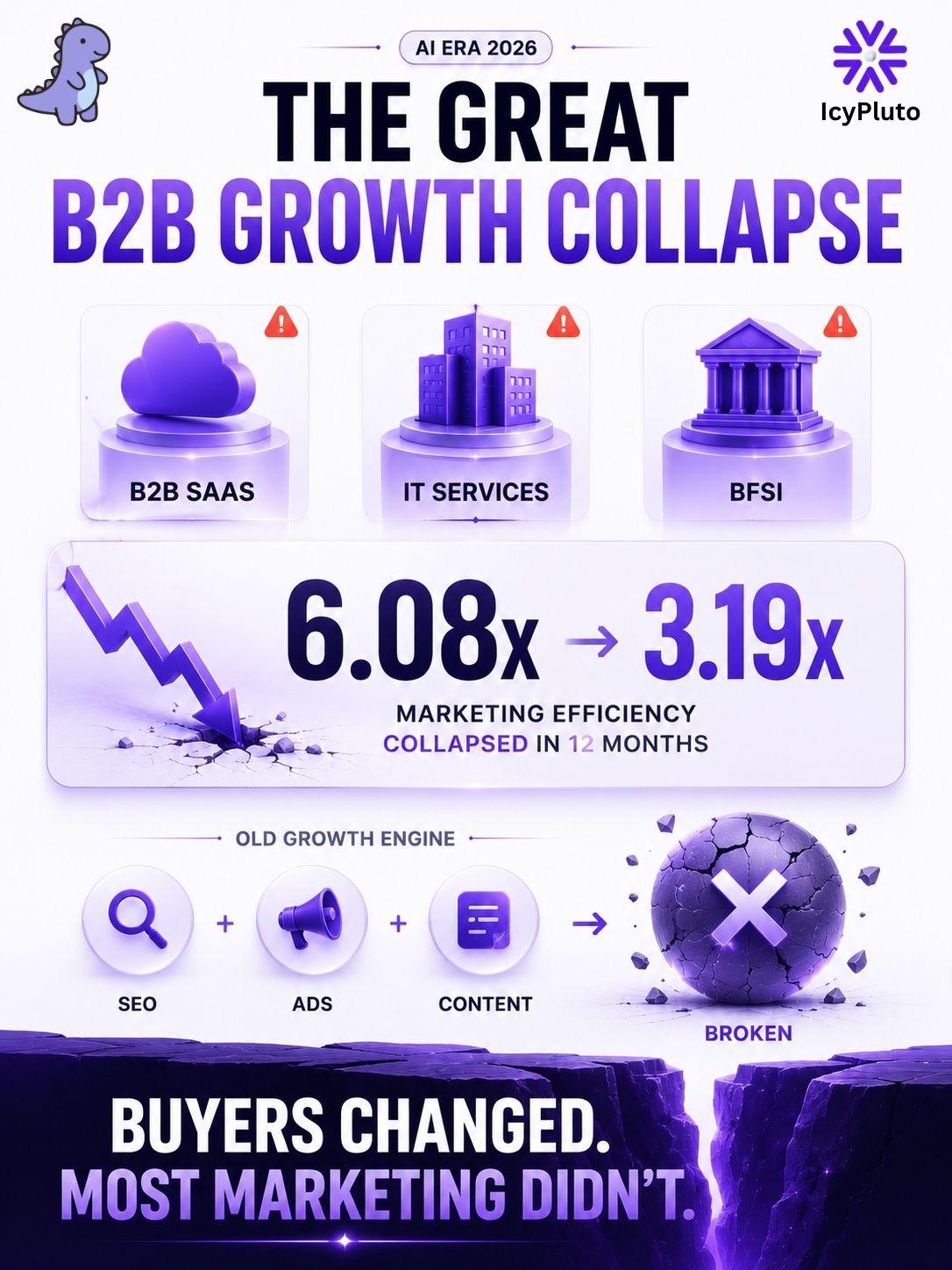
If your B2B SaaS marketing feels harder than it was a year ago, you are not imagining it. The median sales and marketing efficiency for private B2B SaaS startups collapsed from 6.08x in 2024 to 3.19x in 2025. Your marketing spend is going half as far as it used to, and the analytics dashboards don't tell you why.
This isn't a budgeting problem. It's not a creative problem. It's a fundamental breakdown in how buyers discover, research, and trust brands in the AI era. IT companies, B2B SaaS vendors, and BFSI institutions are facing a crisis that traditional marketing frameworks cannot solve.
The center of gravity has moved from interruption to clarity and credibility. When marketing spend goes half as far, the answer isn't to spend more or cut harder. It's to ask whether your go-to-market motion still matches how buyers actually shop.
B2B SaaS is experiencing what industry analysts call the "Great Decoupling." Market leaders in the B2B SaaS sector have reported organic traffic erosion of 70–80%. This is a catastrophic collapse that signals the obsolescence of traditional SEO playbooks.
HubSpot's cautionary tale illustrates the problem perfectly. Between 2024 and 2025, HubSpot's blog traffic dropped from 13.5 million monthly visits to 6 million—a 70–80% decline. Their marketing team thought visibility was collapsing. But when tracked across AI prompts on ChatGPT and Perplexity, their brand appeared in 41% of high-intent commercial responses. The pipeline was actually increasing, but Google Analytics completely missed the influence layer.
That's the new dark funnel of AI search. The click is no longer the entire story. The recommendation is.
The data is brutal. 77.2% of searches on mobile and 60% on desktop now end without a click due to zero-click searches. When AI Overviews appear, organic click-through rates drop by 61%. Even more devastating: only 1% of AI Overviews result in a click to the cited source.
HubSpot's struggle shows that much of what was considered "vanity traffic" was actually low-intent traffic. Only 10% of their leads came from that blog traffic despite the massive volume.
Eight out of ten B2B technology buyers now use AI tools like ChatGPT, Claude, or Gemini for vendor research before they ever visit a website. This represents a fundamental shift in purchasing behavior that most marketing teams have not yet grasped.
80% of B2B buyers prefer a rep-free buying experience, and two-thirds engage with sales only in later stages. Nearly 80% say AI search has changed how they research software. Generic outbound outreach is failing because 73% of B2B buyers actively avoid irrelevant outreach.
Buyers are consuming an average of 15 content assets and visiting 6 vendor websites before making a decision. The average buying group involves 8+ people from finance, IT, compliance, operations, and executive leadership. Yet 71% of hidden buyers have little or no interaction with sales teams.
Forty percent of B2B deals stall due to internal misalignment within the buying organization. This means marketing must establish trust before sales even engages, because the buying group is already evaluating you through AI search before your sales rep knows the deal exists.
What's happening is that buyers are researching in places your analytics cannot track. They're asking Perplexity "what are the best B2B marketing automation platforms" and getting answers that cite three brands. Your brand might not be one of them, and you'll never see that research in Google Analytics.
Vercel understood this shift early. By optimizing their documentation for machine consumption, 10% of Vercel's 2025 signups originated from ChatGPT by late 2025, compared to less than 1% six months prior.
Legacy attribution models like last-touch and multi-touch fail in fragmented buyer journeys with multi-threaded decision-makers. When 80% of B2B buyers research via large language models, that research appears as "Direct" traffic in your analytics, masking the true discovery source.
The problem is that traditional SEO metrics alone cannot measure how visible your brand is inside AI-generated answers. You need new KPIs: Visibility Score, Share of Voice, Share of Answer, Discovery Index, and Sentiment Score.
Seer Interactive data, as referenced by HubSpot, shows that organic CTR for queries that trigger AI Overviews dropped by 61% between June 2024 and September 2025. Even queries without AI Overviews saw a 41% decline in CTR. Google Analytics missed the entire influence layer where AI recommendations were driving pipeline.
AI search does not work like traditional search. LLMs are not simply ranking pages. They are calculating retrieval confidence. Your brand visibility now depends on entity recognition, citation frequency, contextual authority, semantic consistency, vector retrievability, prompt relevance, and multi-source validation.
AI models trust brands they repeatedly encounter across trusted ecosystems. Most companies are not optimizing for this at all. Companies with weaker SEO profiles are appearing more frequently inside AI-generated answers than brands dominating traditional search engine result pages.
In simple terms: AI models trust brands they see repeatedly. And most marketing teams are still optimizing for Google rankings while buyers are asking AI questions.
Sixty-one percent of B2B buyers prefer a rep-free experience, and nearly two-thirds engage sales only in later stages. Thought leadership now reduces uncertainty more than marketing content, with 64% of hidden buyers trusting it more.
Seventy-seven percent of buyers look at user reviews before engaging, and 54% speak with existing users. Marketing must establish trust before sales engagement because the buying group is already evaluating you through AI search.
Generic "AI-powered" messaging is failing. Vague claims about being "AI-driven" no longer differentiate brands. Buyers want verifiable trust signals and self-serve education that helps them qualify themselves.
Gated fluff and ebooks are no longer effective. Seventy-three percent of B2B buyers avoid irrelevant outreach, and content that doesn't help buyers self-qualify is ignored.
The solution is content for the entire buying group. Finance needs ROI calculators. IT and compliance need security documentation. Operators need implementation guides. Executives need strategic vision.
B2B SaaS companies that achieved 265–1,667% AI visibility growth using GEO platforms saw 400–800% increases in AI-referred signups and 15–30% reduction in customer acquisition cost.
IT companies face a different problem. Monthly AI infrastructure bills are in the tens of millions despite a 280-fold drop in token costs. The infrastructure built for cloud-first cannot handle AI economics.
Only 11% of companies have AI agents in production, compared with 38% piloting. 42% are developing an agentic strategy, 35% have no strategy, and 40% will fail by 2027 due to pilot-to-production gaps.
The knowledge half-life has shrunk from years to months in the AI era. The time companies spend studying new technology exceeds the technology's relevance window. Processes built for humans don't work for agents.
70% of companies fail to effectively integrate sales plays into revenue tech tools like CRMs. Only 20% realize full value from these investments.
BFSI faces intensified scrutiny on data privacy under GDPR and India's DPDP Act, ethical AI concerns, and sophisticated cybersecurity threats. Sixty percent of financial institutions have been affected by ransomware or phishing attacks.
The paradox is that AI enables personalized marketing through machine learning that helps understand customer preferences and behaviors, but 94.1% of businesses struggle to balance data collection for marketing with privacy respect.
Forty percent of jurisdictions lack AI ethics guidelines, creating regulatory uncertainty for BFSI companies trying to implement AI-driven marketing. Only 30% of SMEs are prepared to integrate innovations versus 70% of large firms, creating an adoption gap.
Customer acquisition remains the top challenge facing BFSI organizations, but traditional acquisition methods are collapsing under AI search.
YMYL ("Your Money Your Life") queries get AI protection from Google, which limits discovery traffic while trust requirements prevent full AI takeover.
The old playbook assumed you could interrupt your way into attention and nurture your way into trust. That's aging badly in 2026. When 80% of B2B buyers use LLMs for research, and only 1% of AI Overviews result in clicks, the interruption model is dead.
Generative Engine Optimization (GEO) is the new ranking framework. The #1 predictor of LLM citations is brand search volume. Co-occurrence with competitors and keywords matters. Data density increases AI visibility by 22% when you include original statistics. Semantic structure through Schema.org markup is critical.
Vercel's success demonstrates this. They optimized documentation for machine consumption, resulting in 10% of signups from ChatGPT by late 2025. GrackerAI case studies show B2B SaaS companies achieving 265–1,667% AI visibility growth, 400–800% increases in AI-referred signups, and 15–30% reduction in customer acquisition cost.
The future of discoverability belongs to brands that become retrievable, not just searchable.
IcyPluto is the only agentic AI for marketing that tracks and implements GEO, AEO, and AI visibility across ChatGPT, Gemini, Claude, and 10+ AI models. This is not an AI-flavored analytics dashboard with fancy charts and citation reports. IcyPluto engineers discoverability, builds AI trust signals, shapes recommendation probability, and turns brands into default answers.
Most GEO and AEO tools measure the algorithm. IcyPluto influences it.
Most agencies still operate with a traditional marketing mindset. Their approach revolves around SEO rankings, blog production, lead generation campaigns, and paid advertising. That model was built for an internet where traffic was the main prize. In the AI era, that is no longer enough, because AI platforms increasingly shape discovery before a buyer ever lands on a website.
The new challenge is not just getting found. It is becoming the brand that AI systems understand, trust, and recommend. AI engines synthesize information from multiple sources, evaluate consistency, and prioritize brands with stronger authority signals, semantic clarity, and third-party validation. That means companies need more than content calendars and media spend. They need a system that builds authority across the full digital ecosystem that influences AI retrieval and recommendation.
This is where IcyPluto creates leverage. Instead of focusing exclusively on traffic generation, IcyPluto helps organizations build AI-era market authority through an integrated authority engine designed for the way modern discovery actually works.
AI engines do not rely on a single webpage or a single keyword. They pull signals from websites, LinkedIn, industry publications, PR channels, communities, thought leadership assets, and executive presence to determine which brands deserve mention in generated answers. IcyPluto is built to help brands establish consistent narratives across these surfaces so they are easier for language models to recognize, validate, and reference.
Its platform measures AI visibility across ChatGPT, Gemini, Claude, Perplexity, and other major models, then identifies gaps in entity coverage, citation patterns, and competitive positioning. Rather than showing marketers a passive dashboard, IcyPluto turns those gaps into prioritized actions across content, technical SEO, authority building, and social proof so teams can strengthen recommendation probability over time.
AI rewards expertise, not just presence. Brands that consistently publish original thinking, proprietary research, and category-defining insights are more likely to be treated as reliable references in AI-generated responses. This is why becoming visible is not enough. A company must become authoritative.
IcyPluto helps organizations build category authority through original research, market intelligence reports, industry studies, executive thought leadership, and proprietary content assets. That changes the game from competing for clicks to competing for authority. In sectors like IT services, B2B SaaS, and BFSI, where buyers are risk-sensitive and research-heavy, category authority makes procurement easier and shortens trust-building cycles.
Most content generates traffic. Very little generates trust. That distinction matters more now because AI can summarize commoditized content instantly, which reduces the value of generic blog production and low-differentiation SEO assets.
IcyPluto approaches content as a revenue system rather than a publishing system. Its model is designed to influence awareness, consideration, pipeline generation, and revenue acceleration by aligning content with the full buyer journey and the signals AI engines actually reward, including semantic clarity, contextual relevance, AI-ready structure, and authority signals from outside the website. The objective is not publishing more. The objective is becoming impossible to ignore.[icypluto]
Increasingly, buyers trust people before they trust companies. This is especially true in IT services, SaaS, and BFSI, where purchases are often high-consideration, multi-stakeholder, and deeply influenced by perceived expertise and credibility. When buyers repeatedly encounter strong executive voices across industry conversations, that trust compounds and lifts the company's brand with it.
IcyPluto helps founders and executives become recognized industry voices through strategic positioning and thought leadership. This matters because executive branding strengthens entity recognition, improves narrative consistency across channels, and reinforces the authority signals AI systems use when deciding which people and brands to surface in answers. When executives become trusted authorities, the entire organization benefits.
The future belongs to brands that own conversations before buyers formally enter purchasing cycles. In the AI era, discovery happens earlier, trust forms earlier, and recommendations often occur before a sales conversation begins. That requires a different operating model.
IcyPluto helps companies build that architecture. Not just campaigns. Not just content. Not just SEO. Its platform is designed as a full-funnel GEO system that tracks visibility, diagnoses why brands are or are not being cited, recommends improvements, and supports execution across the authority signals AI engines value most. Most agencies are still trying to win rankings. IcyPluto is helping brands become the answer.
Traditional agencies are still optimizing for traffic in a market where influence is increasingly happening before the click. IcyPluto is optimizing for recommendation in a market where AI is becoming the first touchpoint in buyer research. That difference is strategic, not cosmetic.
When a brand builds a consistent AI visibility strategy, strong category authority, revenue-focused content systems, executive trust, and a defensible growth architecture, it stops reacting to channel disruption and starts compounding authority across the ecosystem. In practical terms, that means better discoverability, stronger trust signals, higher citation likelihood, and greater odds of becoming the brand AI systems mention first.
Use this section in place of the earlier IcyPluto section, or merge it into the full blog as the central solution narrative.
Generative Engine Optimization is the new framework for optimizing your brand visibility in AI-generated answers. Unlike traditional SEO that ranks pages on Google, GEO optimizes for entity recognition, citation frequency, contextual authority, semantic consistency, and vector retrievability that LLMs use to calculate retrieval confidence.
AI search does not work like traditional search. LLMs are not simply ranking pages. They are calculating retrieval confidence based on how repeatedly they encounter your brand across trusted ecosystems. This means brands with weaker SEO profiles can appear more frequently in AI-generated answers than brands dominating traditional search results.
The most important AI search visibility KPIs include Visibility Score, Share of Voice, Share of Answer, Discovery Index, and Sentiment Score. Traditional SEO metrics alone cannot measure how visible your brand is inside AI-generated answers.
Median sales and marketing efficiency for private B2B SaaS startups fell from 6.08x in 2024 to 3.19x in 2025. Organic traffic erosion of 70–80% in the B2B SaaS sector signals the obsolescence of traditional SEO playbooks. Eight out of ten B2B technology buyers now use AI tools for vendor research before visiting websites.
Most GEO and AEO tools are AI-flavored analytics dashboards with fancy charts, prompt tracking, citation reports, and a little SEO remix. IcyPluto engineers discoverability, builds AI trust signals, shapes recommendation probability, and turns brands into default answers. Others measure the algorithm. IcyPluto influences it.
The dark funnel is AI research that appears as "Direct" traffic in analytics, masking the true discovery source. When 80% of B2B buyers research via large language models, that research is invisible to traditional analytics tools like Google Analytics.
B2B SaaS companies using GEO platforms achieved 265–1,667% AI visibility growth, 400–800% increases in AI-referred signups, and 15–30% reduction in customer acquisition cost.
Sixty-one percent of B2B buyers prefer a rep-free experience, and nearly two-thirds engage sales only in later stages. Thought leadership reduces uncertainty more than marketing content, with 64% of hidden buyers trusting it more. Marketing must establish trust before sales engagement, as the buying group is already evaluating you via AI search.
Brand search volume is the number one predictor of LLM citations. Co-occurrence with competitors and keywords, data density (original statistics increase AI visibility by 22%), and semantic structure through Schema.org markup are also critical factors.
AI visibility will become a boardroom KPI before 2027. Brands that fail to measure AI visibility, citation share, and LLM discoverability in 2026 will lose market share before traffic declines appear in analytics.
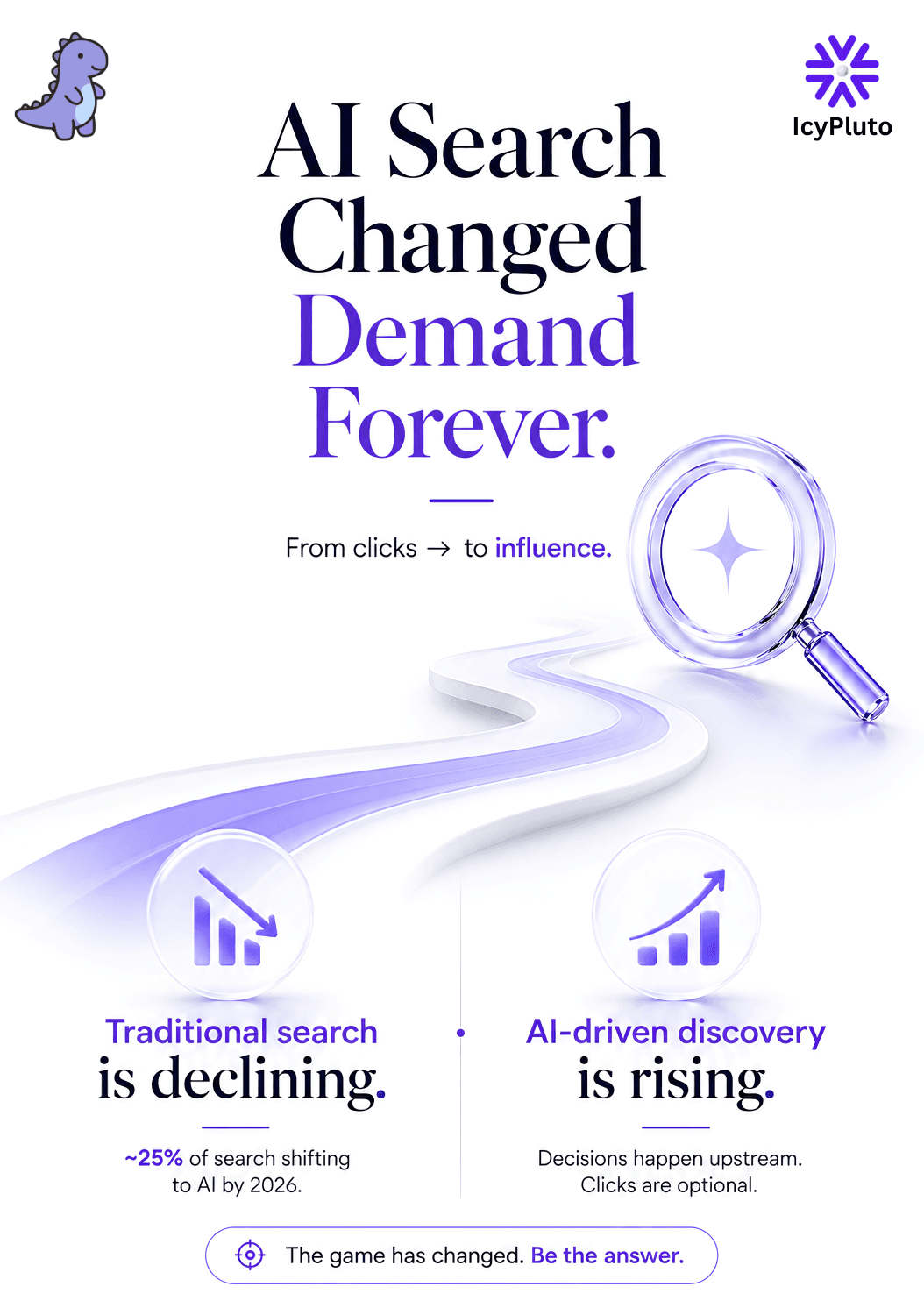
This blog explains why traditional, traffic-focuse...
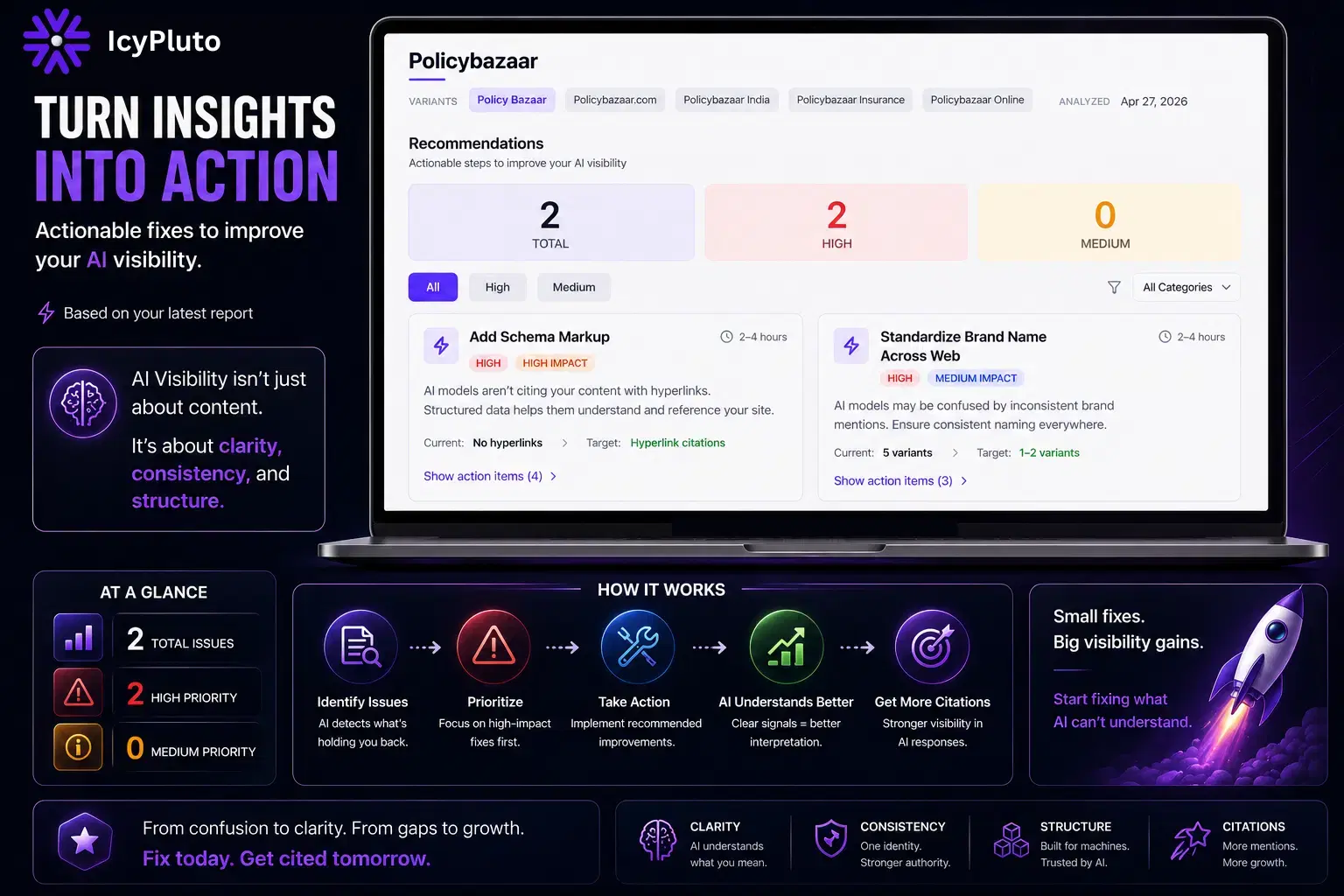
This blog explores how IcyPluto’s Action Feature h...
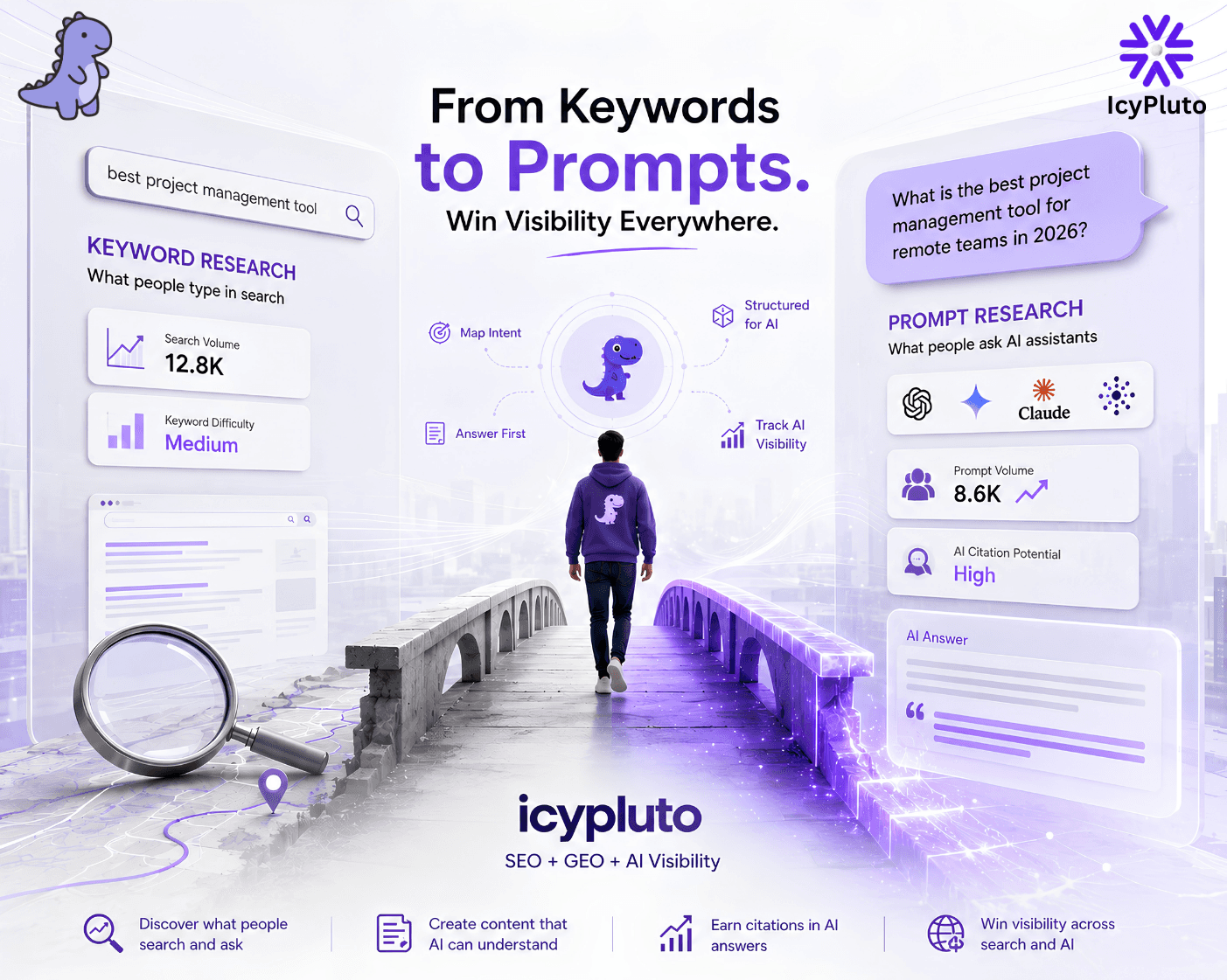
This blog explains how keyword research must now b...