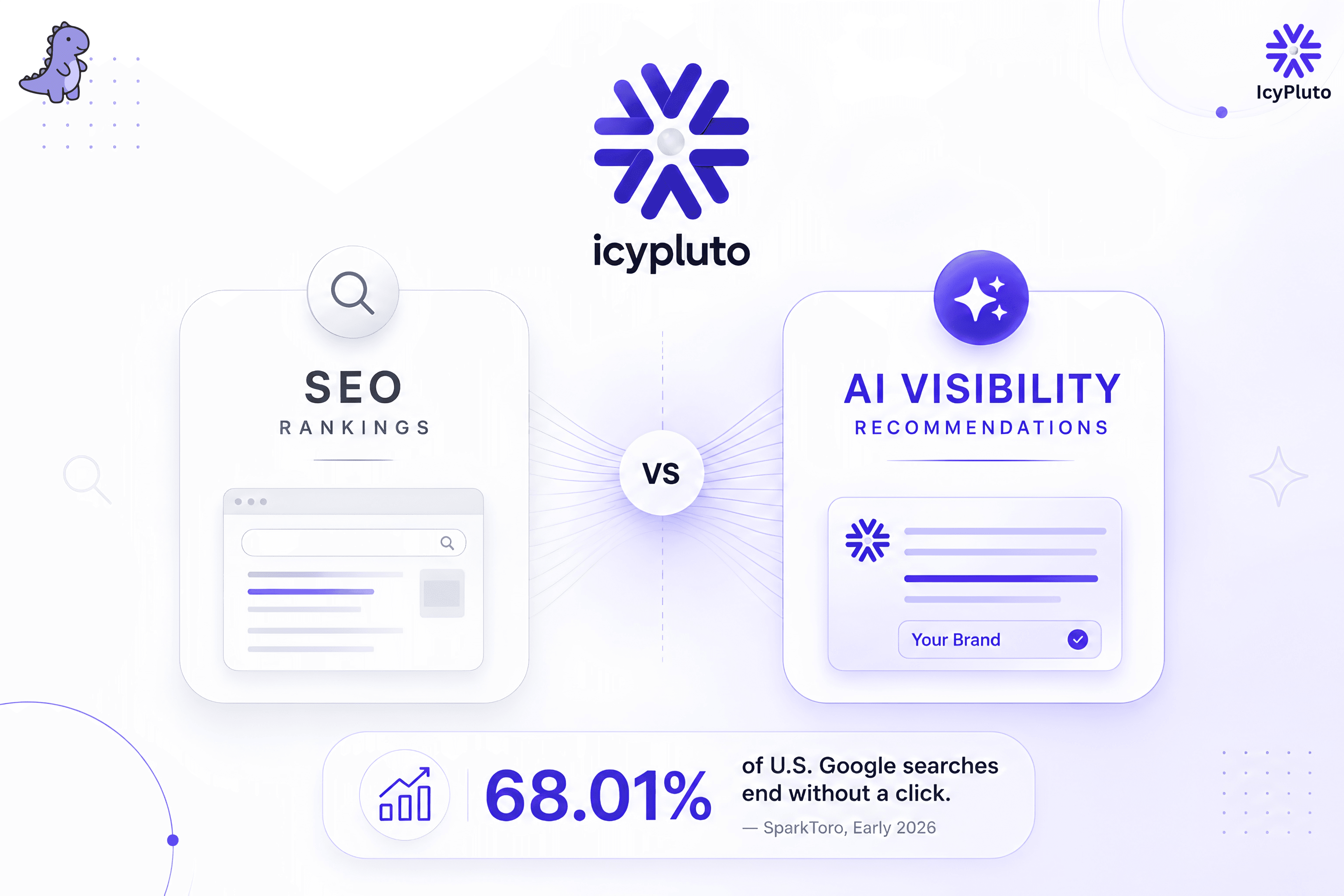
AI search is changing how brands get discovered, a...
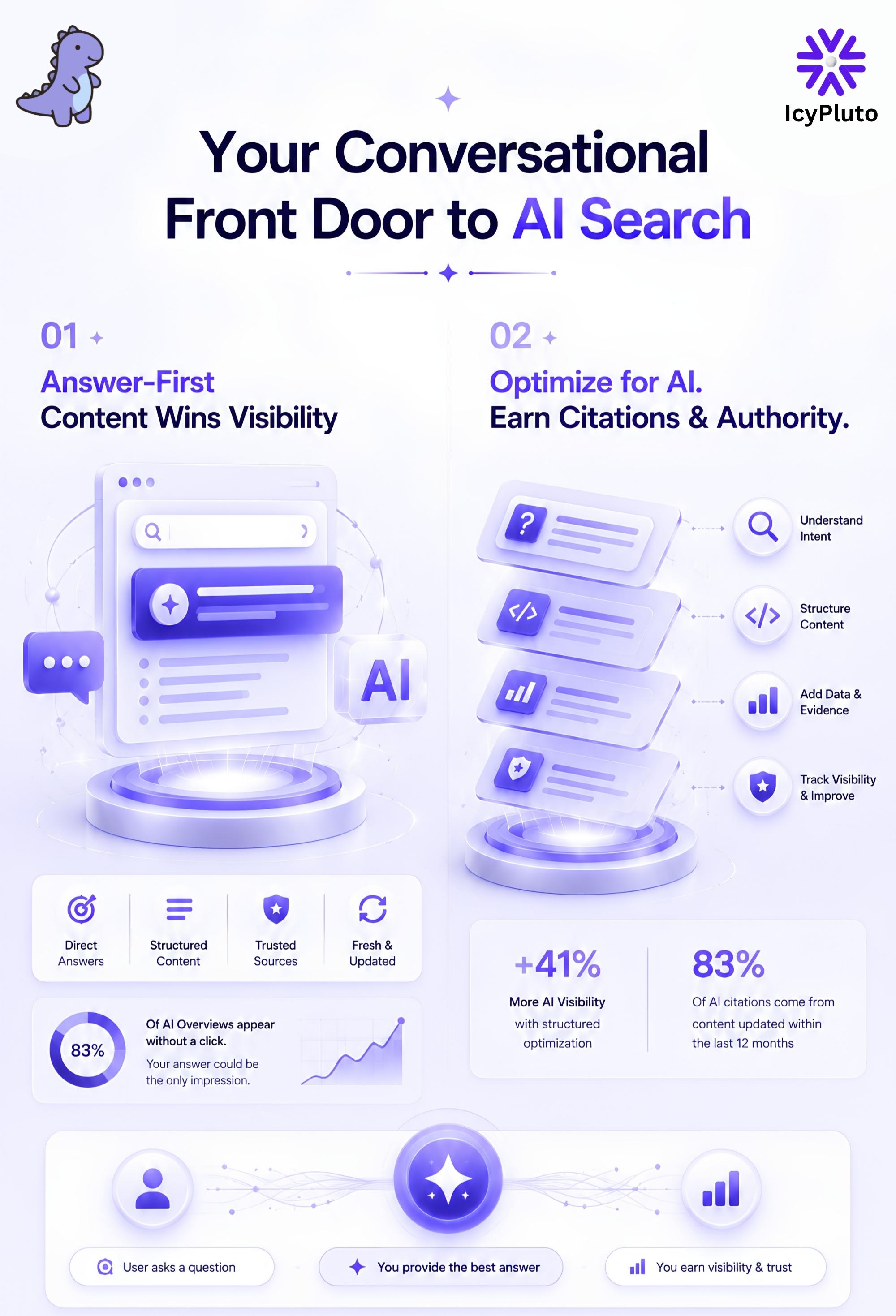
The way people search is changing fast, and conten...
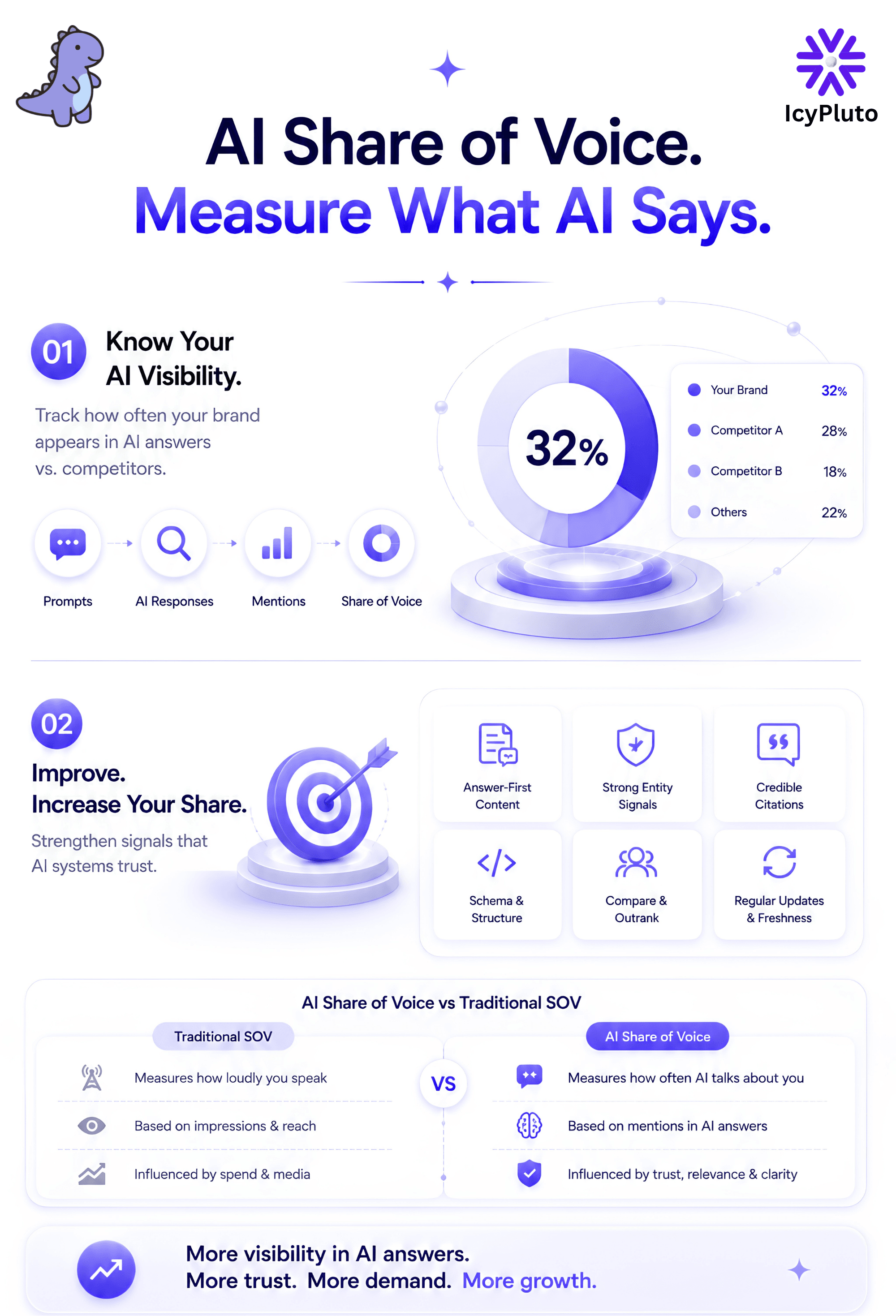
AI share of voice is the new visibility metric bra...
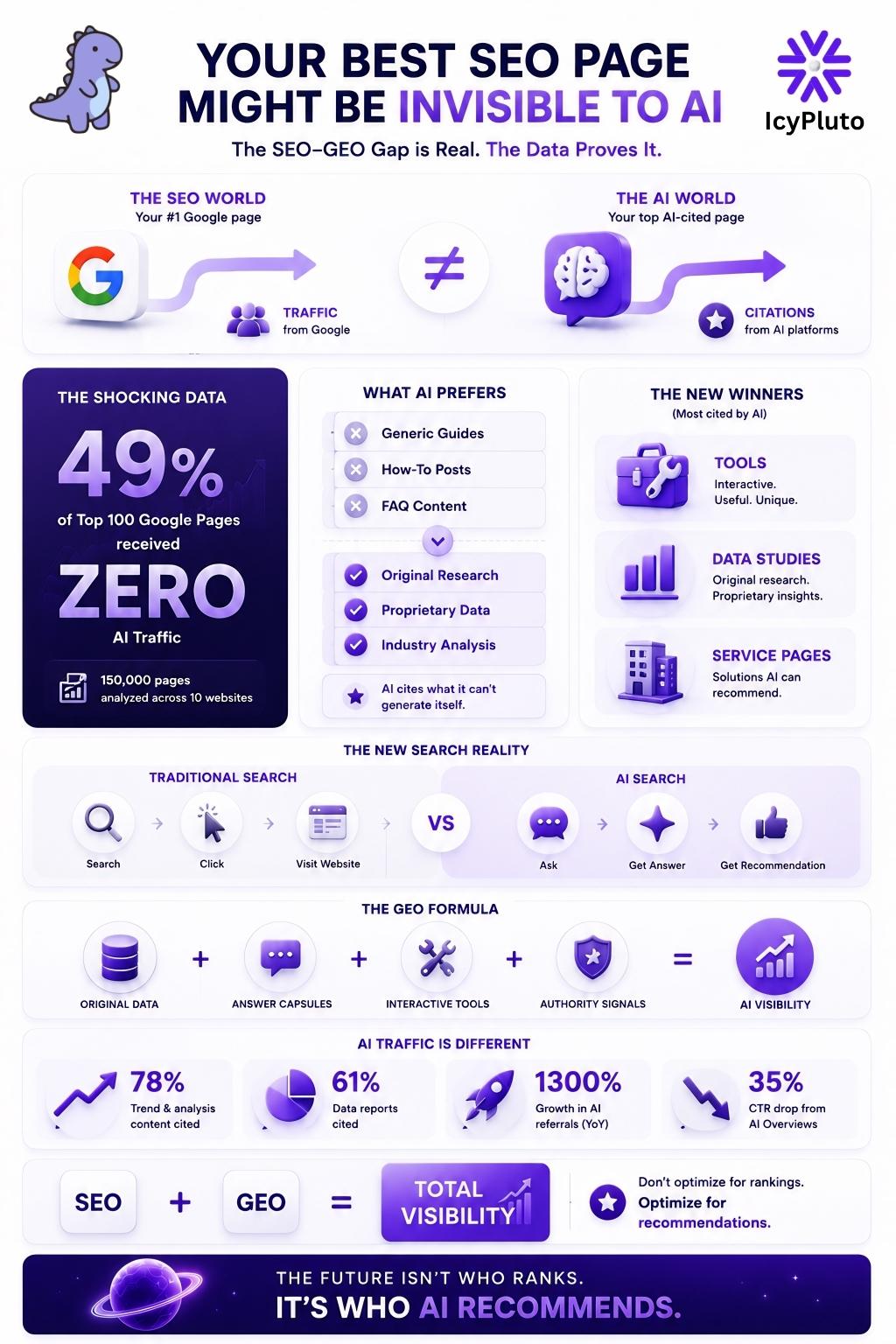
If you have spent years building a content strategy around traditional search engine optimization, you might be surprised to learn that your top-performing articles could be completely invisible to AI search engines. This is not a hypothetical problem. It is happening right now, and the data proves it.
A recent analysis of 10 websites and 150,000 indexed pages revealed something startling. The content that drives organic traffic from Google is not the same content that gets cited by large language models like ChatGPT, Claude, Perplexity, and Microsoft Copilot. In fact, nearly half of the top 100 organic pages in the study received zero traffic from AI platforms whatsoever.
This gap between traditional SEO success and AI search visibility is reshaping how brands need to think about content strategy. Let us explore what this means for your business and how you can adapt.
The term SEO stands for search engine optimization, which most of us know well. It is the practice of ranking higher in traditional search results from Google and Bing. GEO stands for generative engine optimization, which is the newer practice of optimizing content to be cited by AI-powered search engines and large language models.
The SEO-GEO gap refers to the significant difference between what performs well in traditional organic search versus what gets cited and recommended by AI search platforms. These are two different systems evaluating your content using different criteria. Optimizing for one no longer guarantees performance in the other.
Think of it this way. A page might rank number one in Google for a specific keyword but never appear in an AI-generated answer because the AI prefers different content patterns. The audience searching on Google is not identical to the audience asking questions to AI tools, and the content they need is not identical either.
Researchers analyzed GA4 data from 10 websites spanning healthcare, cybersecurity, technology, retail, education, and various B2B and B2C service verticals. The study captured sessions from ChatGPT, Claude, Perplexity, Copilot, and other major conversational AI platforms during a one-month window. Here is what they discovered.
Blog content theme predicted LLM traffic more reliably than almost any other variable. This is perhaps the most important finding for content marketers.
Educational comprehensive guides consistently underperformed compared to shorter posts built around unique data. Trends and analysis posts attracted LLM citations 78 percent of the time. Data-based year-in-review posts sat at 61 percent. Posts with unique proprietary data consistently dominated the LLM citation pool.
Meanwhile, educational how-to content sat at just 12 percent. This includes the SEO workhorse content that fills most content calendars. We are talking about guides, how-to posts, and top-of-funnel FAQs that have driven traffic for years.
If you produce authoritative, data-rich, measurement-oriented content, you are disproportionately likely to be in the LLM citation pool. If you produce generic educational content, odds are that you will not be. The reason is straightforward. Large language models can generate generic educational content themselves. They do not need to cite your blog post for information they can create from their training data. What they need is something they cannot generate themselves: original data, proprietary research, and owned insights.
The top 10 organic pages in this study captured 55 percent of organic sessions. Those same pages captured only 29 percent of LLM sessions. This is a dramatic difference.
Put another way, your best-performing organic content and your best-performing LLM content are likely not the same content. Among the top 100 organic pages, 49 had zero LLM traffic whatsoever. Nearly half.
LLM traffic is correlated with organic performance, but it is not simply organic performance re-labeled. A page that ranks number one in organic results for best practices for X may never get LLM traffic if nobody is asking an LLM about best practices for X. Content mapping for GEO means asking a different question than content mapping for SEO. Instead of asking what do people search for, you need to ask what do people ask an AI.
By raw session count, articles and blog posts still generated the most LLM referrals. But when viewing LLM sessions per 1,000 organic sessions, which is a fairer measure of relative performance, service and product pages outperformed everything else.
This is counterintuitive. Most marketers assume that blog content is their best asset for AI visibility. The data shows that service pages, product pages, and especially interactive tools are disproportionately cited by AI platforms relative to their organic traffic.
Your customers search everywhere. They ask ChatGPT for tool recommendations. They ask Perplexity for product comparisons. They ask Claude for service evaluations. Make sure your brand shows up in those conversations.
At first glance, average engagement time per session between organic and LLM traffic appears nearly identical. The study found 46.9 seconds for organic versus 47.1 seconds for LLM. But that average hides a fascinating statistical artifact.
On 71 percent of LLM-receiving pages, LLM sessions were notably shorter than organic sessions. On 27 percent of pages, LLM sessions were dramatically longer, often three to 10 times the organic average.
This split makes more sense when viewed by page type. LLM users appear more engaged on tools, homepages, and service or product pages but less engaged on articles. One possible explanation is that LLM users arrive at articles to verify or extract a specific piece of information before leaving. Tools and service pages give them something more actionable to evaluate, so they stay longer.
Among all page-type categories, interactive tools showed the highest per-page LLM citation rates in the study. Nearly all interactive tools were gathering at least some LLM sessions.
LLMs actively recommend specific tools by name when users ask about assessments, screeners, or evaluations. Any site with a functional, named tool, such as a calculator, screener, quiz, or configurator, should expect LLMs to route relevant queries directly to it.
If your site has a calculator, screener, assessment, or configurator, it is one of your best GEO assets and potentially more valuable per page than your entire blog archive. Make sure it has a clear, searchable name grounded in keyword research. Make sure it answers a specific question when someone arrives cold. Make sure it provides genuine utility.
Interestingly, 14 percent of all LLM-receiving pages in this study had zero organic clicks during the study window. This is a new category worth watching.
It is tempting to interpret this as evidence of some new discovery mechanism unique to LLMs. A more likely explanation is that these pages either rank poorly in organic search or lose clicks because AI Overviews answer the query directly in the search results page. AI Overview citations consistently underperform blue links on click-through rate, even compared to results near the bottom of the SERP.
Do not dismiss pages that receive LLM sessions with no organic clicks as noise. In this study, the engagement quality on those pages was among the highest recorded. Those users were specifically directed to you by an AI, and they showed up ready to engage. This is a new channel that did not exist two years ago.
The broader context matters here. As of 2024, nearly 60 percent of Google searches in the United States end without a click to an external website. This trend is particularly pronounced on mobile devices, where over 75 percent of searches are zero-click.
AI Overviews now appear in 7.6 percent of Google searches, indicating a significant shift toward AI-generated content in search results and user engagement. During the 2024 holiday season, AI search referrals for U.S. retail sites increased by 1,300 percent, and more time was spent on websites by such referrals, in addition to a 23 percent lower bounce rate.
The rise of zero-click searches, driven by AI's instant answers, is causing a decline in organic traffic and challenging traditional SEO metrics. Organic search traffic is down 2.5 percent year over year according to recent data, with the sharpest declines felt by mid-sized publishers ranked between the top 100 and 10,000 sites. AI Overviews appear in about 30 percent of queries, mostly informational ones, and their presence reduces click-through rate by approximately 35 percent.
At IcyPluto, we do not see SEO and GEO as competitors. We see them as complementary layers of a complete visibility strategy. Our approach is built on a fundamental insight: the brands that win in AI search will not be the brands that abandon SEO. They will be the brands that engineer their entire digital infrastructure to be understood by both traditional crawlers and modern language models simultaneously.
IcyPluto is the only agentic AI for marketing that tracks and implements GEO, AEO, and AI visibility across ChatGPT, Gemini, Claude, and more than 10 AI models. This is not analytics dressed up as optimization. This is systems-level intelligence that operates across the entire marketing stack.
Our GeoMax platform gives marketers the best AI SEO tools to get discovered where it matters most: inside AI-generated answers on ChatGPT, Gemini, and Claude. Traditional tools optimize for crawlers. GeoMax optimizes for language models. These AI SEO tools analyze semantic clarity, entity relevance, and citation signals: the exact factors AI engines use to pick their answers.
GeoMax evaluates your content across five key dimensions that AI engines use to rank trust:
Named Entities cover people, brands, and topics that AI maps to real-world knowledge. When your brand appears consistently across mentions, directories, and content, AI systems build stronger entity confidence.
Semantic Clarity measures how clearly your content communicates its core topic. AI systems need unambiguous signals about what you do and who you serve.
Contextual Relevance tracks alignment with real user query intent. Your content must answer the questions people are actually asking, not just the keywords they search.
AI-Ready Structure evaluates schema, formatting, and architecture that LLMs can parse. This includes Organization schema, FAQ schema, Article schema, Product schema, and Review schema.
Authority Signals monitor third-party mentions across Reddit, LinkedIn, and beyond. AI systems weigh external validation heavily when determining which sources to cite.
IcyPluto generates 1,000 plus tailored prompts and runs them across ChatGPT, Gemini, Claude, and Perplexity. In minutes you get a full AI Visibility Score, per-LLM breakdowns, and nine core metrics. This is not a single dashboard. This is a comprehensive diagnostic across every major AI search surface.
We surface entity gaps, citation sources, and competitive positioning. You see exactly which models overlook you and what signals are holding you back. This diagnostic phase reveals where your SEO strength does not translate to GEO visibility.
Every gap becomes a prioritized action plan across Content, Technical, Authority, and Social Proof, with current versus target metrics and step-by-step guidance. This is where IcyPluto differs from every other GEO platform. Most tools show you dashboards. We give you execution intelligence.
Re-run scans to track changes over time. IcyPluto shows deltas across all nine metrics so you can prove ROI from every improvement. This validation phase closes the loop and turns AI optimization into a measurable operational discipline.
Most AI visibility platforms suffer from one major flaw. They overwhelm users with dashboards but fail to provide execution intelligence. Marketing teams do not need more vanity metrics. They need prioritized fixes, impact analysis, AI-specific recommendations, workflow visibility, and action-oriented guidance.
IcyPluto's Action Feature solves this by categorizing recommendations based on severity, estimated impact, implementation time, and optimization category. This creates operational momentum. High-impact schema gaps become immediate priorities. Medium-impact naming inconsistencies become cleanup tasks. AI citation opportunities become strategic GEO initiatives.
The Action Feature identifies when AI models are unable to properly cite or understand content because structured data is missing. According to Google Search Central, schema markup significantly improves content comprehension for machine learning systems. Websites using structured data often see up to 30 percent higher rich-result visibility and improved contextual indexing. In AI search environments, schema becomes even more critical because language models rely heavily on entity clarity and semantic structure.
IcyPluto also detects brand name inconsistencies across the web. AI systems struggle with fragmented brand identities. If a company appears online as Policy Bazaar, Policybazaar, PolicyBazaar India, and PolicyBazaar Online, AI systems may treat these as separate entities. This weakens citation authority, entity trust, knowledge graph consistency, and AI confidence scores. Research from Semrush and Ahrefs shows inconsistent brand mentions can reduce local and semantic search trust significantly, especially for AI-assisted retrieval systems.
Many SEO tools provide data. Very few provide operational intelligence. IcyPluto's differentiation lies in converting AI visibility problems into execution-ready tasks. That creates several advantages.
Teams can immediately identify what is broken, why it matters, how much impact it has, and how quickly it can be fixed. This dramatically reduces decision-making friction and accelerates AI optimization cycles.
The Action Feature creates alignment between SEO teams, content teams, developers, brand managers, and GEO strategists. Everyone operates from a shared AI visibility framework. This cross-functional alignment eliminates the silos that traditionally slow down optimization efforts.
Instead of randomly optimizing pages, brands can focus on high-impact semantic fixes, AI citation improvements, structured data expansion, and entity consolidation. This prioritized resource allocation improves efficiency and ROI.
Every GEO platform right now says: Congrats, your AI visibility went up 3.7 percent. Meanwhile, IcyPluto says: Cool. We made AI recommend your brand before users even finished thinking. That is the difference.
Most GEO and AEO tools are AI-flavored analytics dashboards with fancy charts, prompt tracking, citation reports, and a little SEO remix. Cute. But AI search is evolving way faster than most platforms realize.
Because the future is not who ranks on Google. It is whom does AI trust enough to recommend instantly. And that is where IcyPluto is playing a completely different game. IcyPluto engineers discoverability, builds AI trust signals, shapes recommendation probability, and turns brands into default answers. Others are measuring the algorithm. IcyPluto is influencing it.
This is the real moat in the AI era. Because consumers are slowly shifting from let me search to let me ask AI. The moment that behavior becomes mainstream, most brands will realize they optimized for rankings while IcyPluto clients optimized for recommendations. One wins clicks. The other wins the conversation before clicks even happen.
Here is how IcyPluto brings SEO and GEO together in a single workflow. First, we run a comprehensive audit that evaluates both traditional SEO metrics and GEO-specific signals. This reveals where your organic strength does not translate to AI visibility.
Next, we identify your highest-leverage GEO opportunities. These are typically your interactive tools, service pages, and product pages that punch above their weight for AI traffic but underperform in your content calendar priorities.
Then we implement structural improvements across schema markup, answer capsules, entity standardization, and brand consistency. These are not content changes. They are infrastructure changes that make your entire site more AI-readable.
We build citations and authority signals through multi-channel publishing across LinkedIn, YouTube, Reddit, and Quora. This strengthens LLM trust and recommendation probability.
Finally, we track performance across all nine AI visibility metrics, including visibility score, share of answer, entity coverage, and model coverage. We show you deltas over time so you can prove that GEO investment drives measurable business outcomes.
Based on these findings, here is what the evidence indicates for effective generative engine optimization. These are not theoretical suggestions. They are tactics supported by real traffic data.
Generic educational content likely underperforms in LLM citations because LLMs are perfectly capable of producing it themselves. Original data, proprietary research, and owned insights are the strongest differentiators for LLM citation.
If you have a data asset, make it the centerpiece of your content. Even better, if budget allows, allocate resources to generating studies and identifying new, verifiable data. This is where you earn your citations.
Consider what your organization uniquely knows that no other organization knows. That could be customer data, industry benchmarks, internal research, survey results, or proprietary measurements. Package that data into content that answers specific questions with specific numbers.
In prior research across 15 domains and nearly 2 million sessions, answer capsules were the single strongest structural predictor of ChatGPT citations. An answer capsule is a concise, direct response to the core question of the page. It is placed early in the content, written in clean prose, free of internal links, and gives the LLM a clean, extractable unit to quote.
Pages with answer capsules have a 34.2 percent citation rate compared to 11.8 percent for pages without capsules. That is a 190 percent increase. Link-free capsules in the 40 to 60 word range perform best at 38.1 percent. Capsules with one or two links drop to 18.7 percent, which is 45 percent lower than link-free capsules.
LLMs pattern-match for the easiest, most direct answers. Give them what they want. The pages in this study that punched well above their organic weight class on LLM traffic tended to answer a specific question with specific data rather than explore a topic broadly.
The answer capsule formula is simple. Direct answer plus key context plus specific metric. Keep it 40 to 80 words. Use a factual tone. Place it immediately after an H2 or H3 heading. Over 90 percent of ChatGPT-cited capsules contain zero links.
If your site has a calculator, screener, assessment, or configurator, it is one of your best GEO assets. Make sure it has a clear, searchable name grounded in keyword research. Make sure it answers a specific question when someone arrives cold. Make sure it provides a useful service that people will remember and reference.
Interactive tools are an underappreciated LLM traffic category. LLMs actively recommend specific tools by name when users ask about assessments, screeners, or evaluations. This is not something you can fake with blog content. You need actual functionality.
Of the top 100 organic pages in the study, 49 pages had zero LLM traffic. That does not mean those pages are failing. It just means LLM citation and organic visibility are not a one-to-one correlation.
Track these as separate funnels. Treat the difference seriously. A page that ranks number one in organic results may never get LLM traffic. Content mapping for GEO means asking what do people ask an AI instead of what do people search for.
If you have pages that already receive LLM sessions with no organic clicks, do not dismiss them as noise. Those users were specifically directed to you by an AI, and they showed up ready to engage. The engagement quality on those pages was among the highest recorded in the study.
The overall picture derived from this data is not that GEO is replacing SEO. It is that GEO is rewarding a slightly different set of on-page tactics. Additionally, the gap between the two may be widening as zero-click search accelerates.
The sites that performed best with LLM traffic built content that answers precise questions with original information while keeping the page useful as a destination, not just a click. That has always been a good strategy. The difference now is that two separate systems are evaluating your content according to two separate sets of criteria.
GEO does not invalidate SEO principles. It extends them. The technical foundations of crawlability, relevance, and quality remain important, but how those foundations are expressed matters more than ever. AI systems favor clear, authoritative content that is easy to interpret. That increases the value of structured signals and verifiable expertise.
If you are planning content for the next quarter, here is what you should prioritize.
First, audit your existing content to identify which pages receive LLM traffic and which do not. You might be surprised to find that your highest-traffic blog posts get almost no AI citations while your obscure tool pages get steady LLM referrals.
Second, shift your content production toward original data and proprietary research. Instead of another comprehensive guide to X, create a study that measures X with real numbers. Instead of another how-to post, create analysis based on proprietary benchmarks.
Third, add answer capsules to your key pages. This is a small structural change with massive impact. Every page you want cited should have a 40 to 80 word answer block positioned after a heading, written in clean prose without internal links.
Fourth, invest in interactive tools if you do not have them. A well-named calculator or screener can outperform your entire blog archive for AI visibility.
Fifth, track conversions and deeper funnel impact, not just traffic. Traffic is no longer the north star. Focus instead on conversions, sentiment, and your brand's visibility inside generative results.
Your customers search everywhere. They use Google. They ask ChatGPT. They query Perplexity. They consult Claude. They check Microsoft Copilot. If your brand only shows up in one of these places, you are missing most of the conversation.
The SEO-GEO gap is real, measurable, and widening. Traditional SEO content strategies do not work well for AI search. Organic success does not guarantee AI traffic. But the good news is that you do not need to rewrite your entire SEO playbook. With smart tweaks focused on original data, answer capsules, interactive tools, and separate tracking, you can shift toward GEO and reclaim your share of search in the age of generative AI.
The sites winning in AI search are not the ones with the most content. They are the ones with the most authoritative, data-rich, answer-first content. They are the ones that make it easy for AI systems to extract and cite their information. They are the ones that understand that visibility inside AI-generated responses, not just clicks, is now a strategic objective.
If you start optimizing for GEO today, you gain a competitive advantage. By optimizing for entity clarity and credible signals, you increase the chance of being surfaced as a trusted source in AI responses. Marketers who move early on GEO will be the ones defining what visibility looks like in the next generation of search.
The question is not whether AI search will continue to grow. It already grew 1,300 percent during the 2024 holiday season alone. The question is whether your brand will be visible when your customers ask AI assistants for recommendations, comparisons, and answers.
Make sure the answer is yes. With IcyPluto, that visibility is not just possible. It is operational, measurable, and scalable. Visit icypluto.com before your competitors become the default answer AI keeps mentioning.