This blog reveals what a massive 37,804 AI respons...
This blog reveals how to maximize visibility in tr...
This blog explores the marketing gaps holding back...
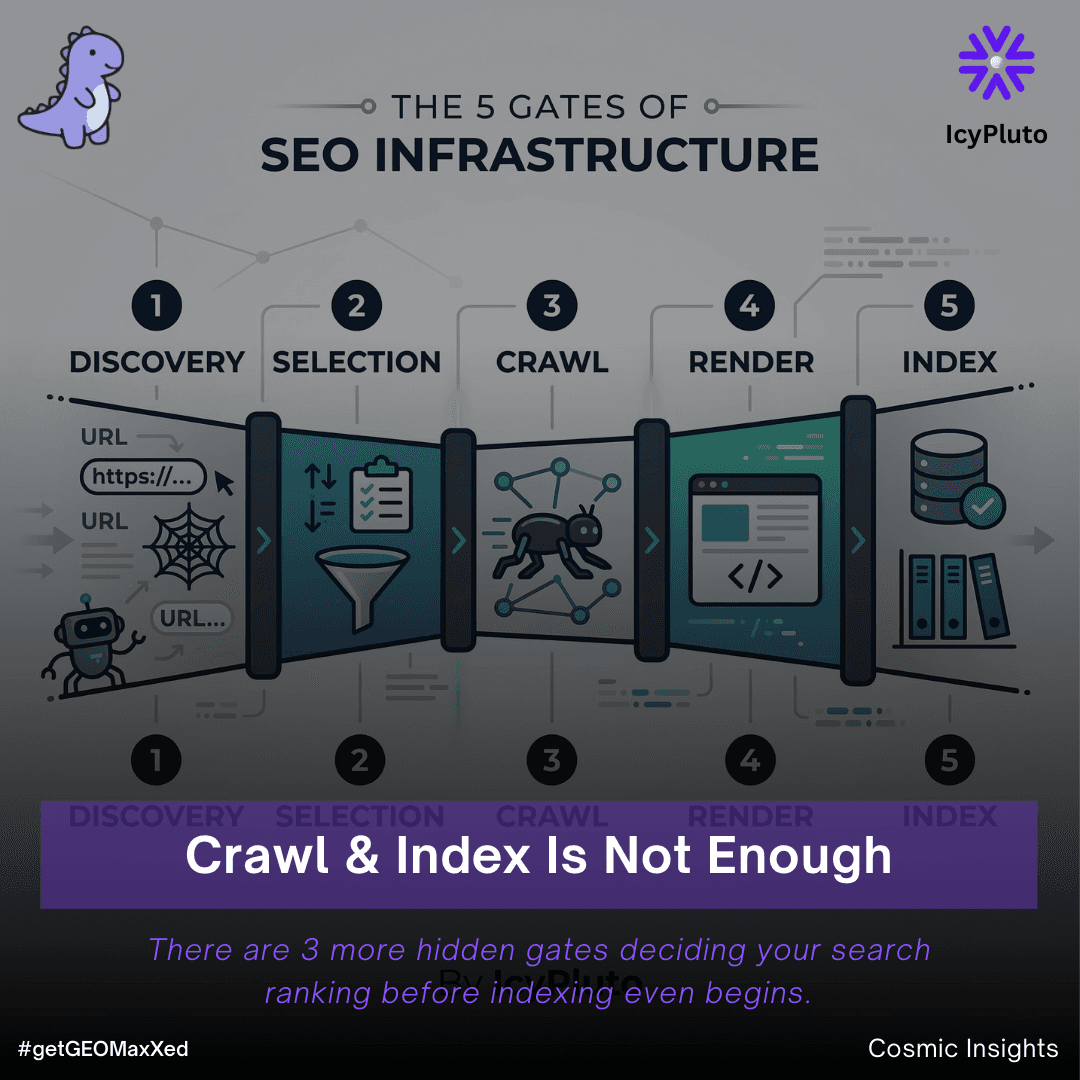
Every SEO professional has heard the phrase "crawl and index" like it's a sacred mantra. But what if that two-word framework has been quietly hiding the most important technical decisions your website makes every single day? The truth is, between your content and a successful AI or search engine recommendation, there are five distinct infrastructure gates — and failing even one of them can silently wreck everything you've worked so hard to build.
At IcyPluto, where we're redefining what it means to be the world's first AI CMO through our COSMOS framework, we believe marketers and SEO practitioners need to stop oversimplifying. The pipeline isn't just "crawl and index." It's discovery, selection, crawling, rendering, and conversion fidelity — five separate checkpoints, each with its own failure mode, its own opportunity, and its own impact on how much confidence your content carries forward.
This guide breaks each gate wide open, shows you what's happening under the hood, and explains why fixing the right gate — in the right order — is the difference between a site that thrives and one that quietly disappears from search results.
The phrase "crawl and index" has become one of the most dangerous oversimplifications in digital marketing. It suggests there are only two things that matter: whether a bot visited your page and whether your page got stored. But that framing collapses five distinct processes into a single checkbox, and each of those five processes can fail independently.
Think of it this way — if your site can't be discovered, fixing your rendering is completely wasted effort. If your content is crawled but renders poorly, every process downstream inherits that degradation. The pipeline isn't forgiving. It's sequential, and every gate's output becomes the very next gate's input.
The industry has been so focused on the gates it already understands — crawling and indexing — that it's been routinely ignoring the three other gates that silently determine how much signal your content carries forward. The result? Websites that look perfectly optimized on paper but underperform in AI-driven search environments because degradation happened somewhere upstream that nobody thought to check.
One useful mental model: better to be a straight-C student than someone with three As and an F. Because the F — the failed gate — is what kills your pipeline. The strongest content in the world can't rescue itself from a discovery failure it never knew it had.
Most SEOs jump straight to crawling. But before a bot ever fetches your page, two critical decisions have already been made: has your content been discovered, and has the system decided it's worth selecting for a crawl?
Discovery isn't passive. Three active mechanisms feed it: XML sitemaps, IndexNow (a push-based notification protocol), and internal linking architecture. Together, these tell search systems what exists on your site and give them a reason to care.
But there's a layer beneath the mechanics that most people miss. When a system discovers a URL, it doesn't just ask "does this page exist?" It asks "does this page belong to an entity I already trust?" Content that isn't clearly associated with a recognized entity arrives like an orphan — unattached, unvalidated, and placed at the back of the queue.
This is where brand authority stops being a marketing concept and becomes a technical SEO variable. If the system doesn't have enough confidence in who you are, your newly published content waits. If it does, your pages move to the front of the line.
The push layer changes the economics of this gate entirely. Instead of waiting for bots to find you on their schedule, protocols like IndexNow let you announce your content the moment it's published. It shifts your site from reactive to proactive — and in competitive niches, that timing difference can determine which version of a story gets indexed first.
Selection is the gate almost nobody talks about — and it might be the most consequential one before rendering. It's essentially the system forming an opinion of you, expressed as crawl budget.
Here's the part that flips the conventional wisdom on its head: more pages doesn't mean more traffic. In a pipeline model, the opposite is often true. Fewer, higher-confidence pages get crawled faster, rendered more reliably, and indexed more completely. Every low-value URL you're asking the system to process is effectively a vote of no confidence in your own content — and the system notices.
Selection isn't binary either. The bot assesses the expected value of a destination page before it commits to fetching it. If the estimated value of visiting that URL falls below an internal threshold, the page gets skipped — not penalized, just quietly ignored.
The internal linking architecture plays a role here that goes far beyond crawl pathways. When a bot follows a link to your page, it carries context from the referring page with it. Your links aren't just roads — they're briefings. They tell the bot what to expect when it arrives, shaping both selection probability and interpretation quality before rendering even begins.
After a page is crawled, the system attempts to build it. It constructs the Document Object Model (DOM), executes JavaScript when it deems the investment worthwhile, and produces a rendered version of the page. What varies wildly across different sites — and different bots — is how much of your published content actually survives that rendering process.
This variable is called rendering fidelity: the percentage of your content that the bot actually sees after attempting to build your page. Content hidden behind client-side JavaScript that the bot never executes isn't degraded — it's simply gone. And information the bot never sees cannot be recovered at any downstream gate, no matter how strong your content quality is.
The bot's willingness to invest computational resources in rendering your page isn't uniform. It depends heavily on how familiar the pattern of your site is. The more common a framework or CMS, the less friction the bot encounters — and the more reliably your content gets seen.
Here's how the rendering friction landscape breaks down:
Platform/ApproachFriction LevelWhyWordPress + Gutenberg + Clean ThemeLowestPowers 30%+ of the web; the bot has maximum pattern confidenceWix, Duda, SquarespaceLowKnown templates; predictable structureWordPress + Elementor or DiviMediumExtra markup noise; harder to extract core contentCustom code (clean HTML5)Medium-HighBot can't validate against a known pattern libraryCustom code (imperfect HTML5)HighDegraded signals; the bot is essentially guessing
The critical point here is that publisher entity authority also plays a huge role. If a site isn't considered important enough based on its established entity authority, the bot may never reach the rendering stage at all. The cost of parsing unfamiliar code exceeds the estimated benefit of obtaining the content — and the system moves on.
For years, the SEO industry quietly relied on Google and Bing rendering JavaScript and assumed that was the standard. It isn't. Most AI agent bots fetch initial HTML and work with that. Smaller, newer AI bots have no rendering infrastructure whatsoever.
The practical consequence is severe: a page that loads a comparison table via JavaScript shows a fully interactive experience to human visitors but presents an empty container to bots that don't execute JS. The bot then annotates the page based on an empty space where your best content should have been.
The solutions worth prioritizing are: server-side rendering (SSR), static site generation (SSG), WebMCP (which gives agents direct DOM access, bypassing the rendering pipeline entirely), and Markdown for Agents (which serves a pre-simplified content version when a bot identifies itself). Both advanced options change the rendering economics in the same way push discovery changes the discovery economics — they replace a lossy process with a clean, high-fidelity one.
A simple test to benchmark where you stand: disable JavaScript in your browser and look at your page. What you see is what the majority of AI agent bots see.
Rendering and indexing are often treated as the same thing. They aren't. Rendering determines what the bot saw. Conversion fidelity determines how accurately the system preserved what it saw when filing it away. Both can fail independently, and both failures are irreversible.
When the system processes your rendered DOM into its internal format, it follows a sequence that most SEOs have never mapped:
Strip: Repeating elements — navigation, headers, footers, sidebars — are removed and stored at a site or category level, not per page. The system's goal is to isolate core content. Semantic HTML5 tags like <article>, <main>, <section>, and <aside> are critical here. Without them, the system has to guess where your core content begins and ends — and guessing introduces error.
Chunk: The core content is broken into typed segments: text blocks, images with associated text, video, audio. The page becomes a hierarchical structure of typed content chunks. This is why content structure matters beyond readability — it directly determines how cleanly your content survives decomposition.
Convert: Each chunk is transformed into the system's proprietary internal format. Semantic relationships between elements are most vulnerable at this stage. Anything the conversion process doesn't recognize gets discarded permanently.
Store: Converted chunks are stored in a hierarchical wrapper structure. Each page inherits topical context from its parent category. A page at /seo/technical/rendering/ arrives at annotation with three layers of established topical context. A page at /blog/post-47/ arrives with one generic layer. That inherited context shapes how every downstream algorithm interprets and ranks your content.
Here's a critical distinction that the industry has almost entirely missed: indexing and annotation are separate processes. A page can be indexed — stored successfully — and still be poorly annotated, meaning it's semantically misclassified.
A page can appear in index coverage reports, get recruited by algorithmic processes, and still be misrepresented in AI responses because the annotation was built on a degraded rendering or a poorly structured conversion. The page is there. The system read it. But it read a compromised version and filed it in the wrong drawer.
This is why URL structure, breadcrumbs, and meta descriptions matter beyond the conventional SEO rationale. Breadcrumbs validate that a page's position in the URL hierarchy matches its physical structure — match equals confidence, mismatch equals friction. Meta descriptions, when they match the system's own summary of the page, create a confidence signal that carries forward into annotation. When they diverge, it's not a penalty — but it's a missed reinforcement opportunity.
Understanding all five gates is powerful. But the most sophisticated SEO move isn't just optimizing each gate — it's skipping gates entirely, and understanding how the system allocates computational investment across each one.
The industry built an entire sub-discipline around crawl budget. That matters, but once you see the full pipeline, you realize crawl budget is just one example of a general principle: every gate consumes computational resources, and the system allocates those resources based on expected return.
There's a separate budget at each gate — crawl budget, fetch budget, render budget, chunking and conversion budget, annotation budget. Each is governed by publisher entity authority, topical authority, technical complexity, and the system's own ROI calculation against everything else competing for the same resource.
The system isn't just deciding whether to process your content — it's deciding how much to invest. A site might be crawled but rendered cheaply, or rendered fully but chunked lazily, or chunked carefully but annotated shallowly. Every gate is a resource decision, not a binary pass/fail switch.
Structured data has attracted three camps of misunderstanding: those who treat it as a magic bullet, those who use it as a band-aid over broken pages, and those who ignore it entirely. None of these positions is accurate.
Structured data works because it requires no rendering, interpretation, or language model to extract meaning. It arrives in a format systems already speak natively — explicit entity declarations, typed relationships, canonical identifiers. When the system crawls your page, schema markup is processed before unstructured content because it's machine-readable by design.
The key principle: structured data confirms what the system already suspects. It reduces ambiguity and builds confidence. But it only works if it's consistent with the page content. Schema that contradicts the page doesn't just fail to help — it introduces a conflict the system must resolve, and that resolution rarely favors the markup.
The value of schema is also shifting. AI systems are increasingly reliable at inferring what schema used to need to declare explicitly. But that makes structured data more targeted, not obsolete — it matters most precisely where the system's own inference is weakest.
The multiplicative nature of the pipeline means every gate you skip doesn't just remove one failure risk — it removes that gate's attenuation from the equation permanently. A brand that navigates all five gates with a 70% confidence score at each enters the competitive phase with roughly 17% of its original signal intact. A brand that skips four gates via a direct product feed enters with 70%. A brand connected via MCP (direct agent data) enters with 100%.
The competitive phase hasn't started yet, and the gap is already that wide.
Here's what the entry approaches look like in practice:
ApproachGates AffectedEntering Competition WithStandard crawlNone skipped~17%Schema markupIndexing improved~18%WebMCPRendering skipped~24%IndexNowDiscovery skipped~26%IndexNow + WebMCPDiscovery + Rendering skipped~37%Product Feed4 gates skipped~70%MCP (direct agent data)All 5 gates skipped~100%
There's a clear progression here: each rung skips more gates, removes more exclusion risk, and eliminates more potential attenuation before competition even begins. A brand with a direct MCP connection is playing a fundamentally different game from a brand still waiting for a bot to discover its product pages.
At IcyPluto, we're not just talking about these principles — our COSMOS framework is built around the idea that AI-driven marketing requires infrastructure-level thinking, not just content-level optimization.
COSMOS understands that brand authority isn't a soft marketing metric — it's a technical SEO variable that determines rendering investment, selection probability, and annotation quality. The brands that win in AI-powered search are those that have engineered maximum confidence at every gate, and those that have identified where gate-skipping delivers the greatest competitive leverage.
The five infrastructure gates aren't a checklist. They're a pipeline. And pipelines reward the teams that understand every valve, not just the two everyone talks about.
Make your content frictionless for bots, and irresistible for algorithms — because in today's AI-first search environment, those two goals are the same goal.