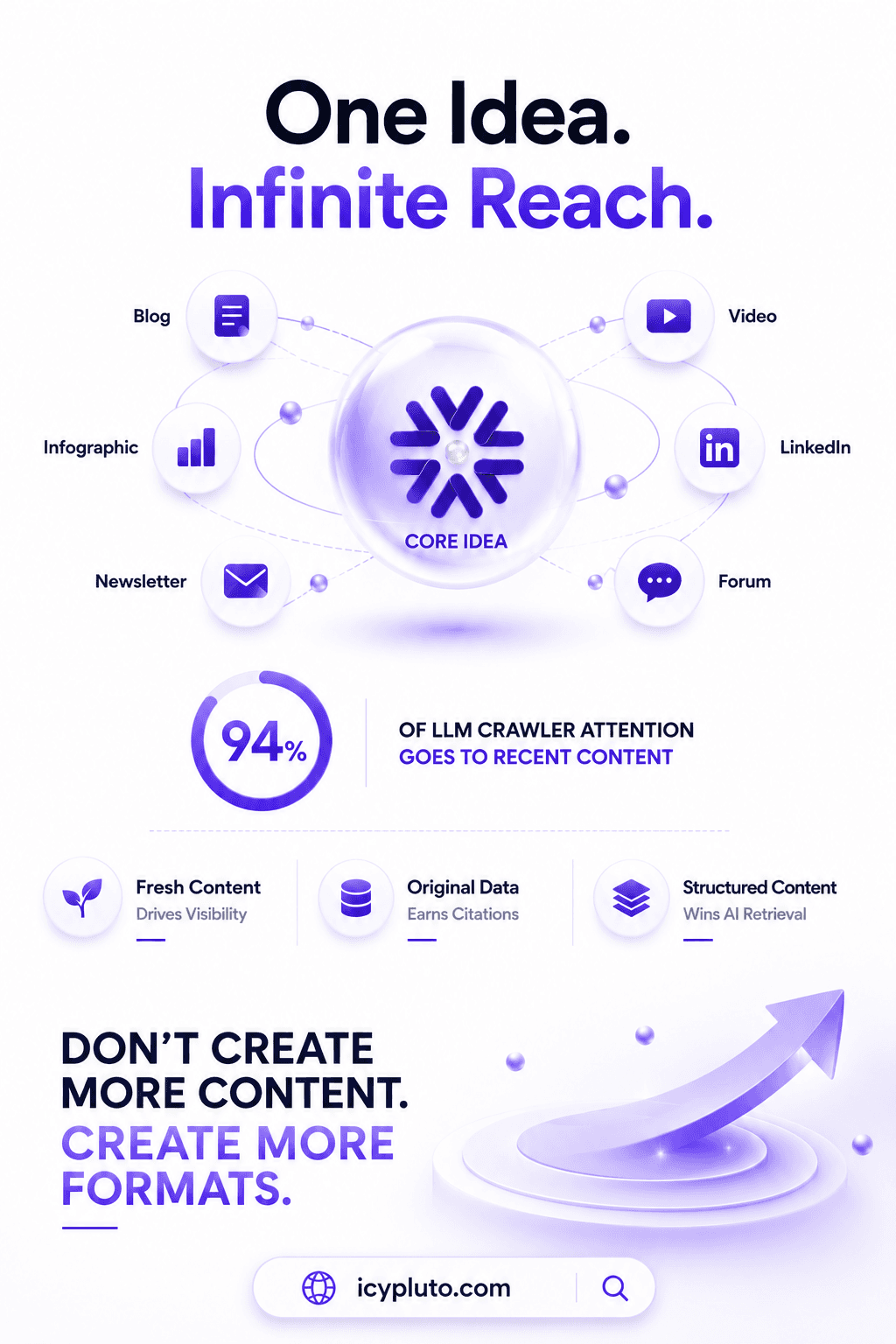
This blog reveals how to maximize visibility in tr...
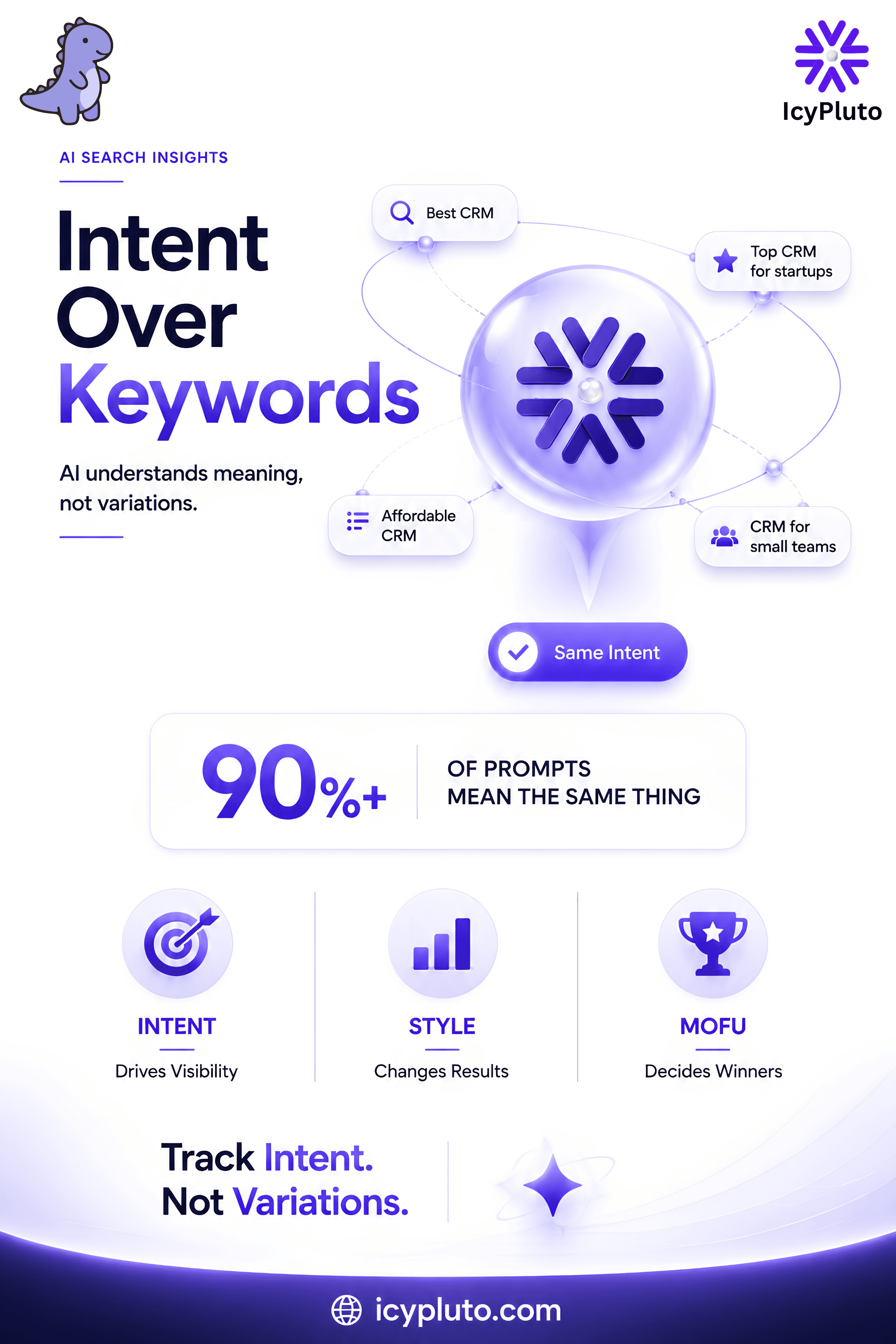
This blog reveals what a massive 37,804 AI respons...
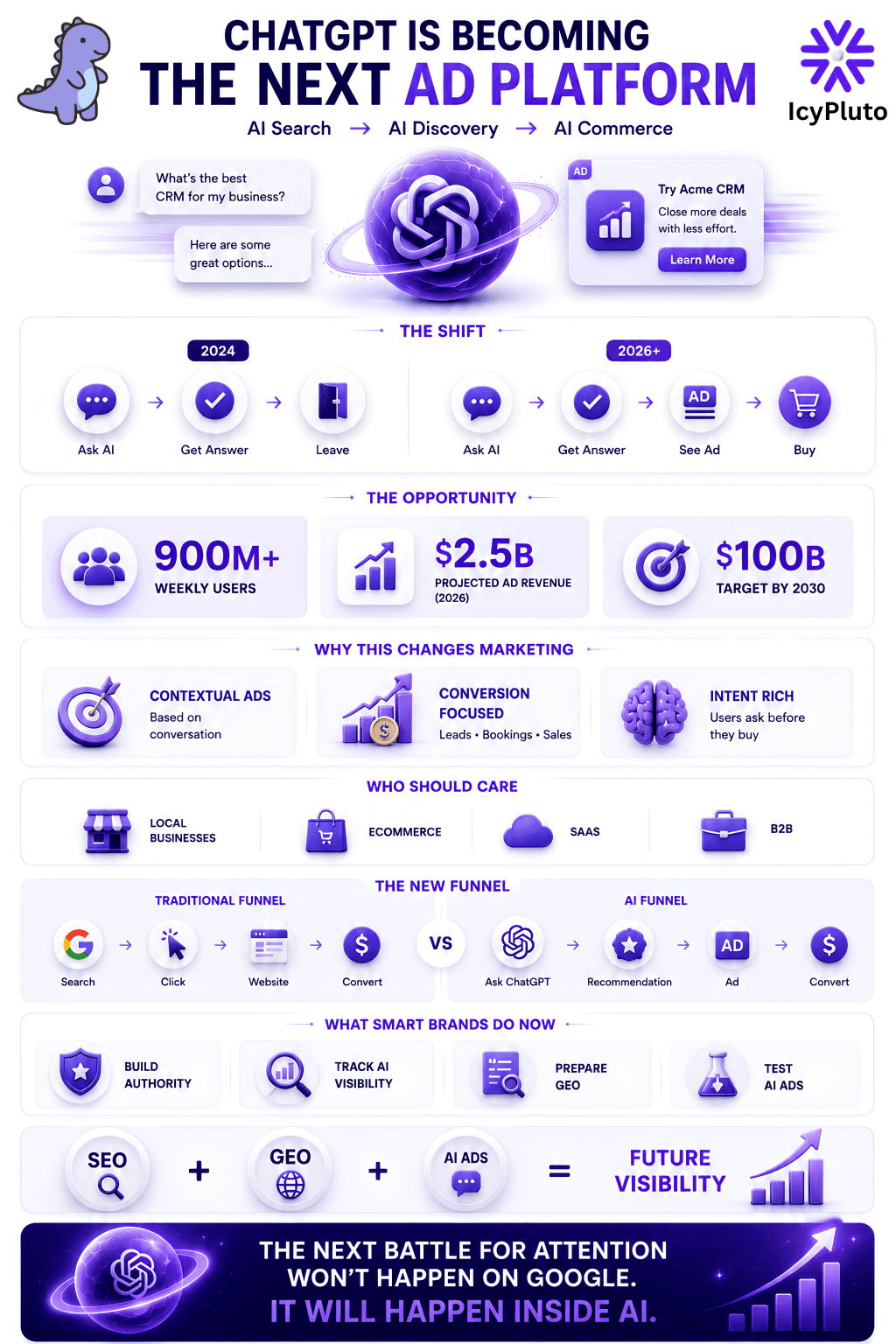
This blog post explores OpenAI's groundbreaking la...
For years, marketing leaders have chased one dream — moving at the same speed as the consumer. Responding to customers in real time, delivering personalized messages at just the right moment, and maximizing customer lifetime value to build loyalty while driving a measurable return on investment. The goal itself is nothing new. What keeps changing is the technology that promises to make it finally achievable.
Artificial intelligence tools today are more powerful than ever. They can scan vast consumer data lakes, generate personalized content at massive scale, and activate campaigns across channels within seconds. Yet despite all of this technological advancement, the overwhelming majority of marketing teams are still stuck. They are unable to harness these capabilities freely, decisively, or at the speed the market now demands.
The reason, perhaps surprisingly, has very little to do with technology. The real bottleneck sits in the org chart. It lives inside the team structure, the approval chains, and the cultural habits that haven't evolved alongside the tools that marketing teams have been handed. This is the central insight delivered by McKinsey's "Organize to Value" framework — and it has profound implications for where marketing is heading next, particularly for teams ready to embrace what is now being called Positionless Marketing.
At IcyPluto, where our entire mission is to push the boundaries of how AI reshapes the CMO function and marketing operations, this framework speaks directly to what we see happening across the industry. The transformation to positionless marketing isn't just a trend — it is becoming the standard for brands that want to compete and win.
Here is a truth that nobody in the industry loves to say out loud: buying AI capabilities is the easy part. Enabling a marketing team to actually use those capabilities — independently, decisively, and at scale — is an entirely different challenge.
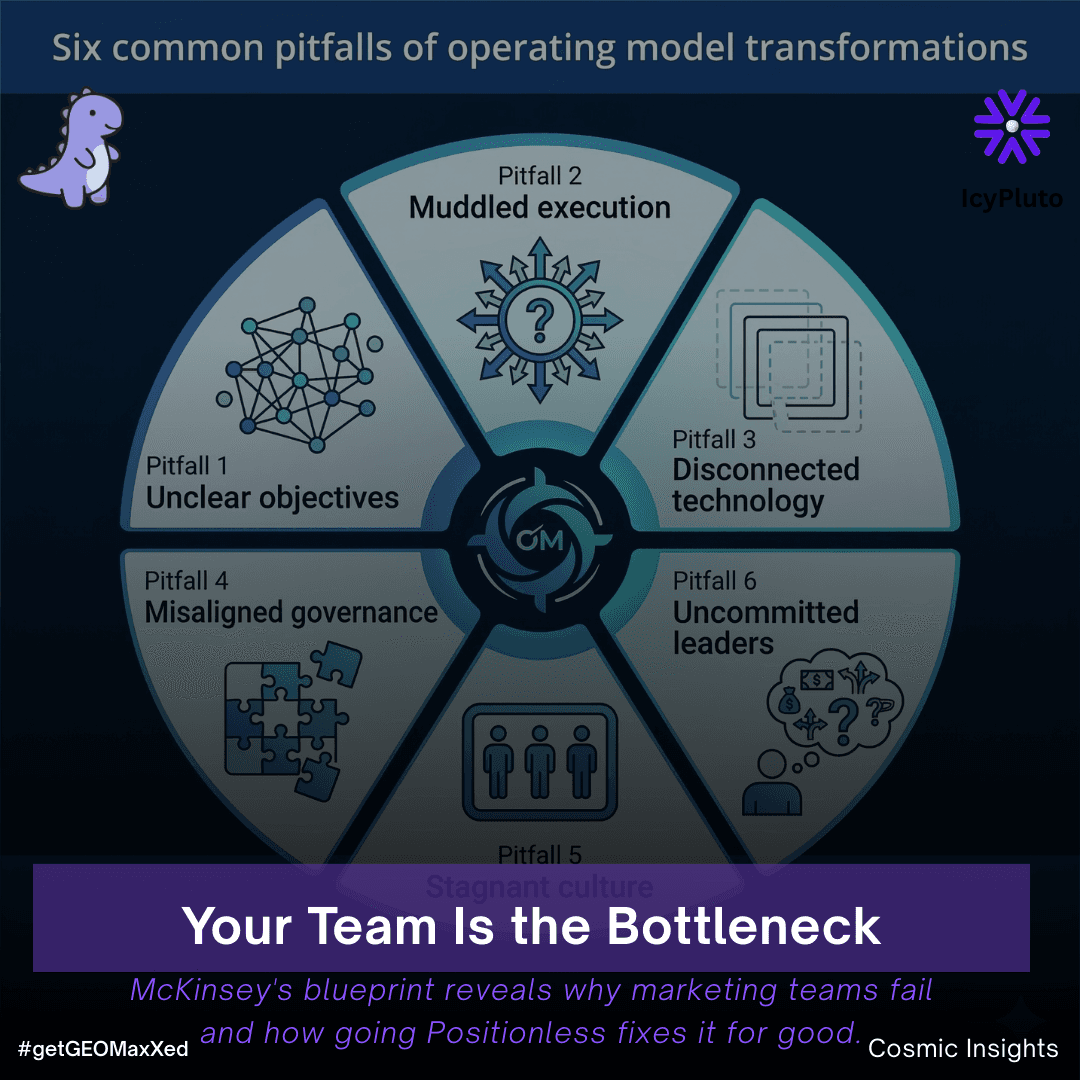
McKinsey's analysis points to six core problems that consistently prevent marketing organizations from making this evolution. Strikingly, only one of them is related to technology. The other five are deeply human and organizational in nature.
Unclear objectives are perhaps the most damaging. When a marketing team is operating without clear outcome-based goals, execution gravitates toward activity metrics — how many campaigns went out, how many emails were sent — rather than toward impact. Vague goals translate to role-based handoffs. Role-based handoffs translate to slow, fragmented execution. In today's marketing environment, that speed gap is lethal.
Misaligned governance is the second culprit. Excessive approval layers add days — sometimes weeks — to decisions that could and should happen in minutes. For a marketing function trying to respond to real-time behavioral signals from customers, bureaucratic governance structures don't just slow things down. They fundamentally break the loop between insight and action.
Uncommitted leadership makes things worse. When leaders manage through silos rather than designing for autonomy, they prevent their teams from ever moving beyond role-based dependencies. Marketers end up waiting — waiting for a designer, waiting for an analyst, waiting for an engineer — rather than executing.
Cultural stagnation is another barrier that deserves serious attention. Even when organizations invest in the right tools and the right people, a culture that resists experimentation will always throttle execution speed. Fear of failure, attachment to process, and comfort with the status quo act as invisible anchors that no technology investment can lift.
Muddled process ownership means nobody is truly accountable for end-to-end outcomes. When responsibility is diffused across roles and sub-teams, performance erodes. Nobody owns the result; everybody owns a piece of the activity.
And finally, disconnected technology — the only truly tech-related pitfall — reinforces data silos and separates execution across sub-teams in ways that make coordinated, agile responses virtually impossible.
Taken together, these six pitfalls describe what most marketing organizations still look like today: an assembly line. Insights sit with analysts. Creative decisions live with designers. Activation depends on engineers. Value gets lost in every gap between these roles. As management visionary Peter Drucker once articulated, the fundamental purpose of any business is to create and keep a customer. The assembly-line model was built for control — never for customer value.
Positionless Marketing is a framework built on a straightforward but powerful idea: every marketer on a team should be empowered to execute any marketing task — independently, instantly, and end to end — without being locked into a fixed role or dependent on another team member to complete the work.
This is a significant departure from how most marketing operations are structured. In a traditional setup, a campaign idea might originate with a strategist, get passed to an analyst for audience targeting, handed off to a designer for creative development, queued up with an engineer for technical execution, and then reviewed again before any activation happens. Even with modern marketing technology in place, that workflow might take five days, five weeks, or longer depending on the organization.
In a Positionless Marketing model, a single marketer can drive a campaign from ideation through execution through analysis — not because they are doing every specialist's job, but because the platform, the data, and the organizational design are aligned to give them that autonomy.
The results this model produces are hard to argue with. Caesars Entertainment is a compelling example. Before restructuring their approach, their marketers were manually building targeting lists across disconnected systems, coordinating across multiple platforms, and waiting on engineers, analysts, and creative teams before a single campaign could launch. The entire operation was too slow to reach players with the precision and timing the market demanded.
After consolidating data, orchestration, and execution into a unified platform and rebuilding their team structure around Positionless Marketing principles, Caesars reduced their campaign execution time from five days to five minutes. Their VP of Player Revenue Strategy described it as a transformation that made marketing not just more efficient, but more genuinely responsive to what customers actually need in the moment.
That is what Positionless Marketing looks like in practice — and it is what McKinsey's Organize to Value framework provides the strategic scaffolding to build.
McKinsey's Organize to Value framework is fundamentally a call to redesign organizations around value creation rather than around job titles, approval structures, or inherited workflows. For marketing specifically, it means creating the conditions under which every member of the team can deliver customer value continuously — not just when their particular function is called upon in the workflow sequence.
Applying this framework to the journey toward Positionless Marketing involves five actionable priorities.
The shift begins with being explicit about why actions are being taken, not just what is being delivered. When a team has a genuinely shared sense of purpose — around outcomes like customer lifetime value, loyalty, or measurable ROI — individual marketers can make fast decisions without waiting for sign-off at every step. Purpose becomes the decision-making shortcut that replaces the approval chain.
The next step is mapping current processes with an honest eye toward where approvals are adding friction without adding value. The goal is not to reorganize overnight — that creates chaos rather than clarity. Instead, the focus should be on incrementally building cross-functional flexibility, giving marketers room to step across traditional role boundaries, and holding people accountable to outcomes rather than to tasks.
Marketing leaders need to establish a clear, visible decision-to-execution flow and set explicit expectations for how fast each phase of the marketing process should move. This is not about eliminating oversight — it is about designing processes that enable flow rather than enforce control. When leadership models speed, decisiveness, and outcome orientation, those qualities move through the team.
Effective governance should ensure consistency and standards without acting as a speed brake. Technology and AI should be deployed to unlock new value — not just to digitize or automate processes that were already broken. And critically, talent should be assigned based on what the work requires, not on what a job title traditionally dictates. This is the organizational move that makes Positionless Marketing structurally possible.
Once purpose, accountability, process, governance, and technology are aligned, the payoff is real autonomy. Marketers are no longer performing their function in a handoff chain. They are executing the full arc of marketing work — from insight to creative to activation to analysis — independently and continuously. Success is no longer measured by role compliance. It is measured by value delivered.
Beyond the Caesars Entertainment story, the track record of Positionless Marketing transformations is growing and hard to dismiss.
FDJ United undertook a Positionless Marketing transformation to eliminate overlapping platforms, reduce reliance on other teams wherever possible, and enable continuous improvement through real-time performance measurement. The outcome was remarkable: campaign development time dropped from six weeks to a matter of hours, and end-to-end campaigns — from ideation all the way through analysis — are now executed by a single marketer.
A major global retailer achieved a 16.1x increase in purchase rates while simultaneously saving 300 working hours per year — with exactly the same team size. This is perhaps the most important data point for skeptical leaders: Positionless Marketing does not require adding headcount. It requires restructuring how existing talent operates. The framework's value is not simply speed; it is the ability to do fundamentally more with what you already have.
These are not edge cases or pilot program results. They represent a growing body of evidence that the structural and cultural transformation McKinsey describes is both achievable and financially compelling.
The tools are already here. AI today generates an effectively unlimited number of creative variants. Data platforms surface real-time behavioral signals. Decisioning engines can coordinate campaigns across every channel simultaneously. The technology argument for waiting has expired.
But there is a trap that many organizations fall into: layering advanced technology on top of an unchanged assembly-line structure. When that happens, the illusion of progress appears — dashboards look more sophisticated, campaign outputs increase in volume — but the fundamental bottleneck remains in the middle of the org chart. The same handoffs happen. The same approvals add the same delays. Speed arrives at the edge of the organization; the constraint stays locked in its center.
External pressure is intensifying this challenge from every direction. Customers today expect deeply personalized experiences across every channel they interact with. Competitive landscapes are becoming more complex and more responsive by the month. Marketing leaders who delay this transformation will find, sooner than they expect, that competitors who moved first have pulled out to a lead that is very difficult to close.
McKinsey's analysis confirms what the best-performing marketing teams already understand: the right structure and the right technology work together to unleash human potential. Neither operates effectively without the other. Smart, talented marketers confined inside the wrong organizational model will consistently underperform. The most advanced AI tools available will consistently fail to deliver their full value when the surrounding organization is still designed for a slower era.
At IcyPluto, we believe this convergence of AI capability and organizational intelligence is exactly the frontier where the future of marketing is being built. The CMO role is evolving — and the teams that will define marketing in the years ahead are the ones restructuring now, not later.
McKinsey's Organize to Value framework has mapped the terrain. Positionless Marketing is the destination. The question is not whether marketing organizations need to make this journey — it is whether they will start before or after their competitors do.