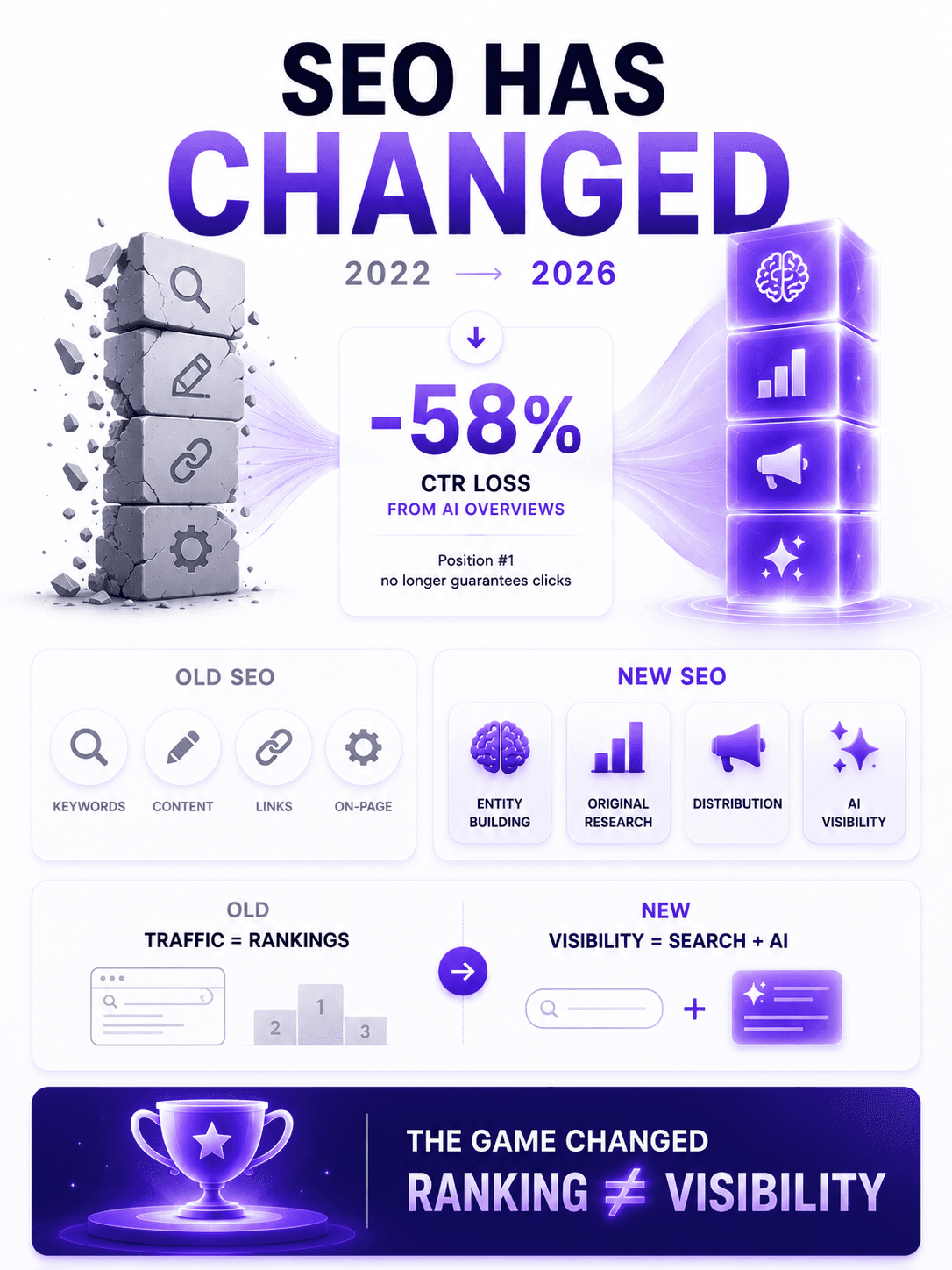
This blog reveals why traditional SEO work no long...
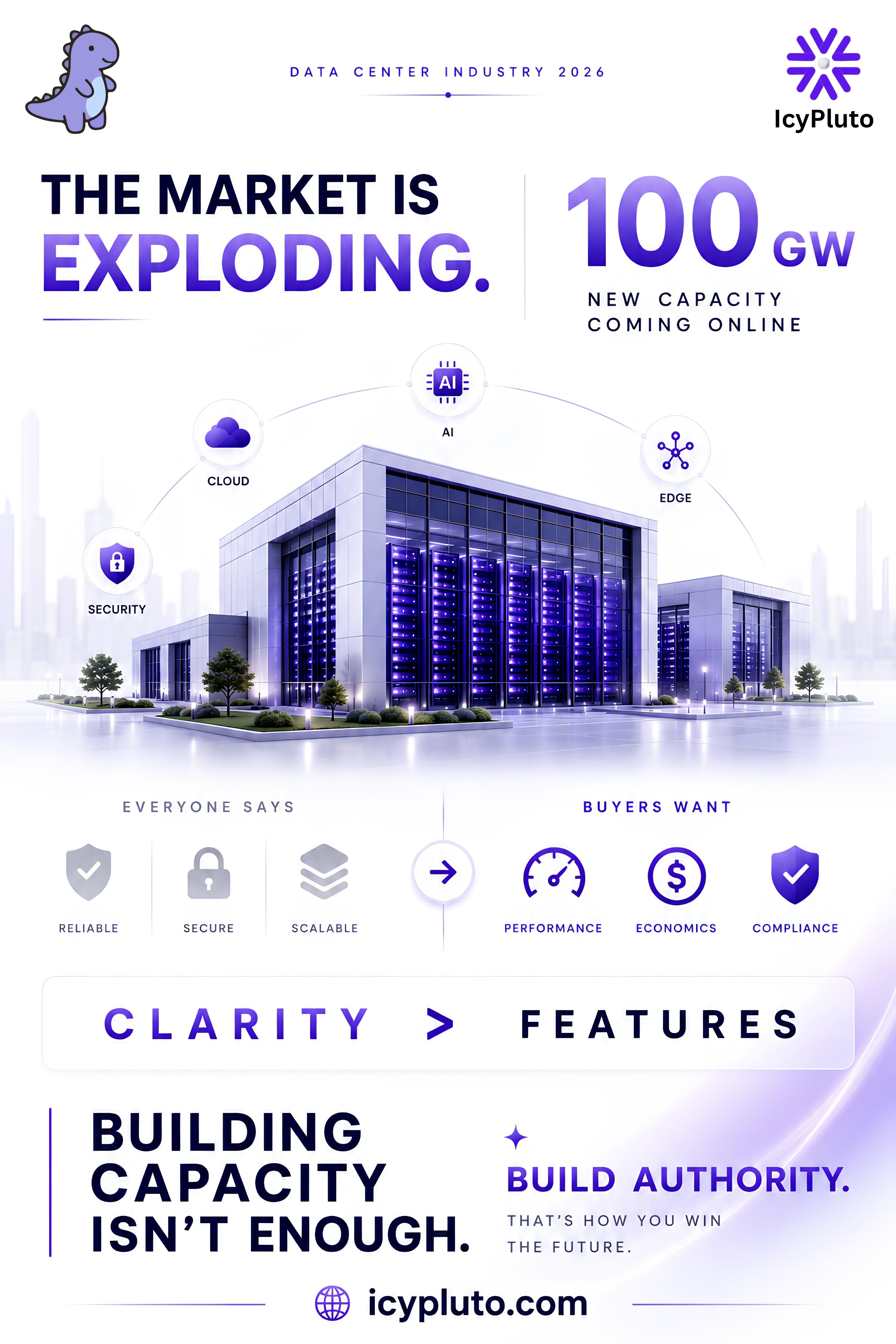
This blog explores the marketing gaps holding back...
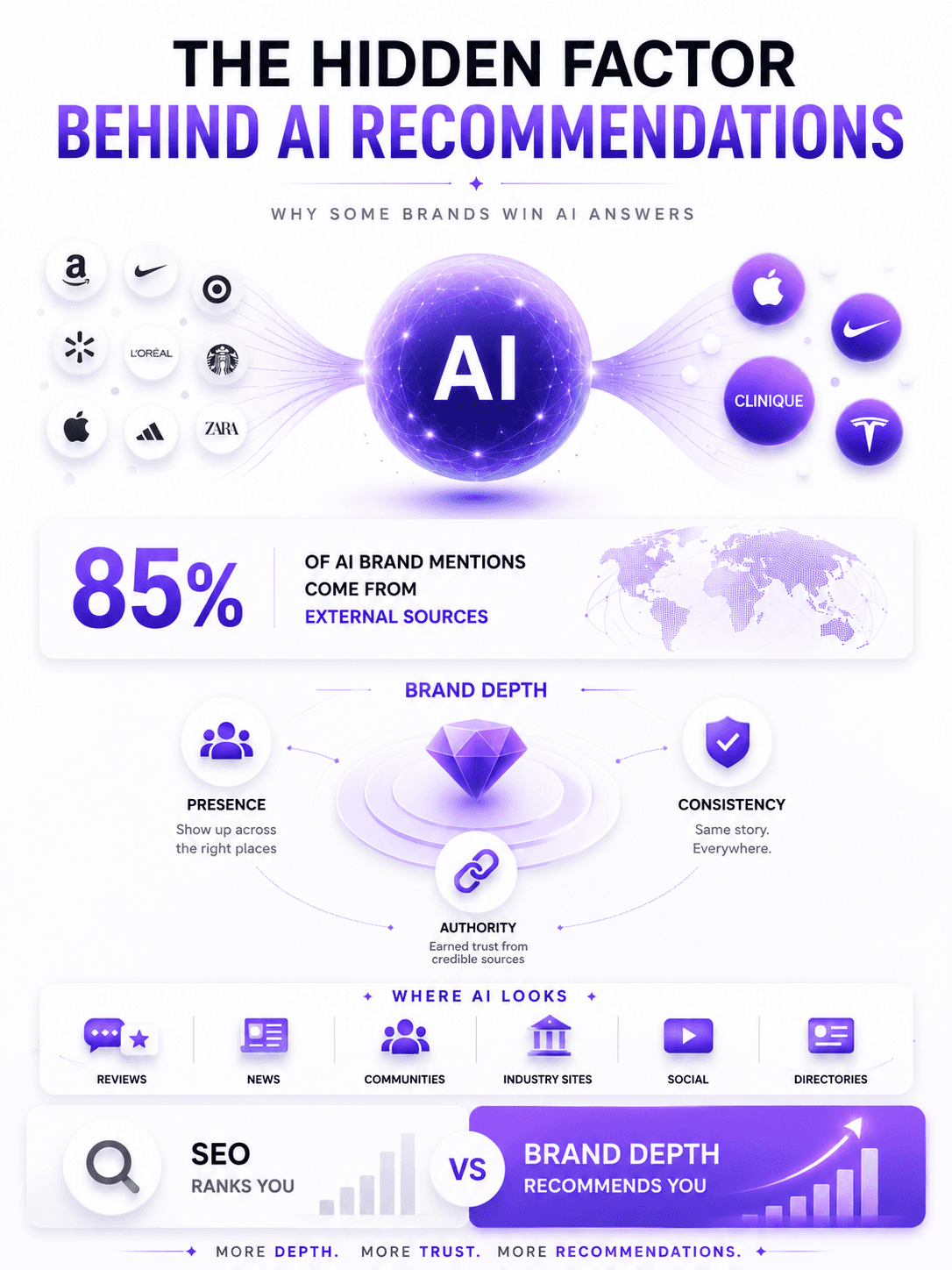
This blog post reveals why brand depth-the density...
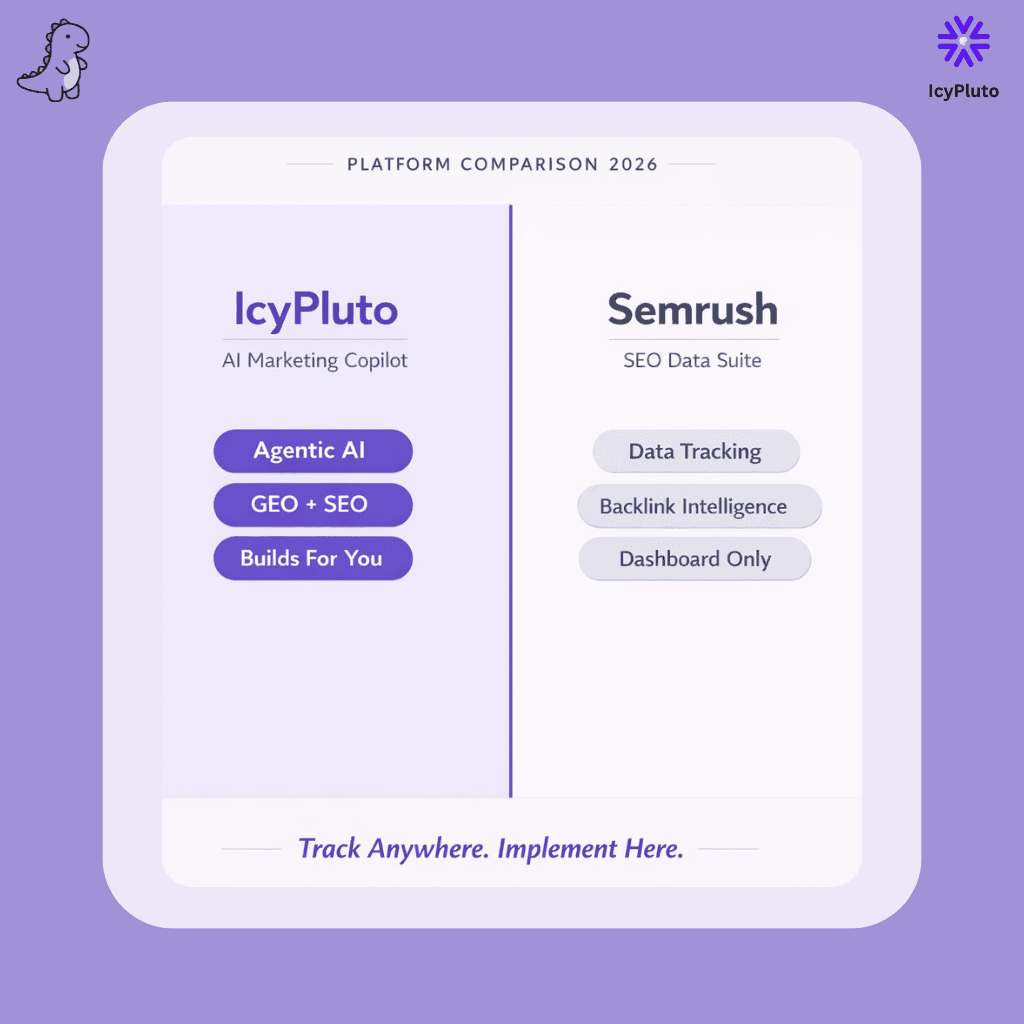
Honest comparison. One builds your visibility. The other shows you a map and hands you a shovel.
The SEO industry spent fifteen years perfecting the art of watching numbers move on a screen. Rank trackers, backlink graphs, crawl reports, keyword gaps. All of it pointed at one thing: Google's blue links.
Meanwhile, the planet shifted orbit.
Today's buyer opens ChatGPT and asks, "What's the best marketing platform for AI search?" They don't scroll through ten links. They read one answer. And if your brand isn't cited in that answer, you don't exist, not to that buyer, not at that moment.
This is the world Semrush was not built for. This is exactly the world IcyPluto was built to win.
This is not a hit piece on Semrush. It is genuinely one of the strongest data tools in the industry for traditional SEO — backlink intelligence, technical site audits, and keyword research at serious scale.
But there is a category difference between a data tool and a marketing copilot. Semrush gives you the map. IcyPluto gives you the map, the vehicle, the route, and the GPS — then drives while you focus on strategy.
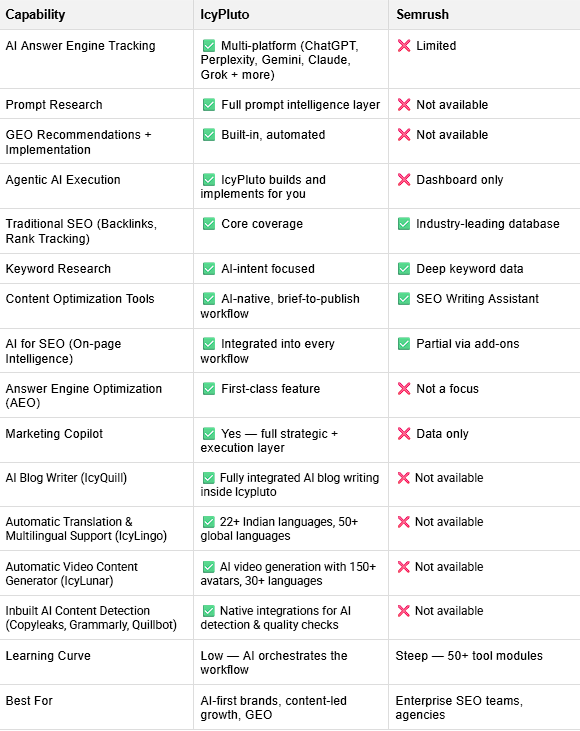
Before breaking that down, here is a side-by-side of where each platform actually stands:
Feature Snapshot
The Visibility Problem Nobody Is Solving (Until Now)
Here's what the last two years of the GEO conversation looked like: a lot of dashboards, a lot of LinkedIn posts about AI visibility scores, and almost nobody actually building the infrastructure that acts on those scores.
Three concepts that gave market its vocabulary:
Prompt Research - understanding which questions your audience is feeding into AI platforms, and whether those answers include your brand or your competitors.
Monitoring and Tracking - watching your citation rate, brand sentiment, and visibility index across AI answer engines in real time.
Recommendations - getting pointed guidance on what content gaps, entity relationships, or structural changes would improve your AI-search presence.
These three things moved the industry forward. But they all stopped at the same edge: the recommendation.
After every insight, every score, every beautifully visualised GEO audit — someone still had to open a blank doc and start building. The tools tracked the problem. The problem still didn't get fixed.
IcyPluto adds the fourth layer: Implementation.
IcyPluto does not just surface the gap. It fills it. Briefing, content creation, on-page fixes, structured entity signals, built inside the same system that ran the audit. That is the complete GEO planet. Track anywhere, implement here.
This is the core market differentiator and it is worth sitting with.
Semrush's model is: Here is your data. Good luck. You extract insights from a dashboard, then transfer them into a separate brief, a separate content tool, a separate CMS workflow, and a separate performance tracking view. Five tools. Five context switches. Five places for the strategy to get lost.
IcyPluto is a closed loop. An agentic AI for marketing that holds the entire workflow — from the first prompt audit to the final published asset to the post-publication citation score — inside one system. No handoffs. No translation layer between insight and execution.
For resource-constrained teams, this is not a convenience feature. It is the difference between strategy that gets implemented and strategy that lives forever in a slide deck.
The word agentic gets thrown around a lot in 2026. Here is what it means when IcyPluto does it.
Traditional AI SEO tools, including Semrush's AI layer, are augmentation tools. They summarise your data faster. They suggest keywords more intelligently. They surface anomalies before you would have spotted them manually. All genuinely useful.
Agentic AI operates differently. It does not wait for you to ask the right question. IcyPluto detects that your brand's citation rate in Perplexity dropped 18% in the last three weeks, cross-references which competitor content is filling that gap, identifies three specific content interventions that would close it, drafts those assets, and maps them to your existing content architecture. All of that happens before your morning coffee.
That is not a faster dashboard. That is a different category of tool entirely. And it is why calling IcyPluto a competitor to Semrush is a little like comparing a Formula 1 team to a very sophisticated GPS unit. One shows you the track. The other wins the race.
Semrush is built around one gravitational centre: Google. Its backlink index, rank tracking, SERP features, and site audit modules are all designed around the assumption that Google is where your audience lives.
That assumption is increasingly fragile.
Answer engine optimization has emerged as a distinct and critical discipline because buyers - especially in B2B, tech, BFSI, and high-consideration categories — now begin research journeys inside AI environments. They ask Gemini which platform to evaluate. They ask ChatGPT to compare vendors. They ask Perplexity to summarise category players before they ever visit a website.
If your brand is not in those answers, you have lost the evaluation before it started. No number of Google ranking improvements compensates for that gap.
IcyPluto tracks brand visibility, citation rates, and competitive positioning across eight or more AI platforms simultaneously. It scores your answer engine optimization posture, benchmarks you against competitors, and builds the content and entity signals that influence how AI systems respond to queries in your category.
This is the complete GEO planet. Semrush covers one country on it.
Semrush has an SEO Writing Assistant. It checks your content for keyword density, readability, and on-page signals relative to top-ranking pages. For traditional AI for SEO workflows, it is functional.
IcyPluto operates at a different layer entirely. Its content optimization tools are built around the signals that influence AI-generated answers, not just search engine crawlers. That means entity coverage, semantic relationships, citation-readiness, structured data alignment, and conversational query matching — the entire stack that determines whether an AI system trusts your content enough to cite it.
The output is not a score. It is brief. A ready-to-execute content intervention that addresses the specific gap your visibility audit identified. Briefing, drafting, and publishing — without leaving the platform.
Semrush's Pro plan starts at around $139/month, with Guru at $249 and Business at $499. That gets you strong SEO data. To unlock AI writing capabilities, trends intelligence, or advanced visibility features, costs climb quickly often above $400-600/month for a fully functional team stack.
IcyPluto starts at $99/month and from day one, that includes GEO tracking, prompt research, content optimization tools, AI writing layer, and implementation workflow, with no critical features locked behind a higher tier.
IcyPluto's value equation is different because it replaces multiple tools at once. GEO tracker, prompt research tool, content optimization tools, AI writing layer, and implementation workflow — consolidated. The question is not whether IcyPluto is cheaper than Semrush. The question is whether your current five-tool stack, stitched together with spreadsheets and Slack messages, is cheaper than a single copilot that actually executes.
So many teams are debating AI visibility. Posting about it. Tracking it in decks. Reporting it to leadership. Very few are actually solving it — because the tools available made tracking easy and implementing the team's problem.
Pluto builds it for you.
Not a summary. Not a score. Not a recommendation sitting in a dashboard while your team figures out the next step. A complete, closed-loop agentic AI for marketing that moves from audit to execution inside the same system — because strategy only counts when it ships.