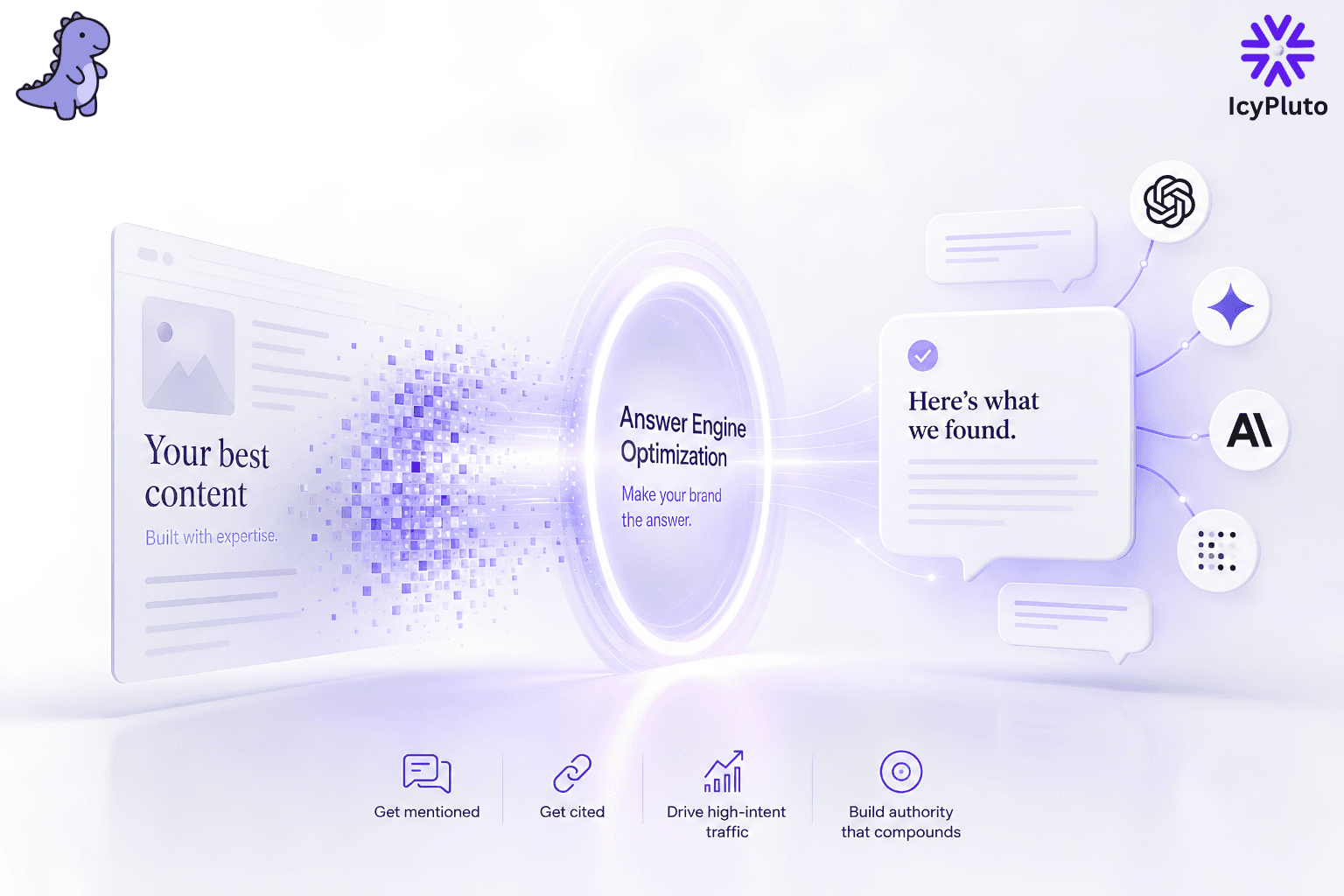
This blog breaks down why Answer Engine Optimizati...
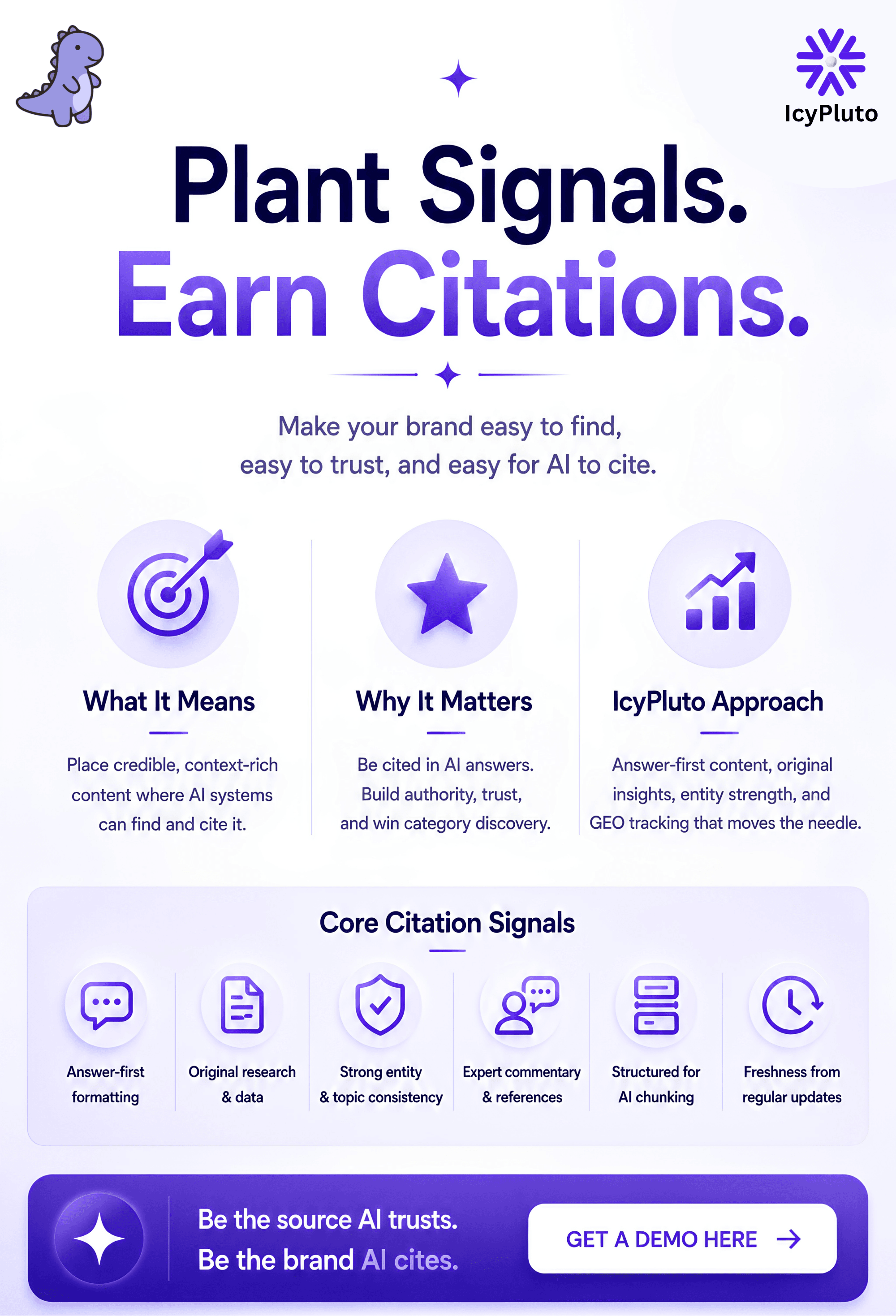
Citation seeding is becoming one of the fastest wa...
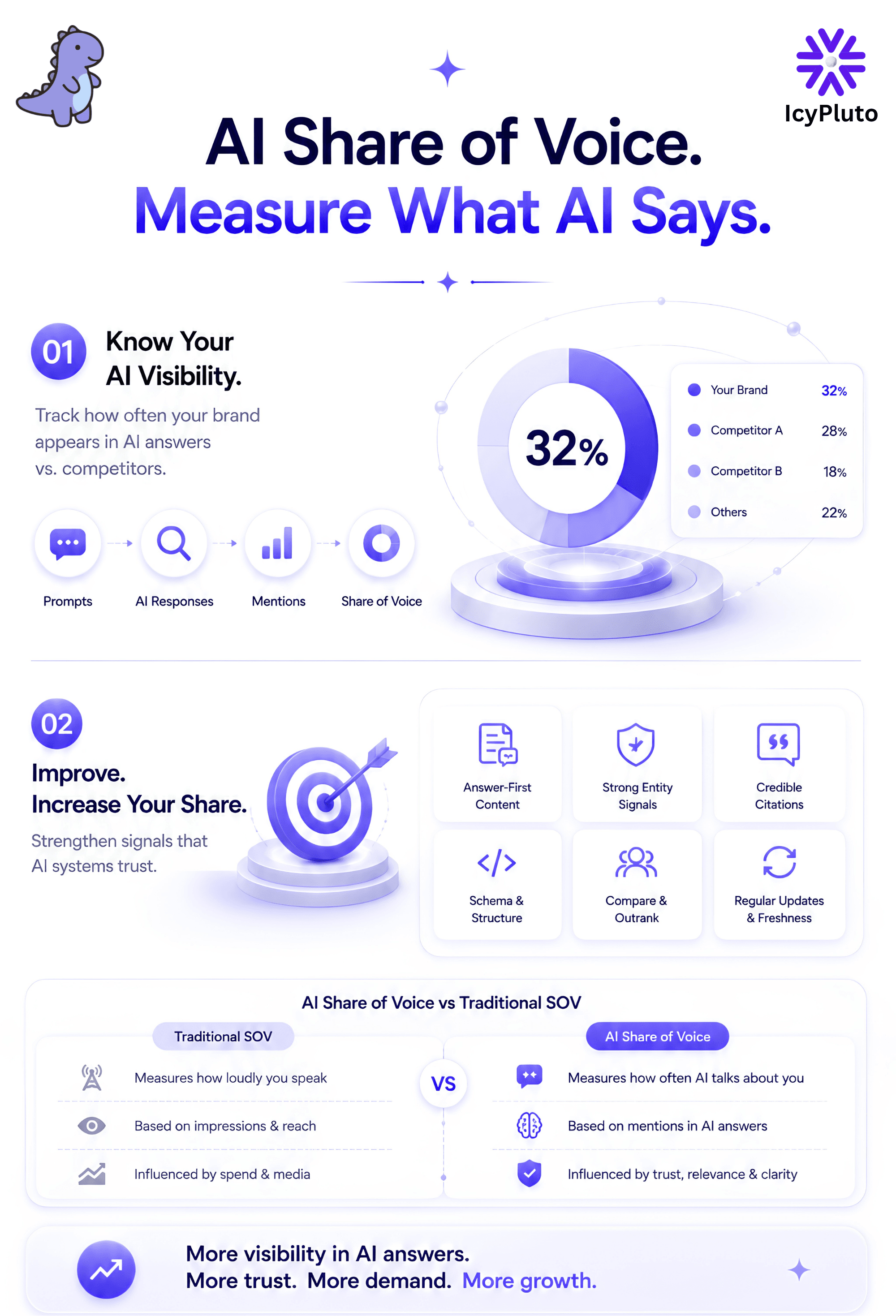
AI share of voice is the new visibility metric bra...
Most brands only notice they have an AI visibility problem after the traffic graphs start dropping. By then, the damage was done months earlier.
In 2026, around 64–68% of Google searches end without a click, and queries that trigger AI Overviews show zero-click rates as high as 83%, with the CTR of position-one results falling by 37–58% depending on the study. Seer Interactive’s analysis of more than 25 million impressions found that organic CTR on AI Overview queries dropped from 1.76% to 0.61% – a 61% relative decline. In other words, buyers are seeing answers long before they visit any site, and rankings can look “fine” while real influence quietly moves to brands that show up in those answers.
AI brand analysis exists to prevent that. It measures how your brand appears in AI answers and authority surfaces, then fixes visibility gaps before rankings and revenue follow the same downward curve. That is exactly the job IcyPluto was built for.
Traditional SEO is a lagging indicator. It reacts to what has already changed in the ecosystem.
AI engines react faster to:
entity clarity and consistency,
structured data and answer-ready content,
citation frequency from credible sources,
and off-site signals like profiles, reviews, and thought leadership.
When those signals drift, AI answers stop mentioning you. You can still hold good rankings for a while, but the early-stage demand has already moved.
This is why teams that rely only on rankings and sessions often get blindsided. Their dashboards tell them “all good” until the drop is visible. AI brand analysis flips that timeline. It looks at the recommendation layer – prompts, answers, and citations – where change shows up first.
Modern AI brand analysis focuses on four pillars.
When someone asks “best [category] platforms” or “[your niche] solutions for [ICP],” the key question is simple: do you appear?
You need metrics like:
Share of Answers: percentage of tracked prompts where your brand appears in the AI-generated answer.
Citation Rate: percentage of prompts where your site or docs are referenced as a source.
Brand Mention Rate: how often AI answers name your brand at all.
Given that AIO queries can reach 83% zero-click rates, this presence layer is the difference between being considered and being invisible.
AI systems think in entities, not just URLs.
Brand analysis checks:
whether models correctly identify your company, products, industry, and positioning,
whether descriptions are consistent across your site, LinkedIn, directories, and media,
and whether schema markup (Organization, Product, FAQPage, Article, Person) reinforces those signals.
Confused entities lead to mixed or missing recommendations. In a world where only about 1% of users click within AI Overviews according to Pew Research, you cannot afford to be misrepresented.
AI engines verify brands against the wider web.
Brand analysis looks at:
editorial coverage, reviews, and community mentions,
participation in podcasts, webinars, and reports,
and co-occurrence with known categories and competitors.
Studies have shown that brands visible on more external platforms are significantly more likely to be cited in AI answers, because repeated exposure builds machine confidence.
In 2026, pages with proper FAQ/schema and answer-first blocks are up to 3× more likely to be pulled into AI summaries compared with unstructured pages.
Brand analysis checks:
whether key pages open with a concise, 100–130 word answer that directly addresses a query,
whether headings are phrased as questions,
whether statistics are dated and sourced,
and whether schema markup accurately describes content.
This is the layer that makes your content easy for AI to extract.
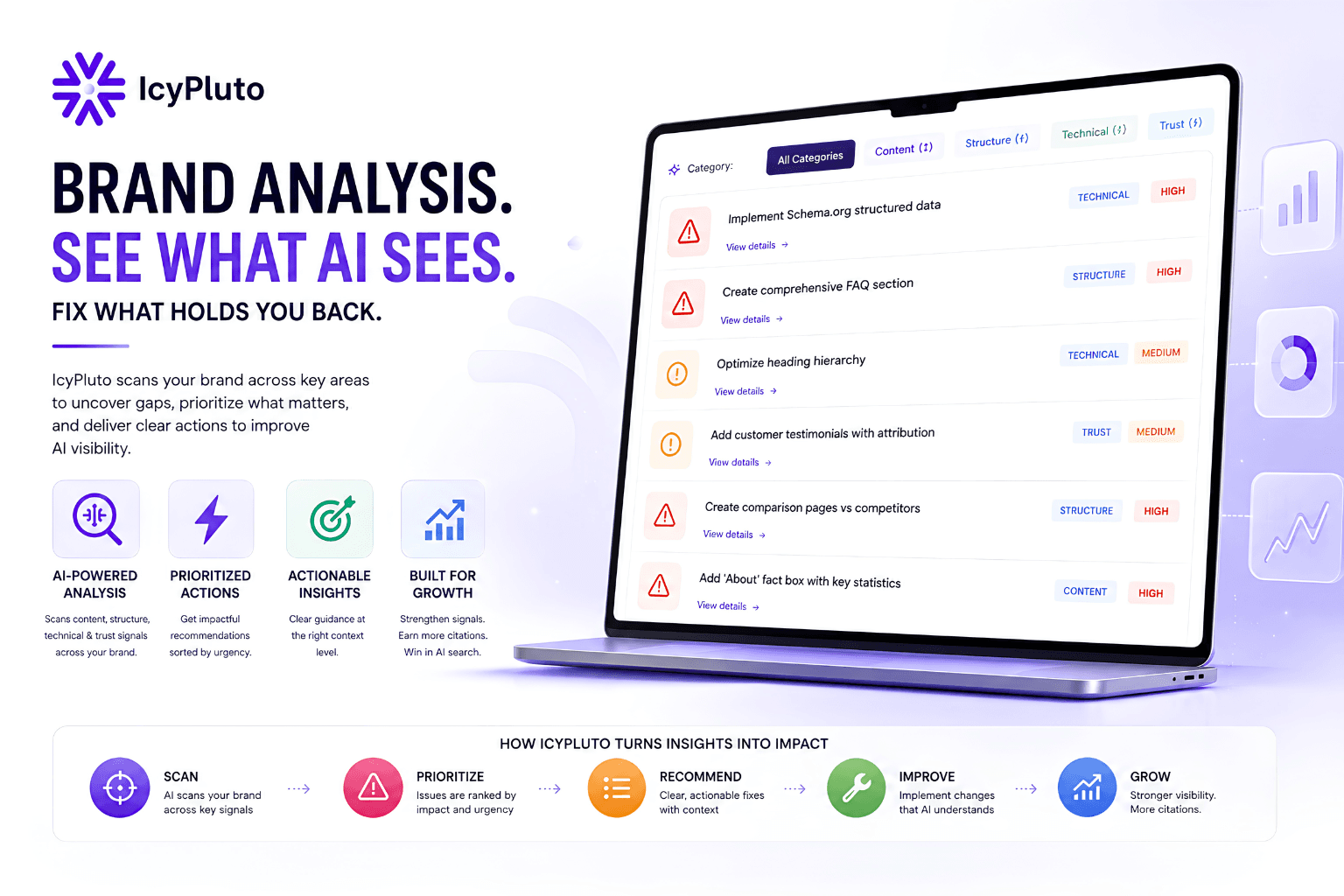
IcyPluto does not treat AI brand analysis as a one-off audit. It builds it into a continuous system with four steps: measure, diagnose, act, validate.
IcyPluto generates prompt families around your category, ICP, and use cases, then runs them across ChatGPT, Gemini, Claude, Perplexity, Copilot, and other engines.
Within minutes, you can see:
which prompts surface your brand,
where competitors dominate instead,
and how visibility looks per engine.
This matches best-practice advice that AI visibility must be measured per engine and per prompt, not via a single blended score.
Once the baseline is clear, IcyPluto’s analysis layer identifies:
inconsistent brand and product descriptions across your site and profiles,
missing or broken schema on key commercial and informational pages,
weak or absent answer blocks and FAQ sections,
off-site authority gaps in media, directories, and communities.
Instead of generic “improve SEO” recommendations, you get a list of specific issues tied to real visibility failures.
IcyPluto’s Action feature converts the diagnosis into prioritized tasks.
Examples:
add Organization and FAQPage schema to your homepage and solution pages,
rewrite top pages with answer-first and question-led structure,
normalize product and company descriptions across owned and external surfaces,
target specific authority sources (industry sites, review platforms) that AI engines cite frequently.
Tasks are sorted by expected impact on AI visibility and traditional rankings, so teams work on the changes that actually move citations and recommendations.
After implementation, you re-run the same prompt set. IcyPluto shows:
changes in Share of Answers and Citation Rate per engine,
new or stronger mentions compared with competitors,
movement in branded search queries, direct traffic, and AI referral performance.
You see whether brand fixes translate into better AI presence – before the rankings and traffic graphs catch up.
When 64–80% of searches end without a click, and AI Overviews reduce CTR for top results by 37–61%, relying on traffic as your first warning signal is dangerous.
By the time organic sessions fall, AI answers have already been recommending competitors for months.
AI brand analysis with IcyPluto gives you faster feedback loops:
prompt-level presence shows whether you are still in the conversation,
entity and schema diagnostics show whether AI can trust and extract your content,
off-site analysis shows whether reputation signals support your category claims.
You get to fix visibility before rankings break, instead of reacting after.
AI brand analysis is not separate from SEO, GEO, or AEO. It underpins all three.
For SEO, better entity clarity, structure, and authority improve crawlability, snippet quality, and topical relevance.
For GEO, prompt-level Share of Answers and citations are the core KPIs for AI search.
For AEO, answer-ready content and schema are exactly what make pages citable by AI engines.
IcyPluto sits across these disciplines:
measuring visibility across prompts and engines,
diagnosing brand and content gaps that hurt both rankings and recommendations,
and turning those findings into a unified action plan that supports SEO, GEO, and AEO.
If the only story your dashboards tell is traffic and rankings, you are watching the slowest moving part of the system.
AI brand analysis surfaces the faster signals: prompts, citations, entities, and off-site authority.
IcyPluto helps you:
measure those signals across major AI engines,
find and prioritize the gaps that actually block visibility,
implement changes that strengthen brand clarity and content structure,
and validate impact before the next algorithm or AI interface shift.
In a search world where most users never click, and answers carry more weight than SERPs, that is the difference between discovering a problem in the analytics after it hurts, and quietly fixing it before it ever shows up.