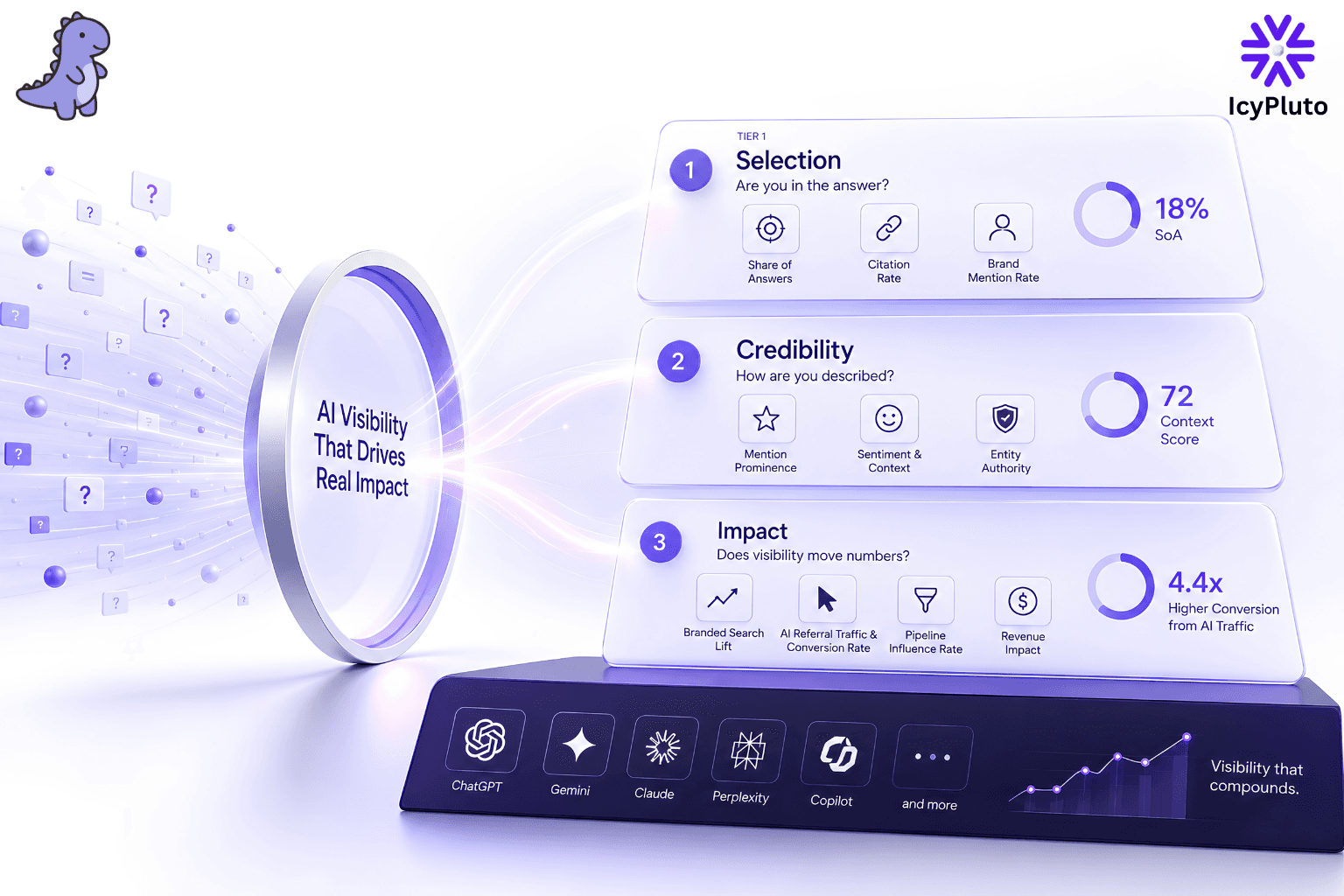
AI search has turned visibility into a numbers gam...
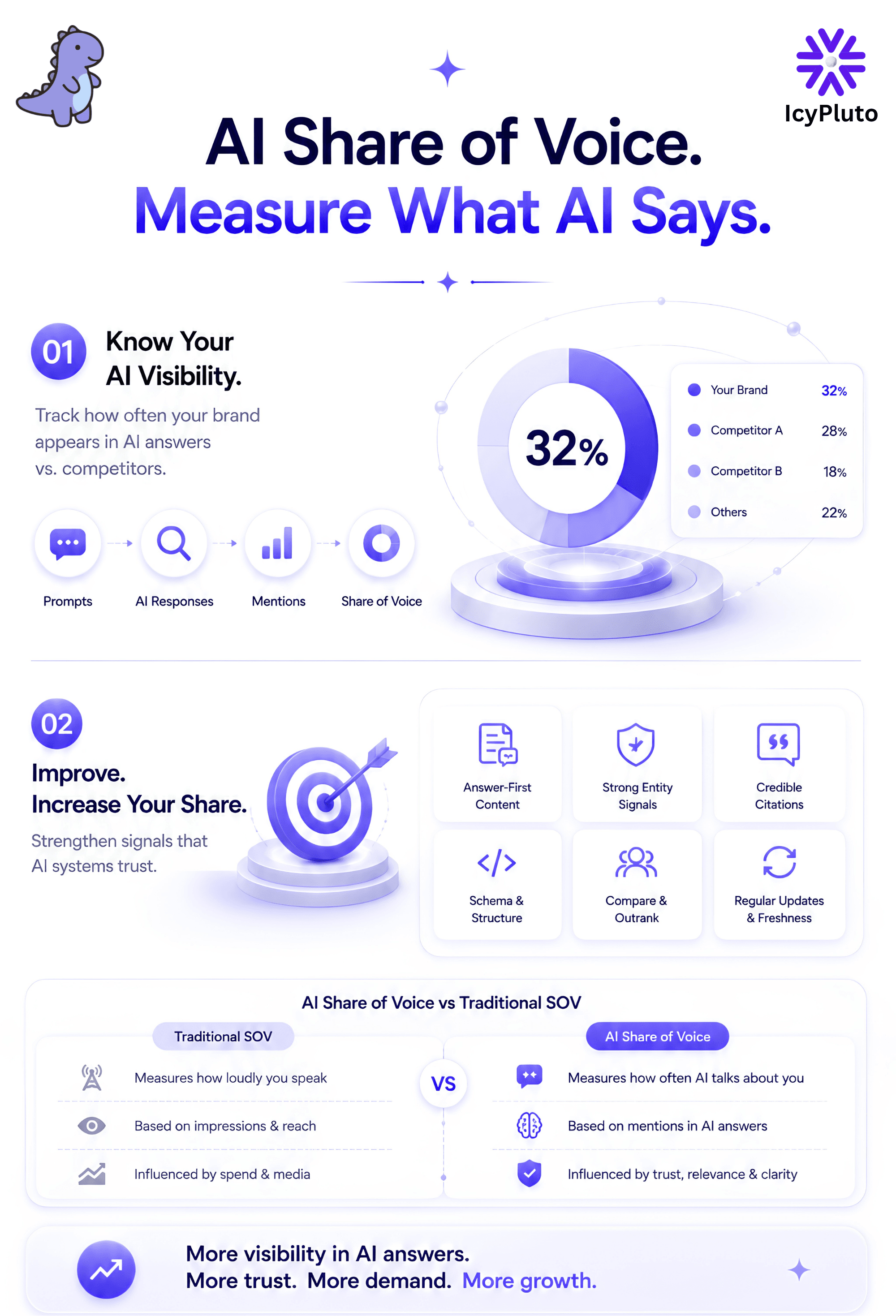
AI share of voice is the new visibility metric bra...
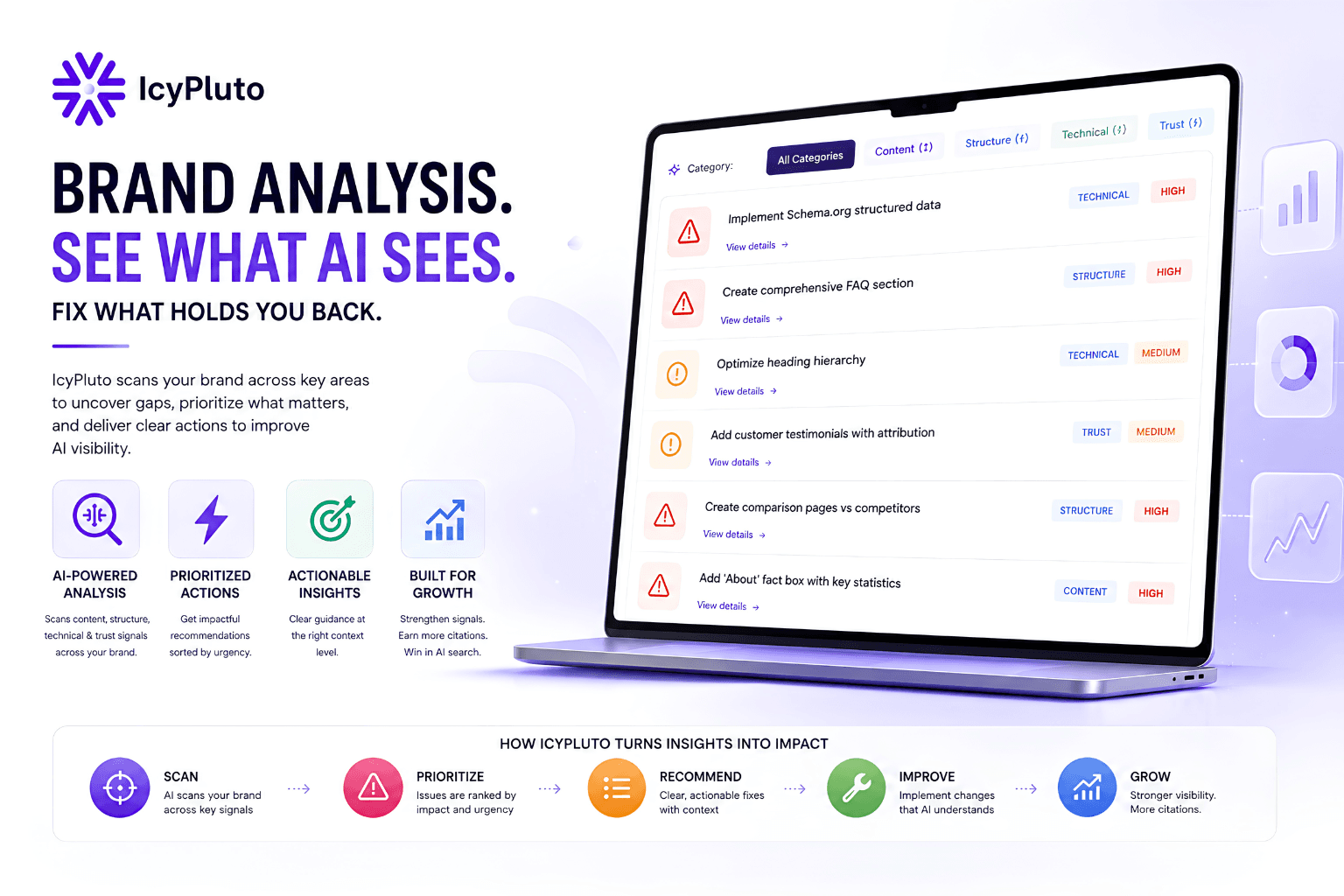
This blog explains why brands are losing visibilit...
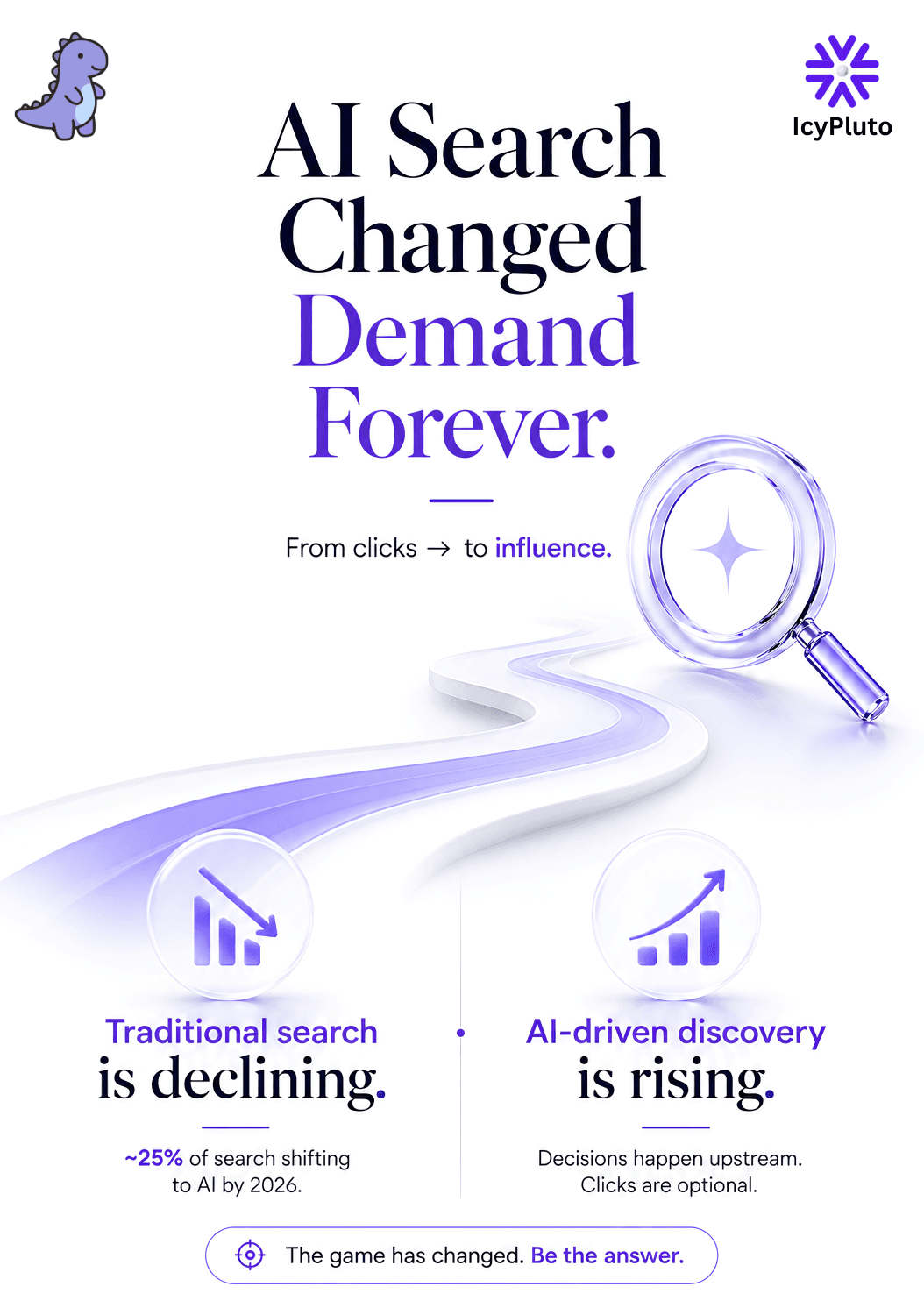
Demand generation used to be straightforward. You launched campaigns, pushed visitors to your site, watched traffic graphs climb, and assumed more sessions meant more pipeline. In 2026, that story is broken.
AI search has quietly turned demand generation into an influence game that most dashboards cannot see. Buyers ask ChatGPT, Gemini, Perplexity, Copilot, and Google AI Overviews what to read, who to trust, and which brands deserve attention. Recommendations now happen upstream. The click is only the visible tip of a much larger decision process.
From SEO teams and PR leaders to analysts and publishers, everyone is wrestling with the same challenge: how do you measure demand when AI reduces clicks but amplifies unseen influence?
IcyPluto’s answer is simple. Stop treating traffic as the main goal. Start measuring how often your brand enters the conversation.
One of the largest keyword-level AI impact studies looked at over 1 million high-volume keywords across hundreds of brands and multiple verticals. At first glance, the top-line number looks alarming: about 29% of search demand is declining. But the detail matters. Roughly 20% of keywords are growing, and those growing keywords carry almost the same total volume as the declining set. Net change across the dataset is only a modest positive shift in monthly searches.
In simple terms, demand did not evaporate. It redistributed to different topics and surfaces.
At the same time, Gartner projections suggest that traditional search engine volume could fall by around 25% by 2026 as consumers migrate toward AI chatbots and virtual agents. Other analyses expect AI-powered assistants and large language models to handle roughly a quarter of global search queries, replacing many interactions that used to happen only in classic SERPs. A growing share of discovery is now happening inside AI interfaces where clicks are optional, and recommendations are the main currency.l
For demand generation teams, this is a critical shift. The job is no longer just driving traffic. It is ensuring that your brand is visible where demand is being shaped, even when users never click your URL.
Different disciplines are starting to converge on a new set of principles for demand generation in an AI-first environment.
Replace traffic goals with correlation dashboards. Instead of obsessing over raw sessions, teams track brand search volume, direct traffic, inbound requests, pipeline, and revenue alongside AI visibility and external attention signals.
Do real audience research. Ideal customer profiles now spend attention across LinkedIn, YouTube, newsletters, communities, and AI interfaces. Demand planning needs to reflect those actual attention patterns, not only keyword tools.
Invest in channels you do not own. Demand creation happens on platforms such as YouTube, LinkedIn, podcasts, media sites, and forums. The work is to show up in the content buyers consume before they think of visiting your site.
Build short-form storytelling skills. Attention increasingly lives inside feeds, videos, snippets, and summaries. Brands must learn to tell sharp, clear stories in formats that humans can skim and AI systems can easily summarize and cite.
The underlying shift is that demand generation is moving from “drive people into our funnel” to “earn presence in the places that shape buyer beliefs.”
AI search systems do not think in old-school keyword lists and pageviews. They think in entities, authority, and answers.
Modern guidance from search and advertising platforms points to three major pillars for effective demand generation in this environment.
Brand authority as an AI citation asset. Engines encourage brands to invest in signals they can recognize as authority: original research, expert commentary, high-authority media placements, and consistent entity presence across the web. These elements help models decide whether a brand is trustworthy enough to surface.
Content tailored to conversational queries. With AI modes supporting complex, multi-part questions, content must answer detailed queries directly. Answer-first structures, deep guides, FAQs, and structured explanations perform better in generative contexts because they are easier to reuse.
Multimodal presence. Video, audio, and text matter together. Platforms like YouTube are cited frequently in AI responses. Brands that publish strong video and audio assets gain citation opportunities that text-only competitors miss.
Demand generation that ignores these pillars risks launching campaigns that look fine in web analytics but barely register in AI search.
Three core issues are undermining the old playbooks.
1. Click-based attribution is blind to AI influence. When someone asks an AI assistant which providers to consider, gets a list of brands, and later types your name into search or visits you directly, your analytics will credit that visit to “Direct” or “Brand Search.” The true discovery source is invisible, creating a new version of the dark funnel.
2. Keyword-only planning misses where demand moved. The large keyword study shows that fewer keywords are growing, but with far more volume per growing keyword. If your content strategy still depends on static keyword lists, you may be spending heavily on topics whose demand is quietly shifting elsewhere, while underfunding emerging, AI-heavy topics.
3. Most content is not AI-ready. Generative systems pull segments, not entire pages. They reward content that leads with direct answers, uses clear structure, and is backed by credible data and references. Campaign assets that are vague, purely creative, or thin on evidence are harder for AI systems to cite.
The result is familiar. Demand-generation teams ship campaigns that drive impressions and clicks, but buyers form their preferences in channels those campaigns barely touch.
At a practical level, demand generation in 2026 is about three things.
Demand creation must happen in formats and channels that AI systems treat as reliable training data. That means:
Publishing original research, benchmarks, and insights that industry news, analysts, and niche blogs pick up.
Contributing expert commentary and thought leadership that gets quoted in authoritative sources.
Structuring content so specific questions receive direct, well-supported answers that generative models can reuse.
The goal is not just to reach people once. It is to become part of the source material AI models rely on when those people ask questions later.
Demand capture must extend beyond click-through rates. Brands should:
Track brand search volume, direct traffic, inbound demo requests, and referrals as indicators of upstream AI influence.
Monitor whether their brand is named or cited in AI responses for high-intent prompts and category questions.
Use correlation dashboards to connect visibility in AI search and non-owned channels with movement in pipeline and revenue.
Clicks still matter. They are just no longer the only sign that demand exists.
Measurement needs to move beyond pageviews and sessions. The new stack should answer:
How often does our brand appear in answers to key prompts?
Which assets are most frequently used as sources?
How does our visibility compare to competitors across AI platforms?
Traffic-only reports cannot answer these questions. AI visibility metrics can.
IcyPluto was built on the premise that AI visibility is now the backbone of modern demand generation. Instead of treating AI as an add-on, it treats generative engines as primary discovery surfaces.
Here is how IcyPluto supports demand-gen teams in this shift.
IcyPluto moves teams from static keyword lists to prompt families. It analyzes how buyers phrase questions across major AI engines and clusters those prompts into meaningful commercial intents.
This lets demand-gen teams:
See which topics have shrinking classic search volume but rising AI prompt volume.
Prioritize campaigns for queries that AI surfaces frequently, not just those that look big in traditional keyword tools.
Build a demand map that reflects current buyer questions, not historic assumptions.
IcyPluto introduces AI-native KPIs such as:
Visibility Score – how often your brand appears in AI answers for a given topic.
Share of Voice – your mention share versus competitors inside AI responses.
Share of Answer – the proportion of answers that use your content as a source.
Discovery Index – how many distinct prompts across models surface your brand.
Sentiment Score – the tone associated with your brand in AI-generated summaries.
With these metrics, demand-gen teams can finally measure whether campaigns move the needle where buyer decisions are forming.
IcyPluto scans your content and external mentions to identify which assets have high citation potential. It highlights:
Pages that already appear in AI answers and can be strengthened.
Content formats that generative systems favor in your vertical (guides, FAQs, data reports, videos).
Missing authority signals like absent schema, weak author bios, or few external references.
Demand-gen teams can turn these insights into action, upgrading key assets into AI-ready citations instead of generic blog posts.
AI search is fragmented. Different models behave differently and cite different sources. IcyPluto tracks visibility across multiple engines and layers that data with signals from search, social, and PR.
This allows teams to:
See AI visibility per engine instead of a misleading blended metric.
Connect gains in AI mentions with shifts in branded search and inbound interest.
Allocate budgets more intelligently by knowing which surfaces truly shape demand.
The biggest mindset shift demand-gen teams need is straightforward: traffic funnels are giving way to influence systems.
In a world where AI engines handle a significant share of global queries and where demand redistributes rather than disappears, winning brands will be those that consciously design how they appear in AI answers, not just how they appear in web analytics.
Demand generation becomes:
Designing the narrative that AI systems recall when someone asks about your category.
Building authority assets that make you a default citation.
Tracking visibility where buyer questions actually land.
IcyPluto exists for exactly this job. It is not just another analytics layer. It is an agentic AI visibility system that helps brands move from chasing clicks to owning recommendations.
For demand-gen leaders, that is the difference between watching numbers erode and actively shaping where demand goes next.