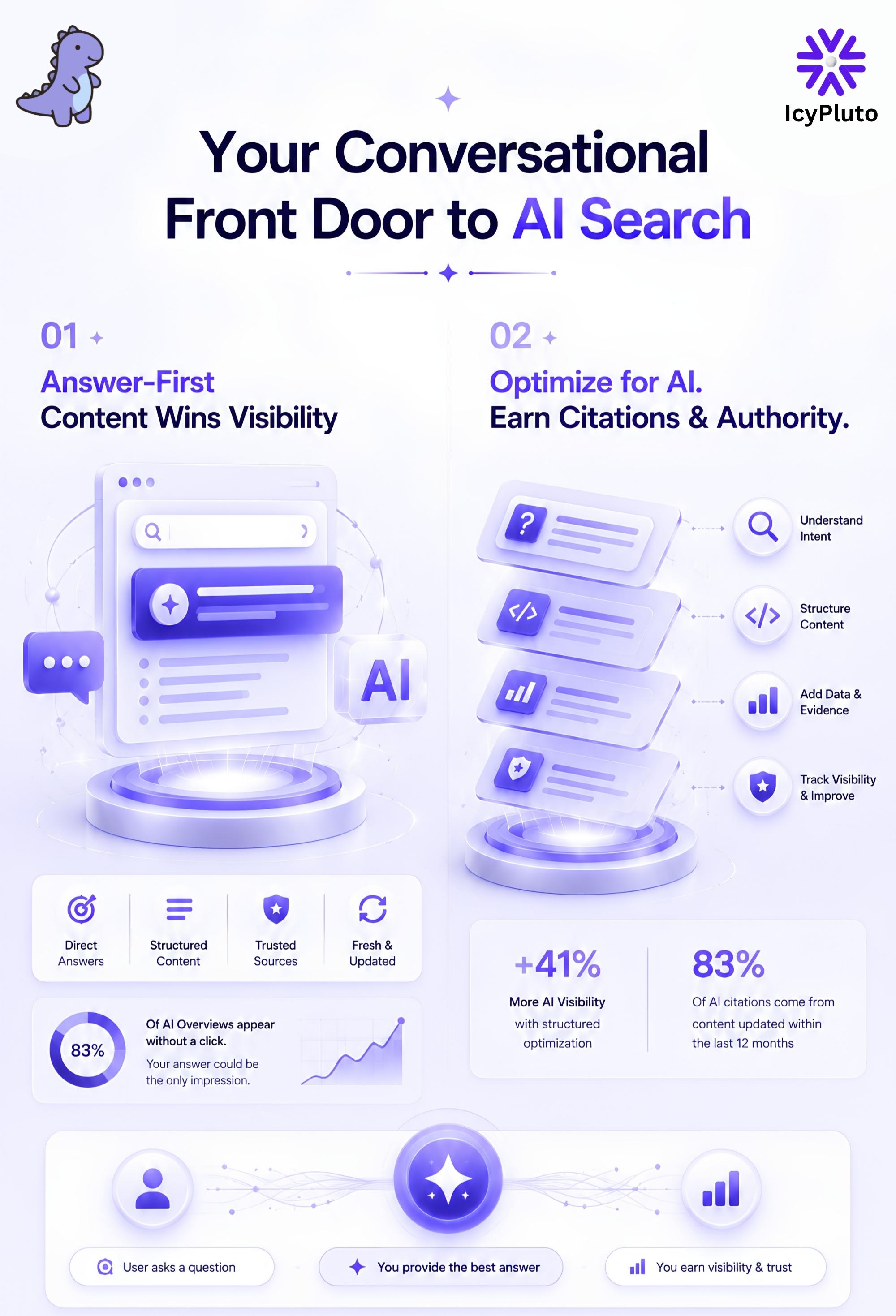
The way people search is changing fast, and conten...
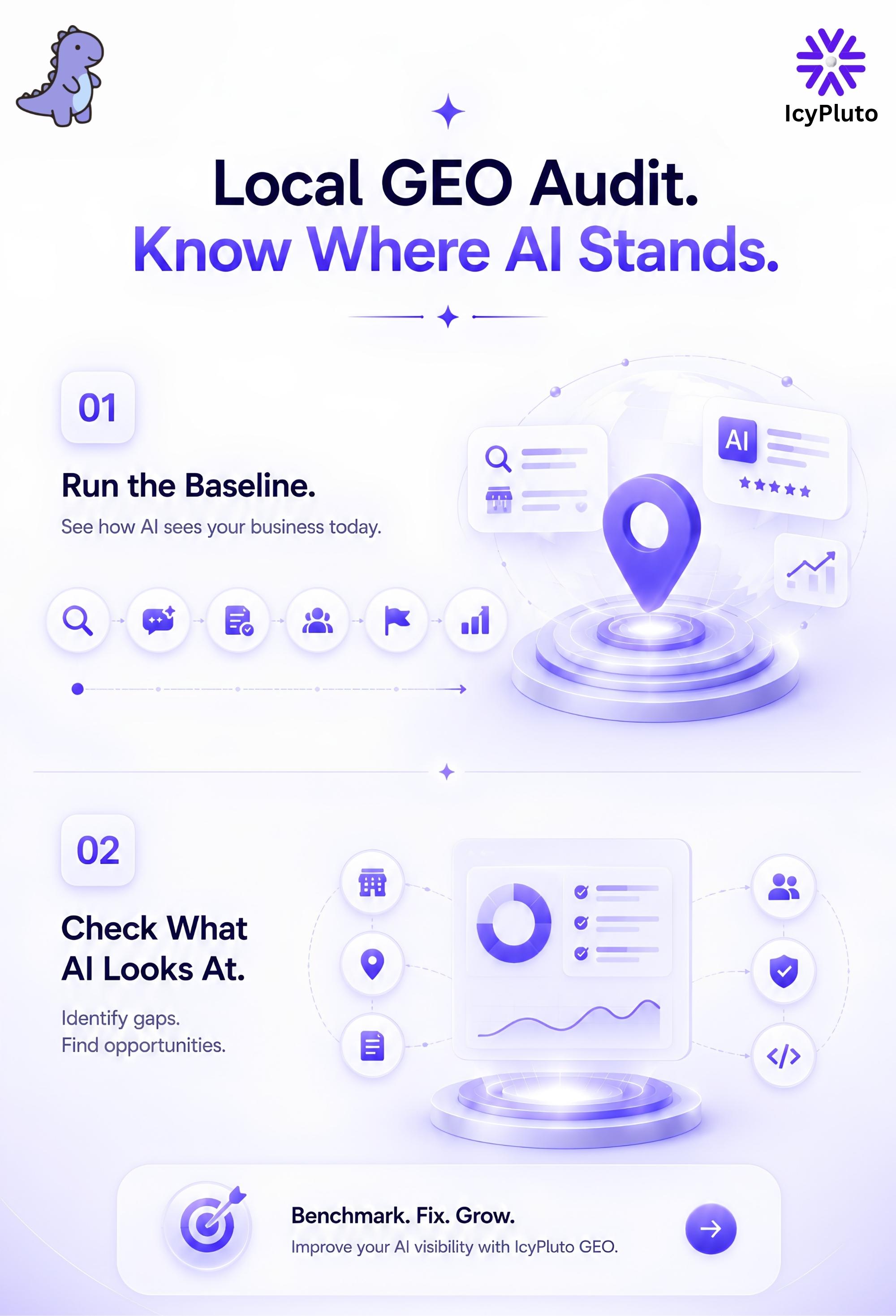
A local GEO baseline audit helps you understand ho...
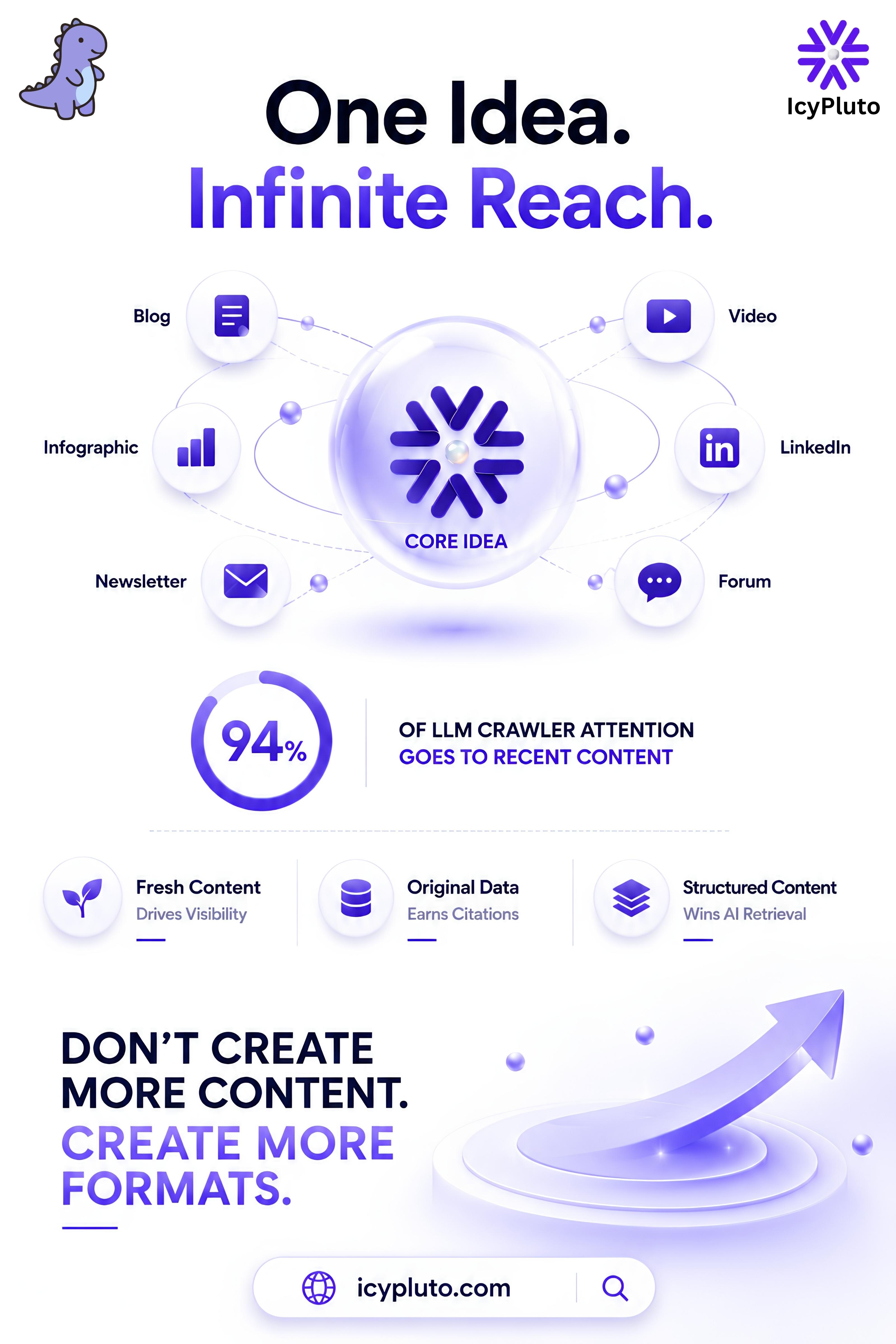
This blog reveals how to maximize visibility in tr...
Over the last few years, every marketer’s inbox has been flooded with promises from AI SEO tools and SEO optimization platforms.
They audit your site, auto‑generate content, optimize metadata, cluster keywords, and even track how your brand shows up in ChatGPT, Gemini, and Perplexity.
Those tools are not useless. They are simply no longer an edge. When 86 percent of SEO professionals already use AI in their workflows, and the AI SEO tools market is forecast to grow from about 2.85 billion dollars in 2025 to 13.81 billion dollars by 2033 (roughly 16–17 percent CAGR), automation has become a baseline requirement, not a differentiator.
If everyone is buying similar AI SEO software, then the question shifts from “Which tool?” to “Who is orchestrating all of this?”
That is where the idea of an AI CMO – and specifically IcyPluto – World’s First AI CMO – starts to matter.
Recent industry statistics give a clear picture of where we are today:
86 percent of SEO professionals report using AI tools in their strategies.
65 percent of businesses say SEO results improved after they implemented AI.
Around 69 percent of companies are integrating AI‑driven SEO tools into their workflows, with 63 percent seeing better rankings within three months.
The AI SEO tools market is valued at roughly 2.2–2.85 billion dollars and is projected to grow at 10–17 percent annually, depending on the segment and forecast.
In other words, AI‑powered SEO is no longer the future. It is the present baseline.
Across reviews, comparison blogs, and market guides, you see the same clusters of AI SEO tools and SEO optimization tools show up over and over:
Keyword and content tools
Surfer AI
Writesonic
Jasper AI
ChatGPT and similar LLMs for outlines and drafts
Technical and on‑page optimization tools
Alli AI
Profound
AirOps
Gumloop (workflow automation)
Rank tracking, research and visibility tools
Ahrefs
Semrush and the Semrush AI Toolkit
RadarKit.ai (AI visibility tracking)
Peec AI (AI search analytics)
AI SEO “agents” and automation platforms
SEObot (programmatic SEO, automated keyword research)
NightOwl
Chatsonic (conversational SEO assistant)
Indexly for indexing automation
Some of these are excellent. They help you:
Automate keyword research and clustering.
Generate content briefs and drafts.
Spot technical issues and ranking anomalies.
Track rankings and now even AI search visibility across ChatGPT, Gemini, and Perplexity.
The problem is not the tools themselves. The problem is that these tools are just working on fragments of the larger problem, and everyone is buying the same stack and pointing it at the same problem.
“Dead” here does not mean you should uninstall your favorite AI SEO tools. It means that piling on more tools is no longer a winning strategy by itself.
The AI SEO tools market has split into two very different segments:
Commoditized content and on‑page optimization tools with intense competition and shrinking differentiation.
High‑end GEO and AI‑visibility tools that track brand presence and citations in LLMs are often used by more advanced teams.
If your “AI strategy” is simply “we use AI for keyword research and on‑page scores,” you are competing in the most crowded, lowest‑margin slice of the market.
Most AI SEO platforms are wrappers around similar large language models, similar SERP‑scraping logic, and similar technical auditing heuristics.
That leads to three issues:
They recommend similar content structures and topics.
They optimize for the same ranking factors everyone else has identified.
They rarely understand the nuances of your category narrative, brand POV, or customer psychology.
You get steady gains, but not a unique strategic edge.
Most AI SEO tools are built to optimize one layer of marketing:
Keyword and content.
Technical performance.
Rankings and AI search mentions.
What they do not do is:
Decide how SEO should work with paid, product marketing, and sales.
Choose which narratives to push across LinkedIn, PR, website, and founder content.
Decide which GEO and AEO bets will matter for your category over the next 12–24 months.
This is why AI SEO tools are “dead” as a standalone strategy. They are powerful instruments in the band. They are not the conductor.
If tools optimize tasks, an AI CMO is about orchestrating strategy, channels, and execution in an AI‑native way.
Instead of asking:
“How can we automate more of SEO?”
An AI CMO asks:
“How should this brand show up in AI search, social algorithms, human communities, and buying committees – and how do we design everything around that?”
This is where IcyPluto – COSMOS’ FIRST AI CMO comes in.
IcyPluto describes itself as “the marketing rebel rewriting the rules” and “the Agentic AI Universe for Marketers.”
Themes that stand out:
It is positioned not as a point tool, but as an AI CMO layer for brands.
It focuses on Generative Engine Optimisation (GEO), Answer Engine Optimisation (AEO), building strategy, creativity, and orchestration, not just planning.
It is built around agentic AI, meaning it can operate as a persistent, goal‑driven marketing agent rather than a one‑off prompt responder.
IcyPluto aims to:
Reimagine marketing strategy, not just automate campaigns.
Turn raw data into “explosive strategies” and creative ideas, not only dashboards.
Help brands achieve cognitive presence – showing up inside narratives, and AI answers when decisions are being formed, not just being visible in feeds.
Act as an agentic AI partner that can plan, coordinate, and adapt marketing moves across channels.
Where AI SEO platforms might say, “here are 200 keywords you should write about,” an AI CMO like IcyPluto is more focused on:
Which stories do you need to own.
Where those stories need to exist (Google, AI search, LinkedIn, communities).
How to sequence campaigns so buyers encounter your ideas repeatedly whenever they consult AI or search.
Traditional SEO, even powered by AI, optimizes primarily for clicks and rankings. IcyPluto is explicitly positioned around cognitive presence: who gets referenced when people ask AI for advice or when narratives are being shaped.
That aligns directly with the rise of:
AI search and answer engines.
GEO (Generative Engine Optimization) – optimizing for AI‑generated answers and citations.
AEO (Answer Engine Optimization) – optimizing content so it is the source AI pulls from.
Instead of just tracking keyword positions, an AI CMO helps you engineer:
“We are the example AI mentions when someone asks about this problem.”
“We are the brand AI search agents shortlist when buyers say ‘who should I talk to?’”
AI SEO tools automate specific jobs: keyword research, internal linking, metadata updates, content drafts.
IcyPluto, by contrast, is built as an agentic AI that can:
Take strategic inputs (ICP, category, GTM model).
Propose multi‑step marketing plays.
Coordinate content, SEO, LinkedIn thought leadership, and outbound motions through its AI CMO framing.
That is a different level of value. It is the difference between:
A stack of assistants.
A single AI executive layer that understands your growth goals and orchestrates the assistants.
IcyPluto emphasizes startups and high‑growth teams.
In that context, the benefits of an AI CMO are clear:
Most startups cannot afford a full executive‑level marketing bench plus specialist SEO, GEO and AEO talent.
They still need someone – or something – to own the big picture: positioning, messaging, search strategy, demand generation, partnerships.
An AI CMO gives founders a strategic partner that never sleeps, grounded in both data and creative exploration.
Your AI SEO tools still matter. But they plug into a coherent go‑to‑market brain, not 20 disconnected dashboards.
Analysts estimate that while AI platforms still account for a small slice of total web traffic today, that traffic can be four times more valuable than traditional search visits, and that traditional organic clicks could drop 25–50 percent by 2028 as AI search takes over many informational queries.
In that world, your questions change from:
“How do we get more organic clicks next quarter?”
to
“How do we ensure AI systems recognize us as the best answer when buying committees ask questions?”
IcyPluto’s focus on AI‑era thought leadership, cognitive presence, and agentic campaigns maps directly to that shift.
If you are leading marketing, growth, or product, and wondering how to act on all this, here is a practical lens.
Ask yourself:
Who is actually deciding which narratives we want AI to repeat about us?
Who is aligning SEO, content, PR, LinkedIn, communities, and sales around those narratives?
Who is thinking about GEO and AEO, not just Google rankings?
If the honest answer is “no one consistently,” you have a strategy gap that more point tools will not fix.
This is where exploring an AI CMO - IcyPluto makes sense:
Treat it as a chief‑of‑staff for marketing, not just another SaaS subscription.
Have it to help you prioritize which SEO and AI search battles matter for your category.
Let it orchestrate multi‑channel plays instead of giving each AI SEO tool its own mini‑roadmap.
Over time, you will likely see your stack evolve from:
“We have 10 AI SEO tools”
to
“We have an AI CMO that decides how to plan and when to execute.”
AI SEO tools are not literally dead. Budgets will keep growing, new entrants will launch, and automation will keep getting smarter.
What is dead is the idea that buying more AI SEO tools is a sufficient strategy for winning in search, AI, or markets.
In a world where buying decisions are increasingly shaped by AI answers, AI search, thought‑leadership graphs, and GEO/AEO dynamics, you need more than better dashboards.
You need an AI CMO – a layer like IcyPluto that:
Understands your market.
Plans and builds a strategy.
Designs campaigns for an AI‑first attention landscape.
If you want to win the next decade, start by choosing the AI CMO that will understand, plan, build, and execute.