A local GEO baseline audit helps you understand ho...
This blog reveals how to maximize visibility in tr...
This blog reveals what a massive 37,804 AI respons...
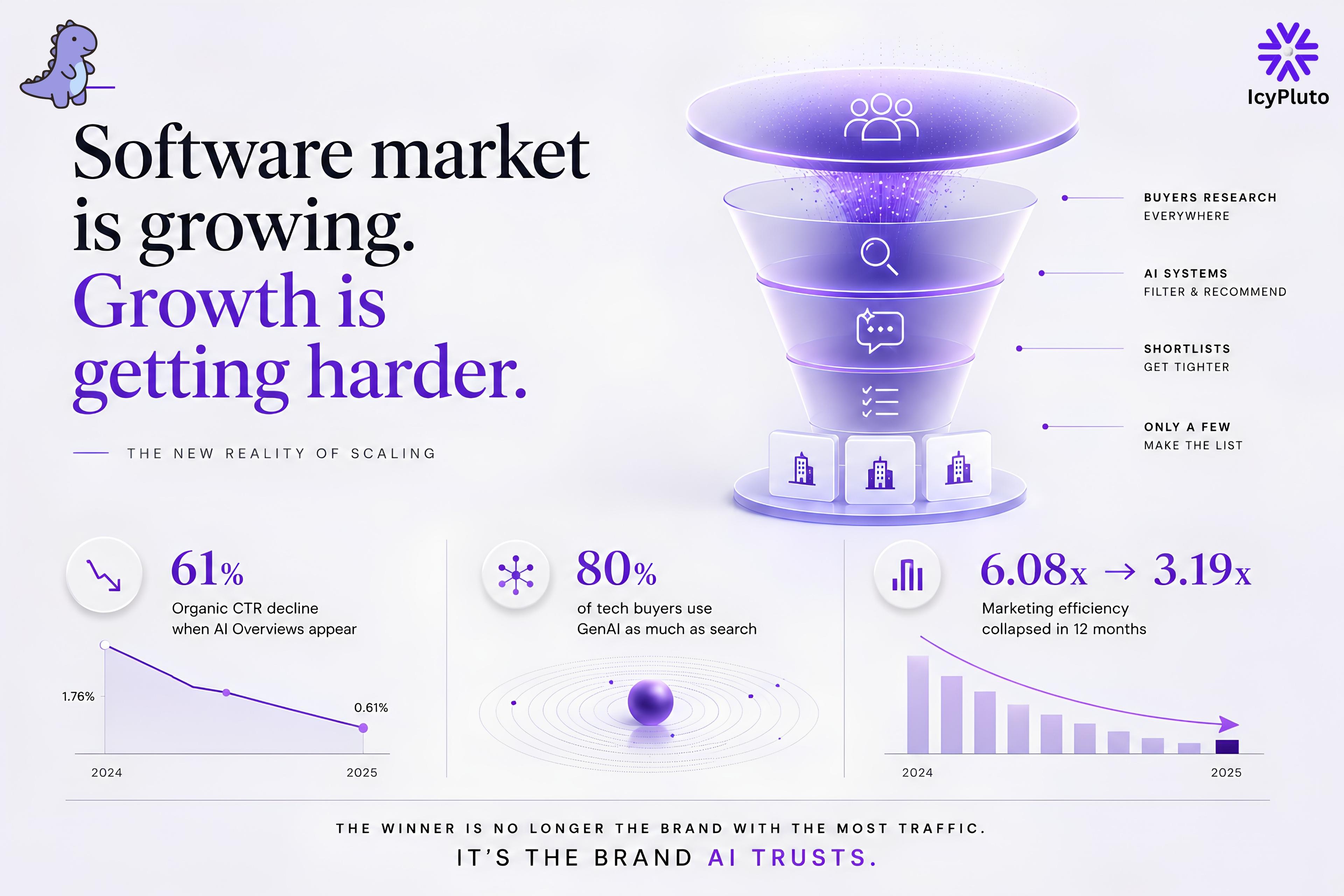
The software market is not slowing down, but the way companies scale is changing fast. Over the last few years, growth used to come from a familiar mix of SEO, paid campaigns, product-led growth, outbound, and content marketing. That model still exists, but it is delivering weaker results because buyers are behaving differently, AI is reshaping discovery, and digital authority now matters more than traffic alone.
The shift is already visible in the numbers. Median sales and marketing efficiency for private software startups fell from 6.08x in 2024 to 3.19x in 2025, which means go-to-market spend is producing almost half the efficiency it did a year earlier. At the same time, organic click-through rates for queries with Google AI Overviews dropped from 1.76% to 0.61%, a 61% decline, even when brands still ranked well.
This is not a theory anymore. It is a structural shift in how software companies are discovered, evaluated, and chosen.
India’s software ecosystem continues to prove that global scale is possible. SaaSBoomi’s India SaaS Unicorn Tracker lists 23 unicorns, showing that India has moved far beyond early experimentation into a mature and globally credible software economy. Companies such as Freshworks, Zoho, Postman, Chargebee, Druva, and Icertis remain major reference points because they have shown that Indian firms can build, sell, and expand at global scale.
The next wave is strong too. Y Combinator’s 2026 tracker includes 31 India-headquartered SaaS startups, showing that the pipeline of globally ambitious software companies continues to deepen. This matters because competition is no longer just local. Indian firms are now entering categories where they compete directly with U.S. and global incumbents from day one.[ycombinator]
Capital efficiency is also becoming a defining advantage. EY reported that Indian B2B SaaS companies remain highly capital efficient, with 8 out of 10 companies recording a burn multiple below 1, while many are still targeting high ARR growth. That sounds positive, and it is, but it also raises the bar. In an efficient market, the companies that win are not only the ones with better products. They are the ones that build trust, authority, and discoverability faster than everyone else.[ey]
If the category is growing, why are so many software companies feeling pressure?
Because the market is no longer rewarding the old demand generation model in the same way.
Today’s buyers do much more research before they engage. Demand Gen Report found that in the technology sector, 80% of buyers use GenAI at least as much as search for vendor research, and 56% use chatbots as a top source for discovering new vendors. That means your future customer may encounter your brand inside ChatGPT, Gemini, or another AI interface before they ever visit your website.
This creates two major problems.
First, visibility is no longer controlled by rankings alone. A company may rank on Google and still lose discovery if AI-generated answers do not mention it. Second, attribution becomes weaker. If a prospect first discovers a vendor through AI, returns later through branded search, and converts weeks after that, the original influence is often invisible in analytics.
That is why many software brands feel like marketing is working harder but delivering less. The performance dashboard captures the click. It often misses the recommendation.
The strongest proof that the market is changing comes from what major Indian software companies are doing right now.
Fractal Analytics has been preparing for a $500 million IPO at around a $3.5 billion valuation, and its growth story is tied closely to its push into agentic AI and partnerships with SAP, Snowflake, and Nvidia. This is not just a funding story. It shows that large enterprise-focused software companies are aligning scale with AI positioning, ecosystem partnerships, and future-facing credibility.
Wingify was acquired by Everstone for about $200 million, signaling continued investor confidence in profitable Indian software assets. That is important because it shows that the market still rewards durable businesses, not just heavily funded ones.
Chargebee expanded its India presence through a partnership with Razorpay, using ecosystem integration to deepen local reach and solve for recurring revenue complexity, payment preferences, and compliance realities in India. That move reflects a broader trend. Software companies are scaling not only through product or ads, but through partnerships that increase distribution, trust, and ecosystem fit.
Taken together, these examples show three important scaling patterns:
AI is becoming central to strategic positioning, not just product features.
Investors still reward operationally strong software companies with clear market value.
Local and ecosystem partnerships are becoming more important in expansion strategy.
The companies that scale are not only building products. They are building authority, ecosystem depth, and strategic trust.
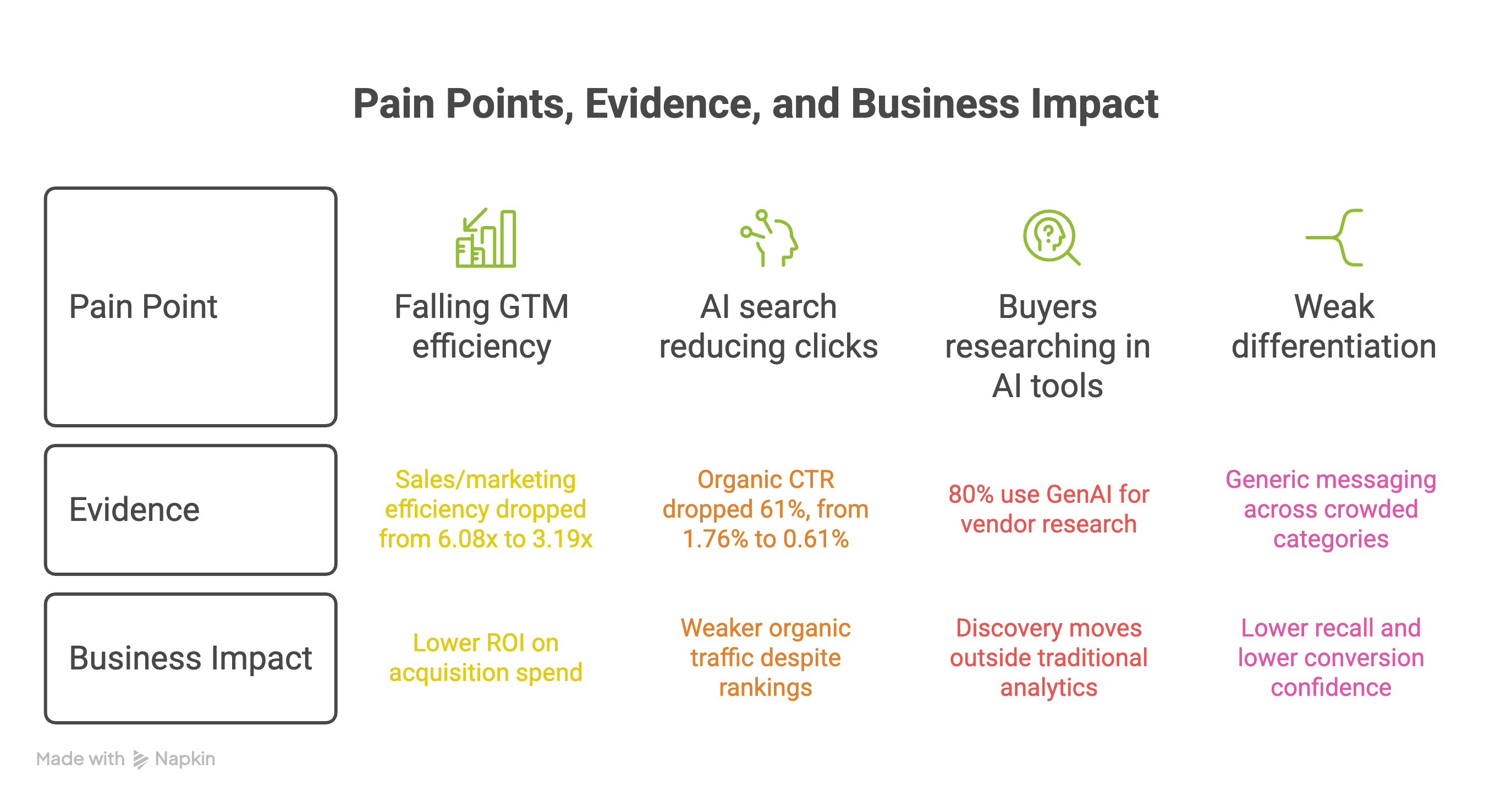
Most software brands describe themselves in exactly the same way. AI-powered. Enterprise-ready. Seamless. Intelligent. Scalable. That language has become so common that it no longer creates memory or trust. Buyers hear the same promise from dozens of companies.
This is dangerous because a market with weak differentiation becomes a market where price, incumbency, or familiarity wins. If a company cannot explain why it matters in a category, it becomes harder for both buyers and AI systems to rank it mentally.
A 61% decline in organic CTR for AI Overview queries means strong SEO performance no longer guarantees strong traffic performance. Software companies that built their entire growth model around informational content and ranking pages are starting to feel this change the fastest.
When discovery happens through AI systems, category roundups, community conversations, or executive-led thought leadership, the final analytics report may not show the original source of influence. That leads teams to underinvest in authority-building channels and overinvest in last-click capture channels.
Publishing more blogs is not the same as building more trust. In a crowded market, content volume alone is easy to replicate. Original research, executive thought leadership, category insight, ecosystem mentions, and consistent brand narratives are much harder to replicate. That is where trust begins to compound.
Most agencies still operate with a traditional marketing mindset. Their approach revolves around SEO rankings, blog production, lead generation campaigns, and paid advertising. That model was built for a web where the click was the center of the journey.
The AI era requires something fundamentally different.
It requires building authority across the entire digital ecosystem that AI systems use to understand and recommend brands. A company now needs coherent presence across its website, LinkedIn, industry publications, PR channels, communities, thought leadership assets, and executive narratives. If those signals are fragmented, weak, or generic, the brand becomes less retrievable and less credible.
This is where many software companies are stuck. They are still investing in visibility, but not enough in authority.
This is where IcyPluto creates leverage.
Instead of focusing exclusively on traffic generation, IcyPluto helps software companies build AI-era market authority. That means helping brands become more visible, more trusted, and more likely to be recommended across the surfaces that now influence discovery.
AI engines synthesize information from multiple sources. IcyPluto helps brands establish consistent narratives across websites, LinkedIn, industry publications, PR channels, communities, thought leadership assets, and executive branding. This increases the likelihood that AI systems recognize, trust, and reference the brand.
AI rewards expertise. IcyPluto helps organizations become category leaders through original research, market intelligence reports, industry studies, executive thought leadership, and proprietary content assets. Instead of competing for clicks, brands compete for authority.
Most content generates traffic. Very little generates trust. IcyPluto builds content ecosystems designed to influence awareness, consideration, pipeline generation, and revenue acceleration. The objective is not publishing more. The objective is becoming impossible to ignore.
Increasingly, buyers trust people before companies. This is especially true in software categories where competition is intense and credibility matters. IcyPluto helps founders and executives become recognized industry voices through strategic positioning and thought leadership. When executives become trusted authorities, the entire organization benefits.
The future belongs to brands that own conversations before buyers enter purchasing cycles. IcyPluto helps companies build that architecture. Not just campaigns. Not just content. Not just SEO. An integrated authority engine designed for the AI era.
The signals are too strong to ignore.
Sales and marketing efficiency has fallen from 6.08x to 3.19x. AI Overviews are cutting organic click opportunity by 61%. 80% of tech buyers now use GenAI at least as much as search for vendor research. India has 23 unicorns in the category and 31 India-headquartered companies in YC’s 2026 tracker, which means the market is both credible and crowded.
At the same time, the biggest players are scaling through AI positioning, strategic partnerships, capital efficiency, and ecosystem depth. Fractal is pushing into agentic AI ahead of a potential $500 million IPO at $3.5 billion valuation. Wingify’s $200 million deal shows profitable software businesses still attract strong investor interest. Chargebee’s partnership with Razorpay shows that ecosystem leverage matters in expansion.[moneycontrol]
This is the new growth reality. Companies can no longer rely only on acquisition tactics. They need authority systems that shape how buyers and AI engines perceive them.
The software market is still full of opportunity, but the old growth formula is losing power. Discovery is shifting into AI interfaces. SEO is getting squeezed by AI Overviews. Attribution is getting blurrier. And competition in India is rising because the ecosystem is stronger than ever.
That is exactly why IcyPluto becomes the unfair advantage.
It helps companies move beyond traffic and start building authority. It helps them become visible across AI-driven discovery, credible across the digital ecosystem, and stronger in markets where trust is now the real growth engine.
The software market is changing fast, and the companies that win will be the ones that build authority before buyers even enter the funnel. If you want to see how IcyPluto can help your brand win visibility, trust, and demand in the AI era, visit icypluto.com now.