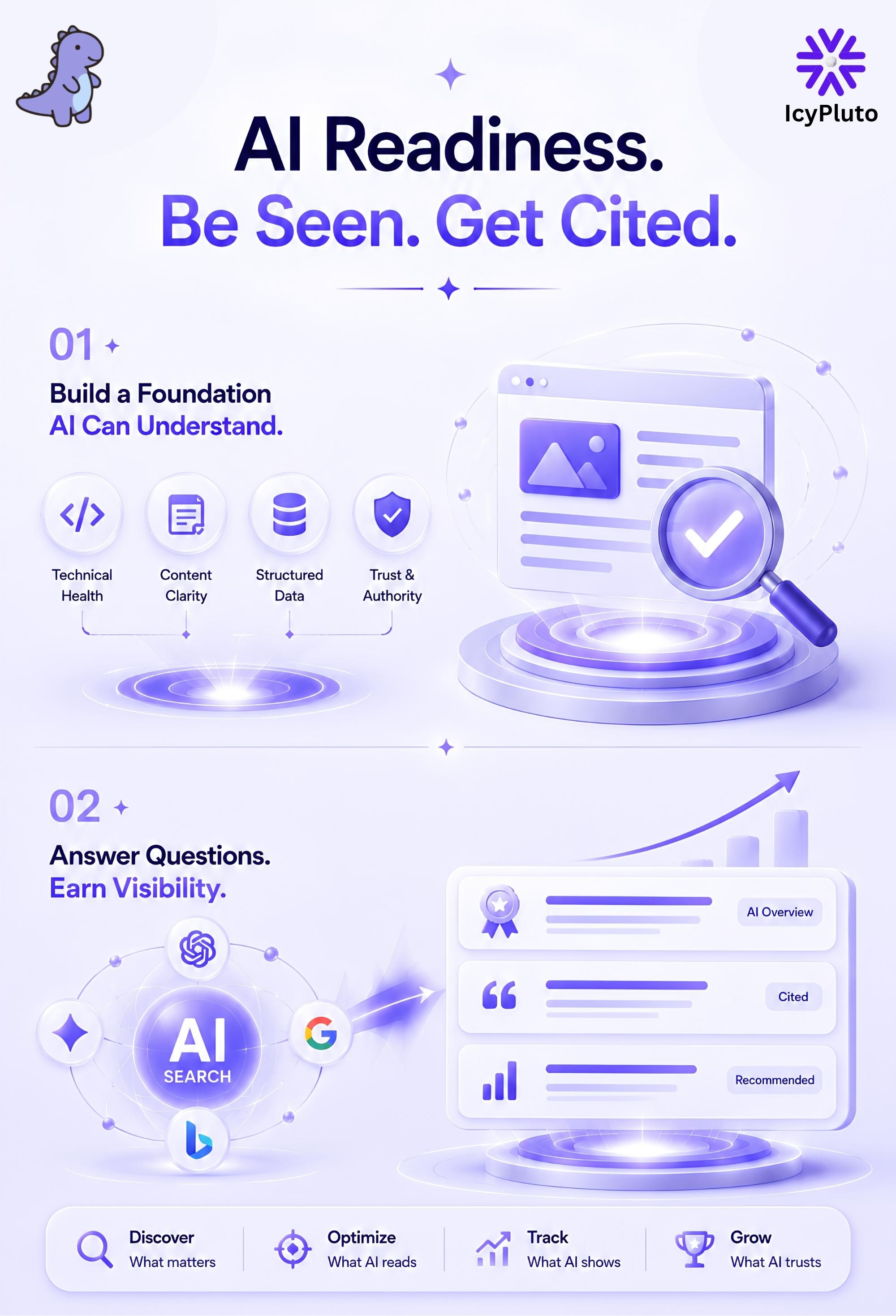
AI readiness is no longer just a technical concept...
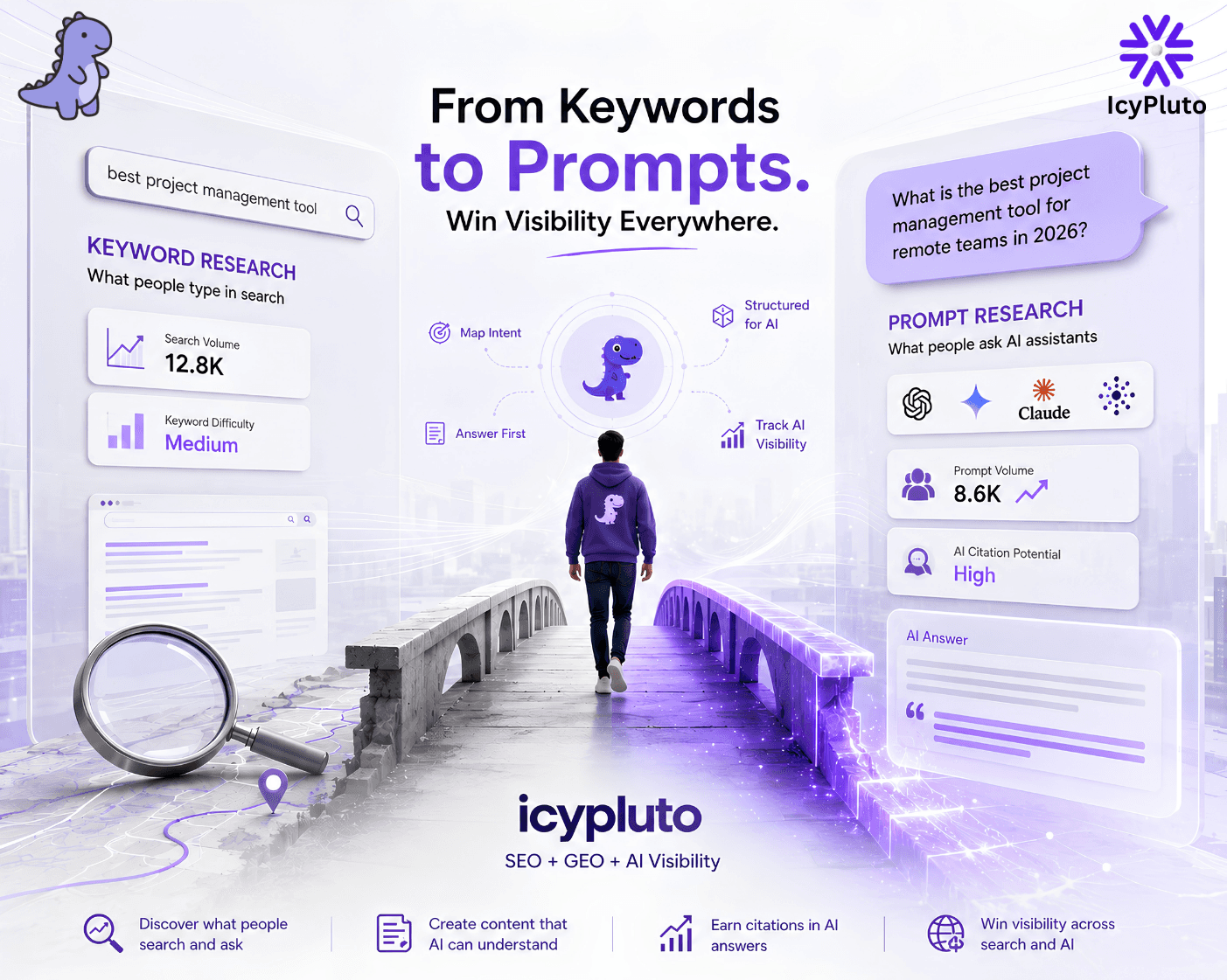
This blog explains how keyword research must now b...
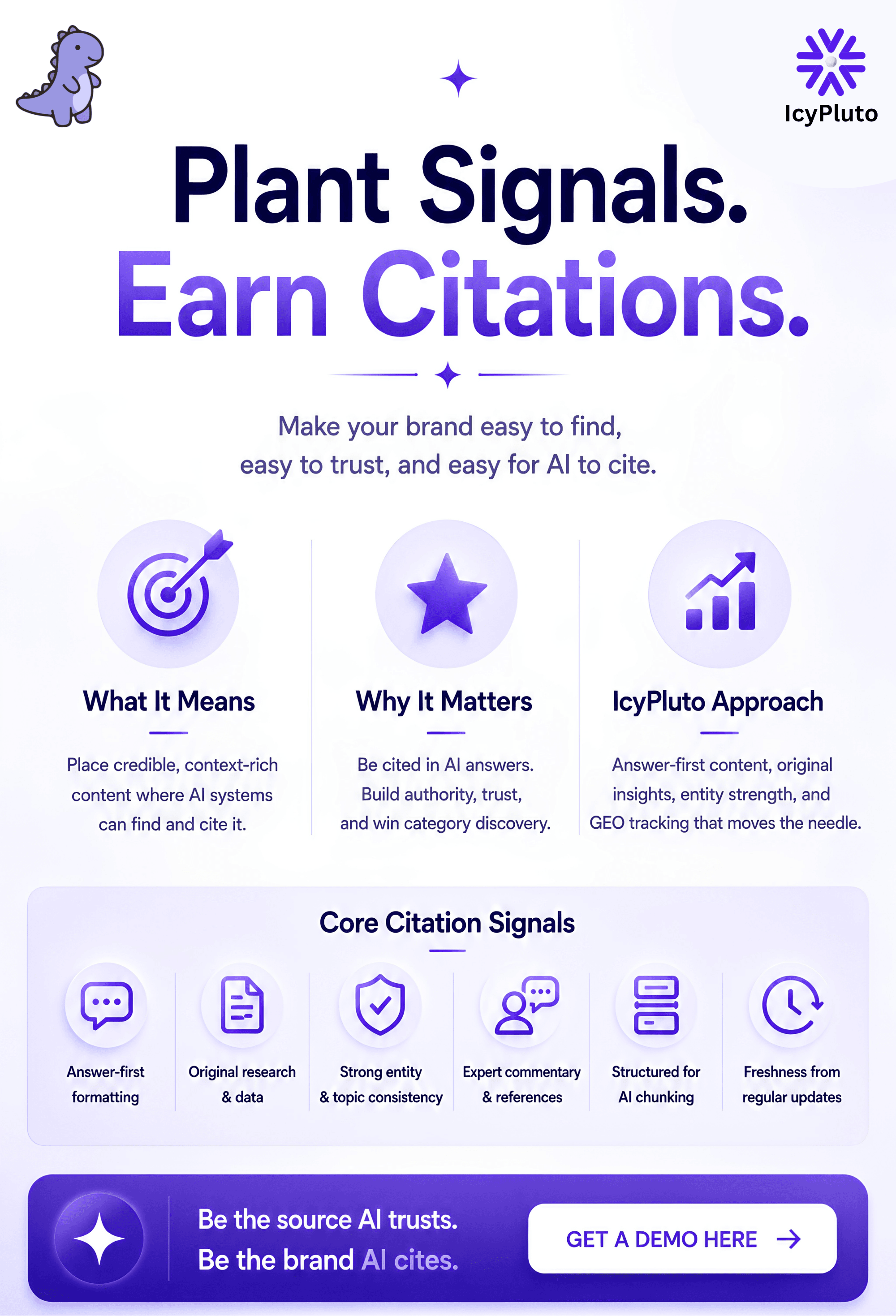
Citation seeding is becoming one of the fastest wa...
For years, SEO professionals have operated with one shared assumption — that search demand can be measured, mapped, and optimized at the keyword level. You find the phrases people type into Google, group them by search volume, assess their competitiveness, and build content around those phrases. It's a system that has powered digital marketing strategies for more than two decades. But right now, in 2026, that system is undergoing the most significant transformation it has ever seen.
The rise of AI-powered search is pushing demand into a new territory — one that no keyword tool can fully quantify. This new territory is what experts are now calling the infinite tail. It represents a shift so fundamental that it doesn't just change how you do SEO — it changes what SEO actually means. At IcyPluto, where COSMOS is redefining how AI-driven marketing strategies are built and executed, understanding this shift isn't optional. It's essential to staying ahead of the curve.
To understand the infinite tail, you first need to understand why traditional keyword research is no longer sufficient on its own. The old model worked because users were trained — consciously or not — to compress their needs into short, search-engine-friendly phrases. Someone looking for a good restaurant nearby wouldn't type "I'm planning a casual dinner with my partner tonight and we're both really into Italian food but prefer something that's not too expensive" into a search bar. They'd type "best Italian restaurant near me." The nuance got stripped away to meet the machine's limitations.
Search engines, in turn, built ranking systems around those compressed phrases. SEO professionals responded by cataloguing thousands of these compressed queries, grouping them into clusters, and producing content that targeted each cluster. It was a systematic, measurable, and largely effective process.
The problem is that AI search assistants — including Google's Gemini-powered features — are actively encouraging users to stop compressing their needs. Samsung and other device manufacturers are marketing AI-enabled search capabilities as core product features, training users to express themselves naturally and in greater detail. People are increasingly asking full questions, describing entire situations, and providing context that would have previously seemed redundant in a search box.
This behavioral shift means that demand is becoming generative. A single underlying need can now be expressed in hundreds of thousands of different ways. "What protein powder should I buy" might once have captured a user's intent well enough. Now, that same user might ask: "I'm a 32-year-old woman who works out three times a week and I'm lactose intolerant but I want to build lean muscle without gaining too much weight — what protein supplement should I consider?" The intent is the same. The expression is infinitely more varied.
This doesn't mean keyword research is dead. Far from it. But its role needs to evolve significantly. Instead of simply extracting keywords from tools and mapping them by volume, marketers and SEO strategists must now begin understanding and modeling user journeys. Instead of grouping by phrase similarity alone, they must group by decision stage — and by the type and level of uncertainty the user is experiencing at each point in their journey.
The output of this process is no longer just a keyword map. It becomes a task map — a structured representation of the real-world pressures, constraints, and decisions your audience is navigating. This is where IcyPluto's COSMOS AI CMO has a genuine edge: by understanding not just what people search, but why they search and what they're actually trying to accomplish, COSMOS helps brands create content that maps perfectly to human tasks rather than just matching machine-readable phrases.
The phrase "infinite tail" might initially sound like just an extension of the well-known long-tail keyword concept. After all, SEOs have been talking about long-tail keywords for years — those lower-volume, highly specific phrases that collectively drive enormous amounts of search traffic. But calling the infinite tail simply a "longer" version of the long tail significantly underestimates what is actually happening.
The long tail was still fundamentally a keyword-based concept. You could enumerate long-tail phrases, even if there were millions of them, because they followed predictable patterns. They could be grouped, tracked, and optimized against. The infinite tail is different because it's not about phrases at all — it's about the layering of personalization, context, constraints, and preferences into each individual prompt.
As users add personal context to their queries — their location, lifestyle, budget, previous experiences, current mood, time constraints — each prompt becomes a unique combination of factors. And because the number of possible combinations of these factors is, for all practical purposes, unlimited, so too is the potential variation in how search demand expresses itself.
This has profound implications for how AI systems respond. Unlike traditional search engines that match query strings against indexed documents using signals like relevance and authority, AI systems work probabilistically. They don't look for the document that best matches your exact phrase — they predict, based on everything in the prompt, which response has the highest probability of genuinely satisfying the user's situation.
This is a completely different optimization problem. You are no longer competing on phrasing. You are not trying to rank for a specific long-tail query. You are competing on task completion — on whether your content, your brand, and your entity can demonstrably and comprehensively satisfy the situation being described, regardless of the exact words used to describe it.
Think of it this way: in traditional SEO, you placed your content in front of users who searched specific phrases. In the infinite tail world, your content needs to be worthy of selection by an AI system that is evaluating whether it can satisfy a given scenario. The bar isn't "did you include the right keywords?" — it's "does this content genuinely help someone navigate the situation they described?"
This is exactly the kind of content philosophy that drives IcyPluto's approach to AI-first marketing. COSMOS doesn't just generate content — it builds content systems designed around genuine audience understanding, task-level relevance, and the kind of depth that AI systems reward when selecting sources for their synthesized responses.
To truly grasp how the infinite tail works in practice, you need to understand two critical mechanics that sit at the heart of AI search systems: query fan-out and grounding queries. These two processes determine how AI systems evaluate your content — and they reward very different things than traditional ranking algorithms.
When a complex prompt is submitted to an AI search system, it doesn't evaluate that prompt as a single string. Instead, it decomposes the request into a network of sub-questions, classifications, and contextual checks. This process is called query fan-out, and it's one of the most important concepts for anyone doing SEO or content strategy in 2026.
Imagine a user asks: "I'm launching a small sustainable clothing brand and want to start building an online presence — where should I focus my marketing efforts first?" An AI system won't simply look for pages that contain those words. It will fan that query out into a cluster of related questions: What are the best marketing channels for small e-commerce brands? What strategies work for sustainable and ethical fashion brands? How do you build brand awareness with a limited budget? What is the role of social media for fashion startups?
For SEO professionals and content strategists, this means your content is now assessed across an entire decision cluster, not against a single phrase or document match. If your content addresses only one narrow dimension of a topic, it becomes fragile — it may support one branch of the fan-out but fail across others. But if your content supports multiple layers of the decision, covering the topic with genuine depth and breadth, it becomes resilient and far more likely to be selected.
This is why IcyPluto advocates for content systems over individual content pieces. A single blog post can't dominate a fan-out cluster. A well-architected content ecosystem — one that addresses multiple facets of a topic, links contextually, and covers decision-stage nuance — absolutely can.
The second critical mechanic is grounding. After an AI system generates a candidate response, it doesn't simply deliver it. It runs grounding queries — checks that validate whether the proposed answer is supported elsewhere across the web, whether the claims are consistent across sources, and whether the entity or brand being cited has a reputation that can be defended.
Think of grounding as the AI system asking: "Can I stand behind this answer? If another source challenges what I'm saying, do I have enough evidence to hold my position?" If your brand is being considered for inclusion in a synthesized AI response, the system needs confidence that you are what you claim to be, that your information is consistent, and that the broader information ecosystem corroborates your authority.
This fundamentally redefines what "authority" means in the post-keyword world. In traditional SEO, authority could be built through technical optimizations, link acquisition, and various other signals. In AI search, authority is about entity clarity — how well-defined your brand is across the internet, how consistent your messaging is, how clearly structured your content and data are, and how reliably external sources validate what you say about yourself.
For brands working with IcyPluto, this is where the COSMOS AI CMO's entity-building and brand consistency capabilities become particularly powerful. COSMOS isn't just optimizing content — it's building the kind of coherent brand presence that grounding queries reward.
One of the most important things to understand about the current search landscape is that organic SEO has not been replaced by AI search. It has been augmented by it. These two layers now coexist in a hybrid environment, and understanding how they interact is critical for any brand serious about search visibility in 2026.
Organic rankings still drive discovery. Technical SEO still determines whether your content can be crawled, rendered, and indexed. Site architecture still shapes how well search systems understand the relationship between your pages. These fundamentals have not changed. What has changed is that an AI layer now sits on top of organic search, synthesizing information from indexed sources and surfacing brands within conversational, summarized responses.
The relationship between organic and AI is not a zero-sum game. In fact, organic visibility and AI selection are mutually reinforcing. When your content ranks well organically, it signals to AI systems that it has been validated through traditional authority mechanisms — something that supports grounding. When AI systems surface your brand in synthesized responses, it creates new awareness and brand recognition that ultimately drives more organic search behavior.
Fan-out rewards depth of content coverage — the more thoroughly you address a topic across your site, the better positioned you are for the sub-question clusters that AI systems generate. Grounding rewards trust and consistency — clean structured data, consistent NAP (Name, Address, Phone) information, consistent brand messaging across platforms, and a healthy profile of external references all contribute to your grounding score.
Together, these dynamics mean the infinite tail doesn't punish great SEO — it raises the bar for what great SEO looks like. The brands that thrive will be those that combine strong technical SEO foundations with genuinely audience-centered content strategies built around real tasks, real decisions, and real human contexts.
At IcyPluto, COSMOS — the world's first AI CMO — is built specifically for this hybrid search reality. Rather than treating SEO as a keyword-matching exercise, COSMOS approaches brand visibility as a system problem. It asks: who is your audience, what tasks are they trying to complete, what decisions are they making, what uncertainties do they have, and what evidence do they need before committing? The answers to those questions drive every content decision, every structural choice, and every piece of messaging that COSMOS helps create and distribute.
This is precisely the kind of approach that the infinite tail demands. As search moves further away from phrase-matching and deeper into task-satisfaction and probabilistic selection, the brands with the most genuine, comprehensive, and contextually relevant content ecosystems will win. COSMOS is designed to build exactly that kind of ecosystem — intelligently, at scale, and in alignment with how AI search systems actually work.
The shift from keyword research to prompt research isn't a cosmetic rebranding of the same old process. It's a genuine evolution in how search demand works and, by extension, how smart brands need to show up online. Here's what this means in practical terms for any brand looking to stay competitive:
Stop thinking about rankings in isolation. Your goal is no longer to rank #1 for a specific phrase. Your goal is to be selected and defended by AI systems across an entire cluster of related queries. Coverage and depth matter more than phrase-level optimization.
Build task maps, not just keyword maps. Understand the real decisions your audience is making, the uncertainties they face, and the journey they go through from awareness to commitment. Your content strategy should reflect this map, not just a spreadsheet of search volumes.
Invest in entity clarity and brand consistency. Make sure your brand is clearly defined across every platform where it exists — your website, social profiles, press mentions, business listings, and structured data. Grounding queries reward brands that are easy to verify and corroborate.
Design content systems, not just content pieces. A single well-written blog post won't cut it in a fan-out world. You need interconnected content that addresses multiple dimensions of the topics your audience cares about, with clear internal linking and contextual architecture.
Treat AI selection and organic ranking as complementary, not competing goals. Technical SEO, crawlability, and site architecture remain foundational. They feed the AI layer rather than competing with it. A strong hybrid strategy addresses both simultaneously.
The infinite tail is not a problem to be solved — it's a shift to be embraced. For brands and marketers who understand it, this evolution creates an extraordinary opportunity to build the kind of genuine, deep, audience-first content ecosystems that AI search systems are designed to reward. That's the future IcyPluto and COSMOS are built for.