This blog reveals how to maximize visibility in tr...
The way people search is changing fast, and conten...
AI SEO writing is getting more specific, and that ...
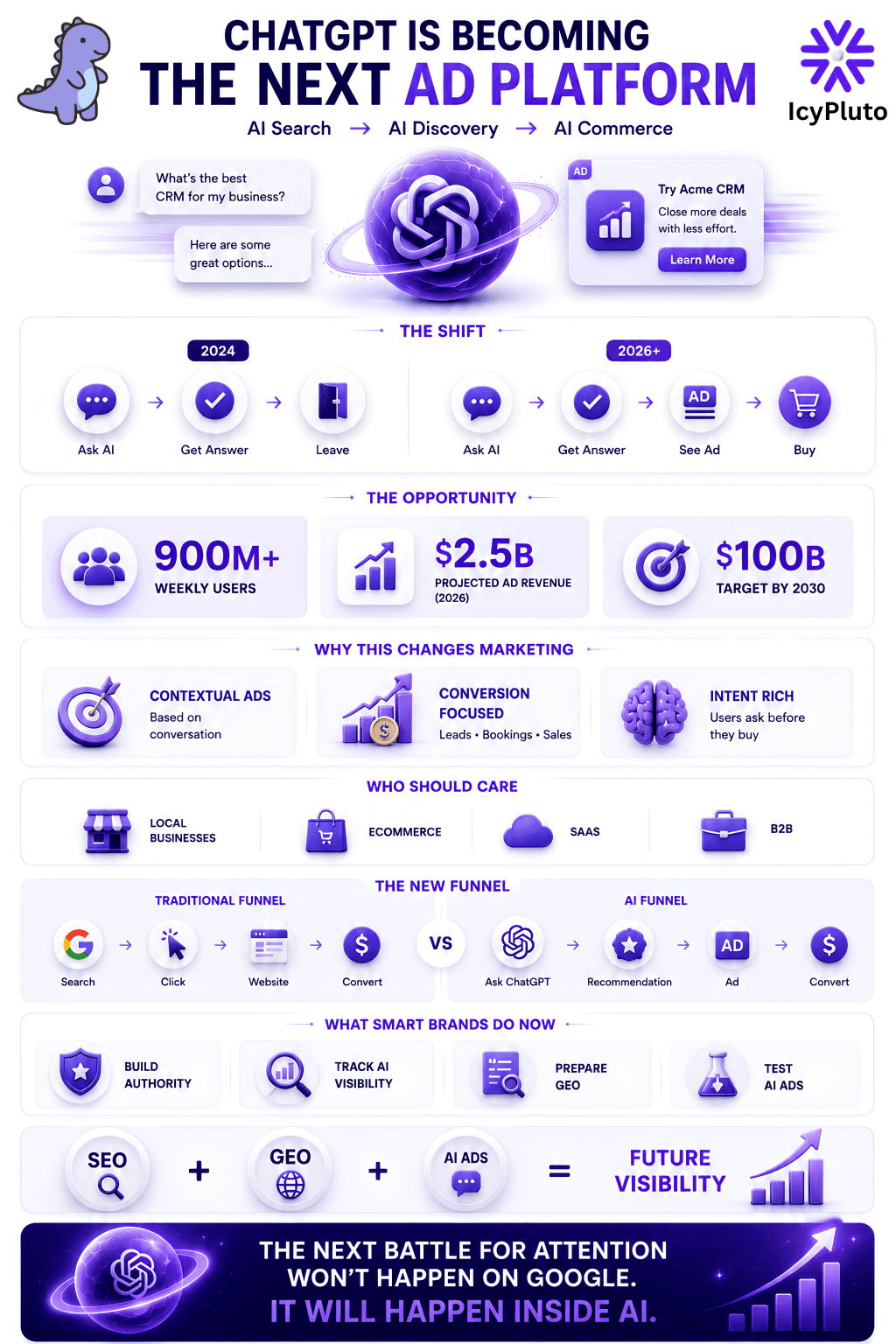
Picture this. You are sitting at your desk, scrolling through ChatGPT, asking it for recommendations on the best CRM for your small business. The AI gives you a thoughtful answer, then suddenly, there is an ad right below the conversation suggesting a CRM tool that matches exactly what you just asked about.
This is not a dystopian future scenario. This is happening right now, starting in early June 2026. OpenAI has officially confirmed that conversion-focused ads are coming to ChatGPT, and the implications for digital marketing are enormous.
If you thought AI chatbots were just for answering questions and generating content, think again. They are about to become the newest battleground for your advertising budget. And if you are not paying attention, your competitors might be already there.
OpenAI just confirmed what industry insiders had been whispering about for weeks. Starting in early June, the company will begin rolling out conversion-optimized ad campaigns inside ChatGPT. This is the clearest signal yet that OpenAI is not just experimenting with advertising. They are building a full-scale performance advertising ecosystem designed to compete directly with Google and Meta.
The timing is no accident. This announcement comes barely four months after OpenAI first started testing ads in ChatGPT. The pilot program launched in February 2026, and within just six weeks, it had already crossed $100 million in annualized revenue. By the time you read this, OpenAI will have worked with over 600 advertisers in the pilot alone.[searchengineland]
What makes this different from the initial ad testing is the focus on conversions. The original ads were about brand awareness and getting clicks. The new system is about driving measurable business outcomes like purchases, appointment bookings, and contact form submissions. This shift from awareness to performance is what makes ChatGPT ads a legitimate channel for lead generation and e-commerce advertising.
Let us break down what conversion-focused advertising really means in practice. When you run a conversion-focused ad campaign on ChatGPT, you are not just paying for impressions or clicks. You are paying for actual actions that matter to your business.
According to reports from advertisers testing the formats, businesses might only pay when specific actions occur. This brings ChatGPT advertising much closer to traditional performance marketing models that small and mid-sized businesses have used on Google and Meta for years. Think pay-per-lead or pay-per-sale instead of pay-per-impression.
The types of actions OpenAI is targeting include purchases on e-commerce sites, appointment bookings for service businesses, and contact form submissions for lead generation. These are the exact same conversion events that drive advertising decisions for dry cleaners, car washes, and appointment-based services that OpenAI is specifically trying to attract.[searchengineland]
Why does this matter for you as a marketing professional? Because it means ChatGPT is no longer just a place for brand awareness campaigns with big budgets. It is becoming accessible to smaller businesses that care about ROI and measurable results. The barrier to entry is dropping fast. The minimum ad spend commitment has already fallen from $250,000 at launch to $50,000, and self-serve ads managers are now available to global advertisers.[searchenginejournal]
Here is where things get really interesting from a technical perspective. OpenAI is building infrastructure that closely resembles traditional performance advertising platforms. They are not reinventing the wheel. They are copying what works.
The OpenAI Pixel is now available for advertisers to install on their websites. This pixel enables website activity tracking after users interact with ads inside ChatGPT. It works exactly like the Facebook Pixel or Google Tag, tracking what users do after they click on your ad. Did they add something to their cart? Did they complete a purchase? Did they fill out a contact form? The pixel tells you.
But OpenAI is not stopping at just a pixel. They are also offering a Conversions API that allows advertisers to send first-party conversion data directly back into OpenAI's systems. This is important because browser restrictions and privacy changes continue weakening traditional tracking methods. The Conversions API could become increasingly important for proving campaign performance and attribution inside AI-driven ad experiences.[searchengineland]
Advertisers who configure conversions by June 1 will receive early access by June 5. You can already begin tracking conversions inside OpenAI's Ads Manager today. The system allows advertisers to measure actions driven by ads after users interact with campaigns, giving OpenAI the ability to optimize campaigns toward measurable business outcomes rather than simple engagement metrics.[searchengineland]
Let us talk about the scale of what OpenAI is trying to build. The revenue projections are staggering. OpenAI expects to generate $2.5 billion in advertising revenue in 2026 alone. By 2027, they project that number will surge to $11 billion. The company is aiming for $25 billion in 2028 and $53 billion by 2029. The ultimate target is $100 billion in ad revenue by 2030.[za.investing]
These projections assume OpenAI's products will reach 2.75 billion weekly users by 2030. But here is the thing. They are already at 900 million weekly active users as of February 2026, up from 800 million in October 2025. They also have 50 million paying subscribers. This user base is growing faster than almost any technology platform in history.[techcrunch]
To put this in perspective, ChatGPT set a record as the fastest app to reach 100 million active users, achieving that milestone in just two months. By the start of 2025, it had reached 400 million users. Now it is at 900 million weekly active users worldwide, with 67.7 million people using ChatGPT in the United States alone.[businessofapps]
The revenue growth is equally impressive. OpenAI's total revenue went from $5.5 billion in December 2024 to $10 billion by June 2025. That is 82 percent growth in just six months. They are targeting $12.7 billion for 2025. Much of this growth is coming from the advertising business, which has gone from non-existent to $100 million in annualized revenue in less than two months.[facebook]
The advertising market is dominated by three platforms. According to eMarketer's 2026 forecast, Meta will surpass Google in digital ad revenues for the first time ever this year. Meta is expected to reach $243.46 billion in net worldwide ad revenues in 2026, accounting for 26.8 percent of global ad spending. Google is predicted to command 26.4 percent, totaling $239.54 billion. Amazon sits in third place with 9.0 percent share.[emarketer]
Together, Meta, Google, and Amazon represent 62.3 percent of total worldwide digital ad spending in 2026. OpenAI is trying to carve out a piece of this massive market. The global advertising market is currently led by these companies, and OpenAI is betting that conversational AI represents a new category that can compete with traditional search and social advertising.[axios]
Here is how ChatGPT ad pricing compares to traditional platforms. When OpenAI launched ChatGPT ads in February 2026, they used a CPM model with rates around $60 per 1,000 impressions. CPMs have since fallen from $60 at launch to as low as $25 in some cases, roughly ten weeks after launch. The minimum spend commitment also dropped from $250,000 to $50,000.[thekeyword]
More recently, Digiday reported that an early version of ChatGPT's ads manager now shows cost-per-click bids ranging from $3 to $5 per click. This CPC option became available after OpenAI opened its self-serve ads manager to global advertisers on April 15, 2026. The reported $3 to $5 CPC range is competitive with Google Search CPCs in many verticals, though whether ChatGPT can match Google's conversion rates has not yet been established.[searchenginejournal]
Well-optimized ChatGPT ad campaigns typically achieve 2 to 5 percent conversion rates from click to conversion. Early benchmarks suggest 2 to 5 percent CTR for ChatGPT ads. The key is to optimize for conversions and CPA rather than just CTR. High CTR with low conversion rate means you are paying for clicks that do not turn into business results.[adventuremedia]
OpenAI has been telling advertisers and ad tech firms that they want to attract smaller local businesses. This includes companies like dry cleaners, car washes, and appointment-based services. These are not Fortune 500 brands with massive marketing budgets. These are small and mid-sized businesses focused on leads, bookings, and sales, not just impressions.[searchengineland]
The ad formats are designed to encourage direct actions such as purchases, appointment bookings, and contact form submissions. This positions OpenAI more directly against Google and Meta by targeting the massive market of small and mid-sized businesses that care about ROI. The addition of conversion-based pricing, pixels, and API tracking signals that ChatGPT could soon become a serious channel for lead generation, bookings, and ecommerce-driven advertising.[searchengineland]
But here is the catch. Today, OpenAI shows ads to Free and Go users in the United States, Canada, Australia, and New Zealand. They do not show ads to users on Plus, Pro, or any Business plan, or to any users who tell them or that they predict are under the age of 18. Ads appear below relevant ChatGPT conversations, and each ad includes the advertiser name, favicon, title, copy, landing page, and image asset.[help.openai]
The ads system primarily selects ads based on how relevant they are to the context and intent of the conversation. Ad selection considers multiple inputs such as context hints, landing page, ad title, and ad copy. At the ad group level, advertisers can provide context hints that describe the conversations, topics, or keywords where their products or services may be relevant. These hints help guide ad matching, but they are not exact-match keywords and do not guarantee delivery in specific conversations.[help.openai]
OpenAI's push into conversion-focused advertising signals a broader evolution of AI platforms from information tools into transactional ecosystems. This is not just about advertising. This is about AI becoming the place where people discover, compare, and decide on products and services.
Ads in ChatGPT help advertisers reach users as they explore, compare, and decide within a single conversational experience. By using richer conversational context, ChatGPT Ads create opportunities to deliver relevant, helpful messages aligned with what users are trying to accomplish. This is fundamentally different from traditional search advertising, where you are bidding on keywords without much context about user intent.[help.openai]
OpenAI's policy is to place ads only near chats that are safe, appropriate, and aligned with user trust and brand safety. Their safeguards are designed to prevent ads from appearing in sensitive user contexts or brand-unsafe environments. This is important because conversational AI creates novel risks that regulators, publishers, and consumers are only beginning to address.[bbf]
The shift to conversational AI advertising is creating a new category that sits between search and social. When someone asks ChatGPT what is the best laptop for video editing under $1500, they are in a different mindset than when they search for that on Google. They are asking for a recommendation, not just results. The AI is acting as a trusted advisor, and the ads that appear are part of that advisory conversation.
If you are a marketing professional specializing in SEO, AI-driven marketing strategies, and content creation for B2B audiences, this development should get your attention. The lines between organic search, paid search, and AI-driven discovery are blurring. What worked for SEO yesterday might not work for AI visibility tomorrow.
Here is what you need to think about. First, consider whether ChatGPT ads could be a viable channel for your business right now. If you are a small or mid-sized business focused on leads or bookings, the answer might be yes. The minimum spend has dropped to $50,000, and CPC bids of $3 to $5 are competitive with Google Search. Well-optimized campaigns achieving 2 to 5 percent conversion rates could deliver solid ROI.[adventuremedia]
Second, think about how your content strategy needs to evolve. If AI systems are increasingly recommending products and services in their responses, you need to make sure your brand appears in those recommendations. This means building content that AI models want to cite. Original research, proprietary data, and unique insights are more likely to be referenced by AI than generic educational content.
Third, prepare your tracking infrastructure. If you want to run conversion-focused ads on ChatGPT, you need to set up either the OpenAI Pixel or Conversions API in advance. Advertisers who configure conversions by June 1 received early access by June 5. The Conversions API is particularly important because it allows you to send first-party conversion data directly back into OpenAI's systems, which is crucial given increasing privacy restrictions on third-party cookies.
Fourth, measure ChatGPT traffic separately from traditional search traffic. Ads Manager Beta reporting currently includes impressions, clicks, spend, click-through rate, average CPC, average CPM, and conversions. You can also track traffic from ChatGPT Ads by adding static tracking parameters like UTM parameters to landing page URLs. These parameters persist on ad clicks and can be used in existing analytics tools to understand traffic from ChatGPT Ads.[help.openai]
Let us be honest about the challenges. The success of OpenAI's advertising ambitions may depend heavily on measurement accuracy and advertiser trust. As browser restrictions and privacy changes continue weakening traditional tracking methods, proving campaign performance and attribution inside AI-driven ad experiences becomes harder, not easier.
The reported $3 to $5 CPC range is competitive with Google Search CPCs in many verticals, but whether ChatGPT can match Google's conversion rates has not been established. This is unproven territory. You are essentially betting on a new channel without historical performance data to guide your decisions.
There are also privacy and brand safety considerations. OpenAI's safeguards are designed to prevent ads from appearing in sensitive user contexts, but the conversational nature of ChatGPT creates unique challenges. What if a user is asking about a sensitive topic, and an inappropriate ad appears below their conversation? OpenAI says they have policies in place, but the real-world implementation is still being tested.
The advertising market is also highly competitive. Meta and Google together control over 53 percent of global digital ad spending. Amazon controls another 9 percent. OpenAI is trying to enter this market as a new player with no proven track record of delivering ROI for advertisers. They have the user base and the technology, but they need to prove they can deliver results consistently.[marketingdive]
Here is what the adoption timeline looks like. OpenAI confirmed conversion-optimized ad campaigns will begin rolling out in early June 2026. Early access is available for accounts that set up either the OpenAI Pixel or Conversions API in advance. Advertisers can already begin tracking conversions inside Ads Manager today.
The self-serve ads manager was opened to global advertisers on April 15, 2026. Before that, advertisers had to go through partners or use the beta self-serve Ads Manager in the US only. The CPC bidding option rolled out shortly after the self-serve manager became available, alongside the reduction in minimum ad spend.[thekeyword]
If you want to get in early, now is the time to act. Early advertisers will have the advantage of learning what works before the channel becomes saturated. The first mover advantage in advertising platforms is real. The advertisers who figure out the winning strategies early often dominate the channel for years.
Several key developments will tell us whether ChatGPT advertising is going to be a major channel or a niche experiment. First, watch the conversion rate benchmarks. If ChatGPT ads consistently deliver conversion rates comparable to Google Search or Meta Ads, they will attract serious advertising budgets. If conversion rates are significantly lower, adoption will be slower.
Second, watch the CPM and CPC trends. CPMs have already fallen from $60 to as low as $25 in roughly ten weeks. If prices continue dropping, more small businesses will be able to afford advertising on ChatGPT. If prices stabilize at a high level, the channel will remain dominated by big brands with large budgets.
Third, watch the user base growth. OpenAI needs to reach 2.75 billion weekly users by 2030 to hit their $100 billion ad revenue goal. They are at 900 million now, which is impressive growth. But they need to more than triple their user base in under five years. Whether they can achieve this growth while maintaining user trust and satisfaction is an open question.[za.investing]
Fourth, watch regulatory developments. Conversational AI advertising creates novel risks that regulators are only beginning to address. If regulators impose strict rules on how AI platforms can show ads or use user data for targeting, it could limit OpenAI's ability to compete with Google and Meta.
OpenAI is preparing to expand its advertising ambitions beyond brand awareness and into performance marketing. This is not a side experiment. This is a core part of their business model. The company is projecting $2.5 billion in ad revenue for 2026, $11 billion for 2027, and $100 billion by 2030. They are building the infrastructure to support this vision, including pixels, conversion APIs, and self-serve ad management tools.[reuters]
For marketing professionals, this means AI chatbots are becoming a legitimate advertising channel. They are not just for answering questions or generating content anymore. They are becoming places where people discover, compare, and decide on products and services. The ads that appear in these conversations are contextually relevant, based on what users are actually asking about.
The key question is whether you should get in early or wait until the channel is more mature. If you are a small or mid-sized business with a $50,000 advertising budget, the answer might be to wait and see. Let the early adopters figure out what works. If you are a larger business with the resources to test and learn, the answer might be to get in early and establish a presence before the channel becomes crowded.
Either way, you should be paying attention. The advertising landscape is changing, and ChatGPT is at the center of that change. The companies that adapt quickly will have a significant advantage over those that wait too long.
The SEO-GEO gap that we discussed in previous analysis is real, and now there is a paid advertising dimension to consider as well. Your content strategy, your SEO strategy, and your paid advertising strategy need to work together in the AI search era. ChatGPT ads are just one piece of that puzzle, but they might be an important piece depending on your business model and target audience.